Archive for category The Americas
Amazon Adventure
Posted by Peter in The Americas on December 21, 2025
NEW! – see youtube video of the rally courtesy of Rod Kirkpatrick https://www.youtube.com/watch?v=OurFL0m6wNg
26 October

The Jungle Road – a long time ago!
We set off for Lima but were soon concerned about the electrics – the dynamo was producing too much charge and was very hot – and that was after 5 miles! I decided there was not much to be done and if it went pop, the worst outcome was a flat battery. Some miles later we stopped to check and had a quick clean of the contacts in the Regulator Box – and carried on. Some route adjustments to the Lima hotel; had been put on the windscreen overnight and when we tried to follow these, things took a turn for the worse.

Lima – the Cathedral
We got completely lost on a side street with hump after hump and the only way back seemed to be by crossing a busy dual carriageway – so I waited for a lessening of traffic and just drove across, hoping the oncoming traffic would prefer to stop rather than hit us! Allison then, for the first time, managed to follow the GPS and after we had settled our route I looked at the water temperature guage. Panic! The guage stats at about 9 o’clock when cold then climbs through 6.00 and generally settles at about 4.00 (about 90 degrees) – it was now at 1.00 so way off the scale but there were no clouds of steam. I stopped, blocking one of two busy lanes of traffic and leapt out, Allison gathering the warning triangle.

Lima – Plaza Mayor
Neither electric fan was working. Fortunately it was just a fuse problem but Allison had by now flagged down a passing police car and gesticulated that they should push us to a garage on the other side of the road. I restarted the engine, fans whirred, the temperature dropped, oil pressure rose and we reached the hotel as the first car to arrive (apart from the two which had driven up the day before). We were greeted by the camera, John, the organiser and a pisco sauer, the local cocktail.
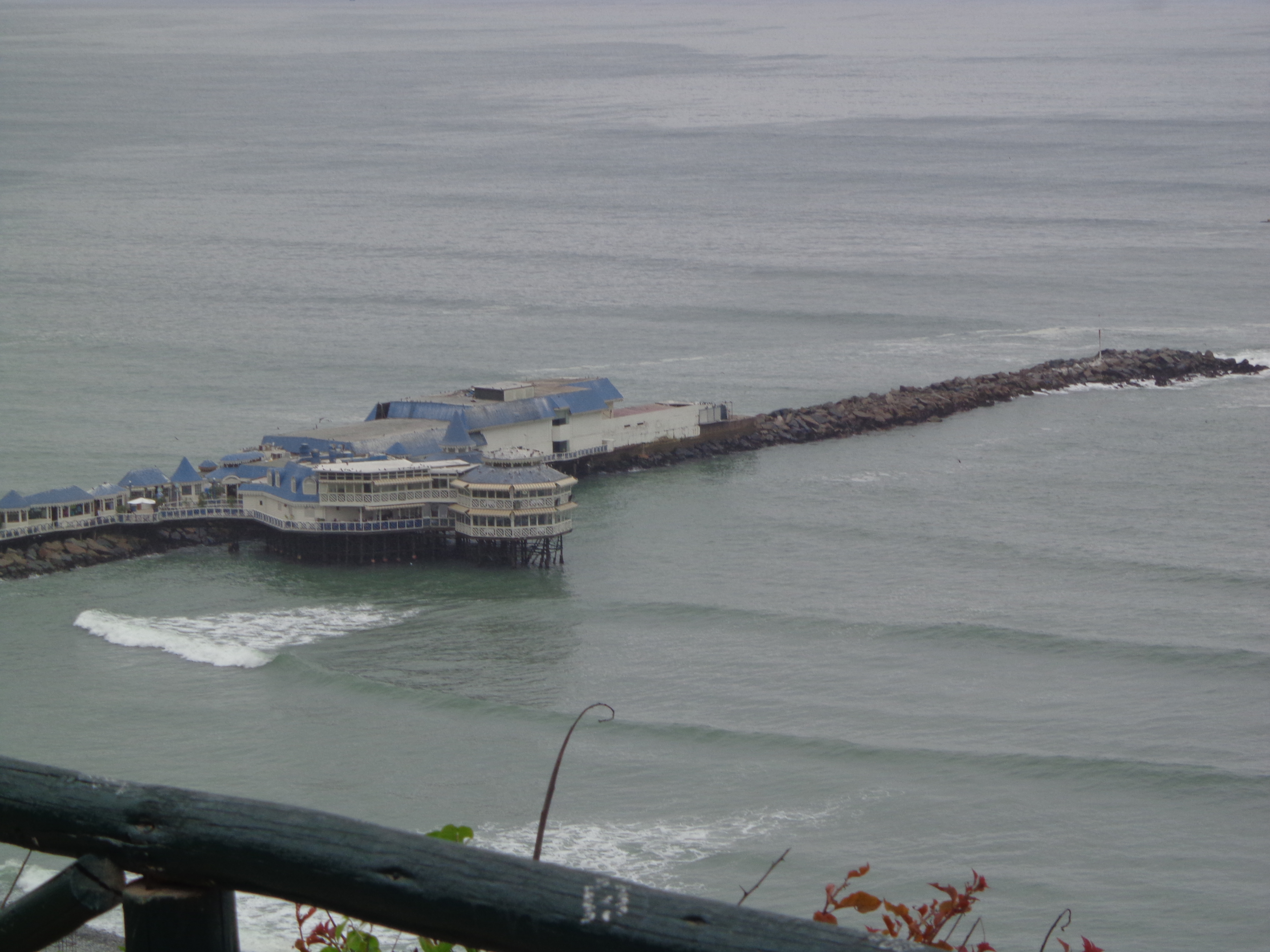
Lima – the Pier and the Pacific
It had been a hard rally, the car had taken a pounding but was still running – just needs a little (?) time in the garage. In his “close of rally” speech, John identified the Elan as being rebuilt at least half a dozen times en route – a slight exaggeration but certainly on the cards now! We did have time in the afternoon for a brief sightseeing tour of a very overcast Lima.
25 October A rest day before the final 260 km “push” into Lima on 26th
24 October This was to be the longest day of the rally – 780 kms and about 10 hours from Arequipa to Paracas – a beach and national park resort just north of the Nazca lines. We left at 6.15, following a rally car out of town before he stopped to refuel then climbed slowly out of the dusty valley following and overtaking queues of slow lorries up winding narrow roads with plenty of hairpin bends. It took nearly two hours to complete the first 100 kms so we were well behind the average we needed to get in before darkness.

Is this the first Lotus to get to the Nazca Lines?
The road improved and traffic thinned but the dust remained and for most of the day we drove through arid landscape and dustbowl towns. For long sections it was overcast and either dusty or drizzling. The drizzle caused trouble as we knew from experience that the car electrics could not cope with the fans plus wipers and lights – but all were needed; we reached speeds of 140 kph so wanted oncoming traffic to see this unexpectedly small car but I needed the wipers to see where I was going – so we alternated wipers on, lights off lights on, wipers off – at least it kept Allison awake! This was the Pan American highway and had an excellent surface – unlike in Brazil we were not on “pothole alert” but in every village we remained on “hump alert” – sleeping policemen are a feature – and unforgiving! We reached Nazca in early afternoon and stopped at two viewing towers to see the Lines
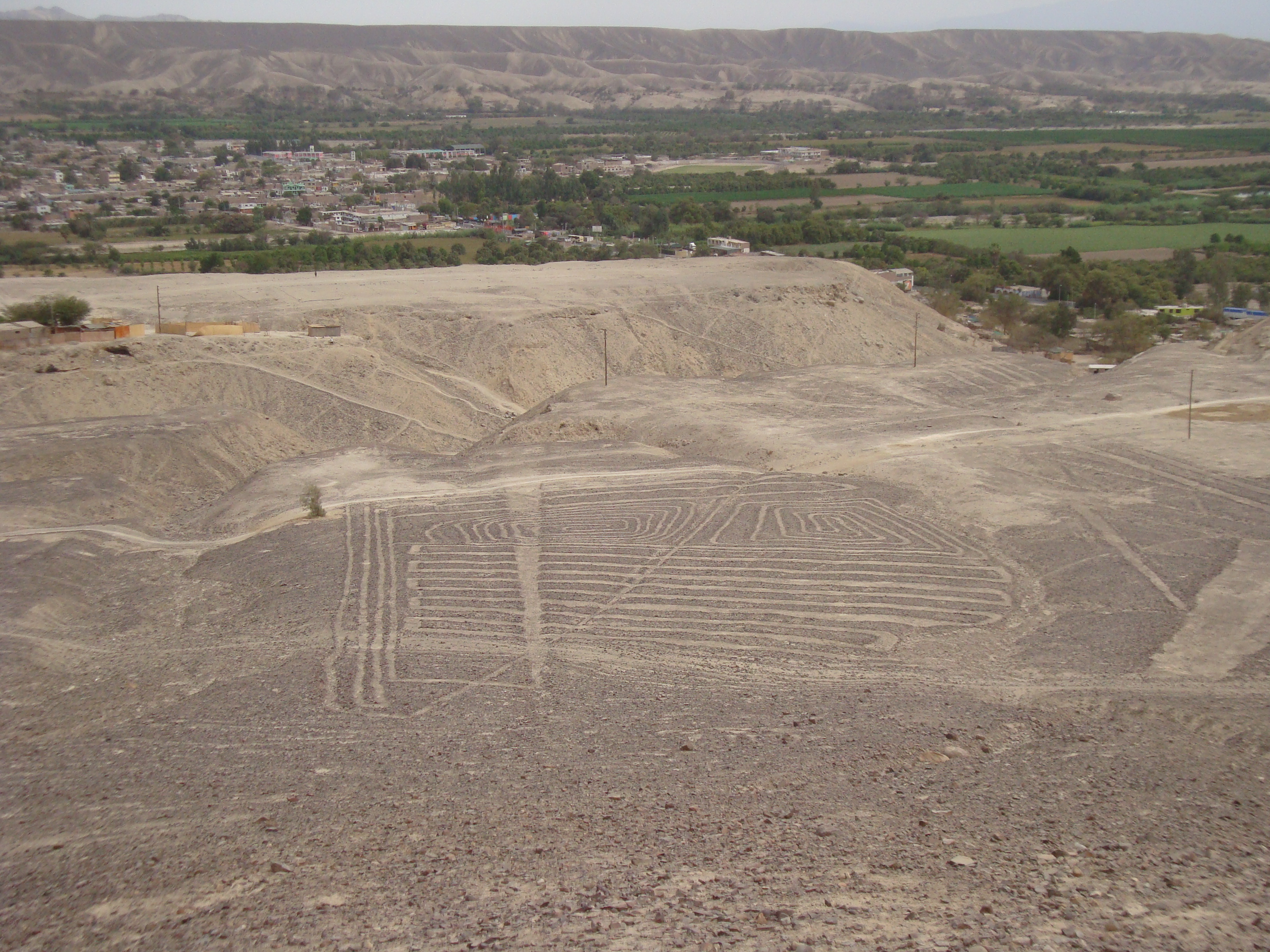
The “Solar Clock”
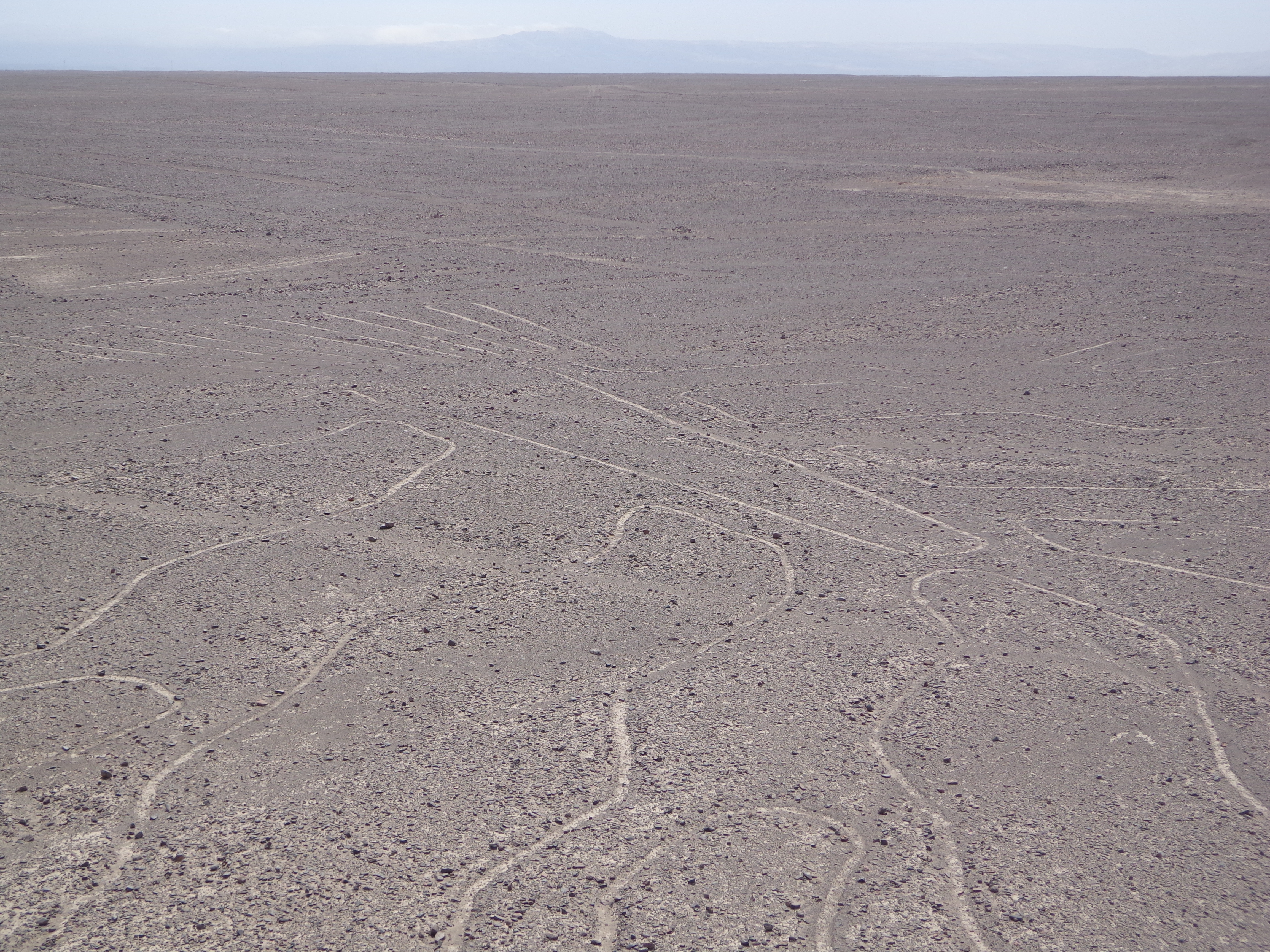
“Lines” from a roadside viewing Tower
We reached our hotel at around 5.30pm, just before dark – a long day and the car faultless, appreciating the lower altitude and better quality fuel.
23 October Colca Canyon claims to be the deepest canyon in the world and is an important tourist attraction. It is also home to Condor Vultures and one tourist trap is the Mirador Cruz del Condor.

Colca Canyon and the Mirador (viewing area)
We had an early breakfast and the car was immediately affected by its own altitude sickness – revving engine and slipping clutch just to get up the incline from the hotel car park! We followed the rough track to the viewing area and came across this tunnel – and stopped. The tunnel was long, unlit, the track rough and there was no light from the other end. The Elan has vacuum pop-up headlights running off the engine but with the thin air there was little engine vacuum and the headlights drooped, casting their beam a few inches in front of the bonnet. We waited for a tourist bus and followed close this tail, following where he went, completely unable to see for ourselves. We waited for about an hour until the first Condor appeared – using the air currents to climb and circle with hardly any movement of their 3.2 metre wings. We retraced our steps, hitch a “tunnel ride” off another rally car.

Colca Canyon, terracing and the Rio Colca
. We retraced some of yesterday’s journey back over that pass – with a pause to cool down as the engine temperature reached 98 degrees despite the two fans. Our hotel was in Arequipa and in the desolate and dusty industrial outskirts we first lost electrical power and then I created an electrical fire when some wires short circuited. I put that out at the cost of burnt fingers, the power was restored but Allison, in manoeuvring the fire extinguisher, tried to extinguish the front wheel!
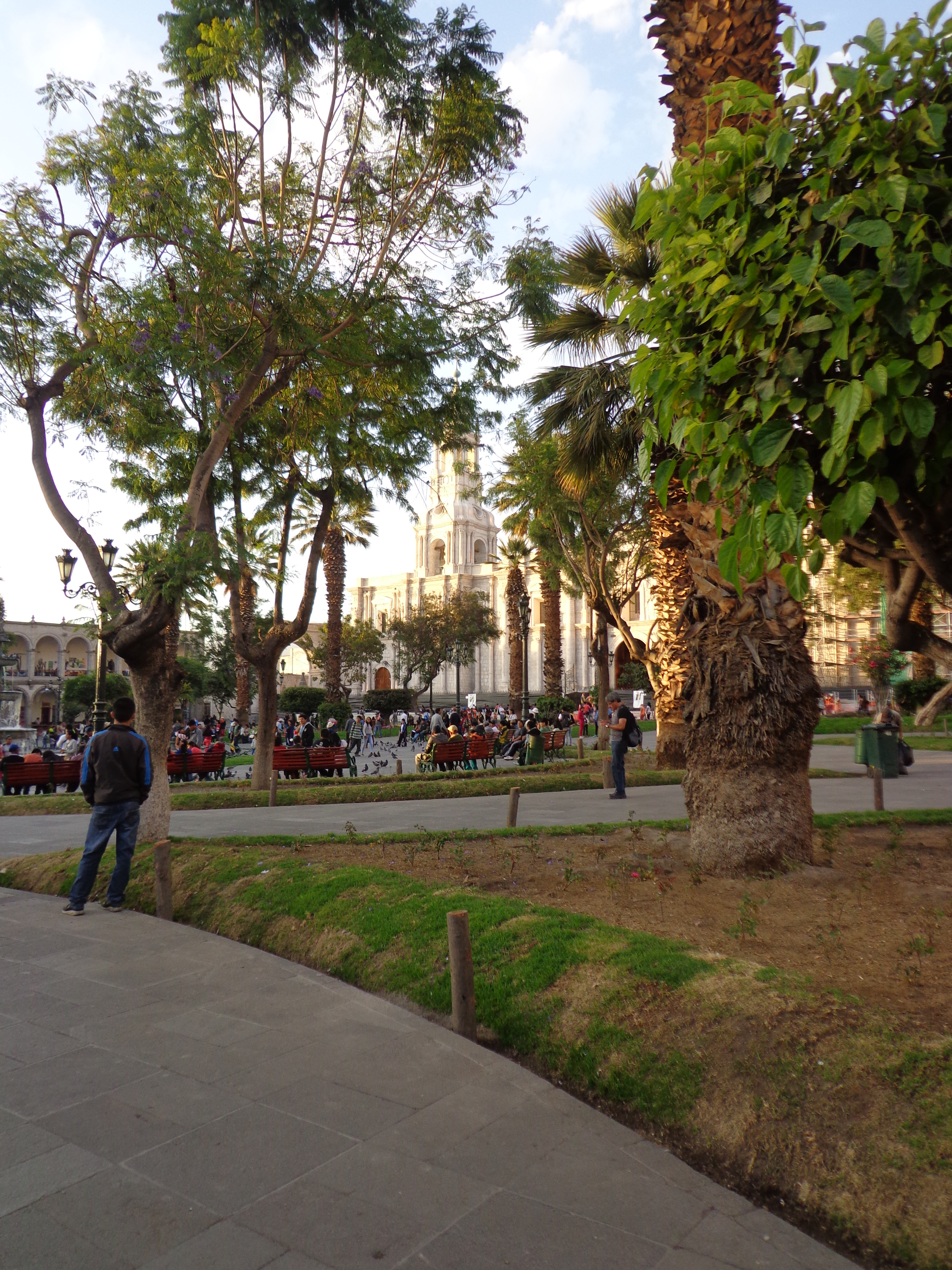
Arequipa Plaza de Armas with Colonades and Cathedral
There were no more dramas and we followed another rally car through the town to the hotel as Allison decided she could not cope with the navigation. Later I was very ill and did not look forward to tomorrow and the longest da’.s drive.
22 October We left Puno for the mountains at Chivay after wiping the overnight frost off the car – it had been -5. The rally was split today; we were strongly advised to take an alternative route to avoid a 30 km section of old un-maintained track, with serious rocks and ground clearance worries – and the unanimous consensus was there was no way we could have got through.
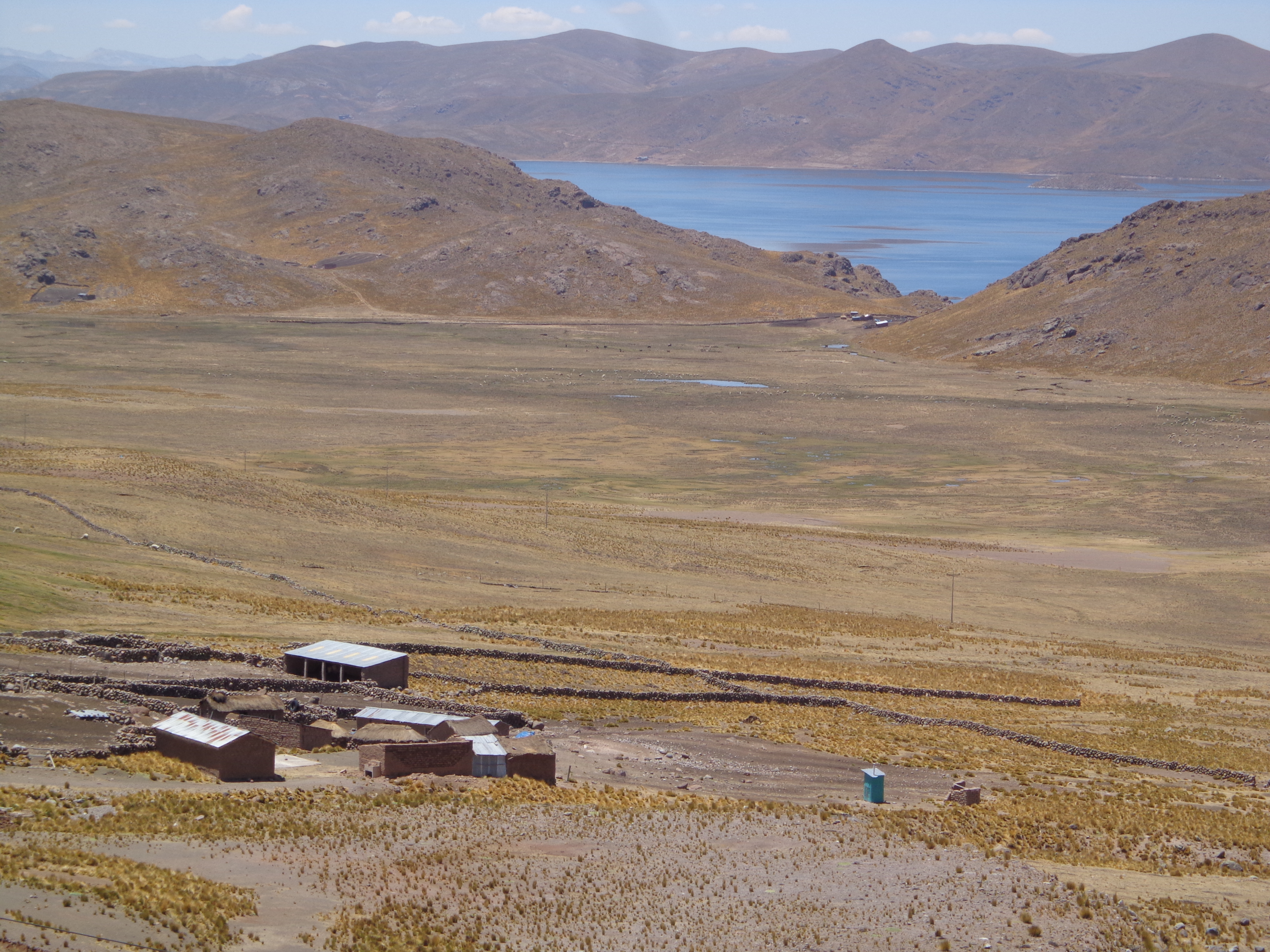
Bleak landscape at Laguna Lagunillas – 4174 metres
We took a longer route, with one organiser’s 4WD and the Sweep all to ourselves! Each car had been given an oxygen cylinder when we left Urubamba as we would be climbing to nearly 4900 metres and today we would remain at a high altitude overnight.

At 4883 or was it 4950 metres
We clocked the pass at 4883 metres whist someone else made it 4950 – either way it was high! We stopped in Chivay

Chivay street decoration and Church
for lunch and then to the village of Yanque, where we parked in the square. Large squares dominated by Churches seem to be a feature in this area – Colca Canyon – and from here we saw the smoking Sabancaya
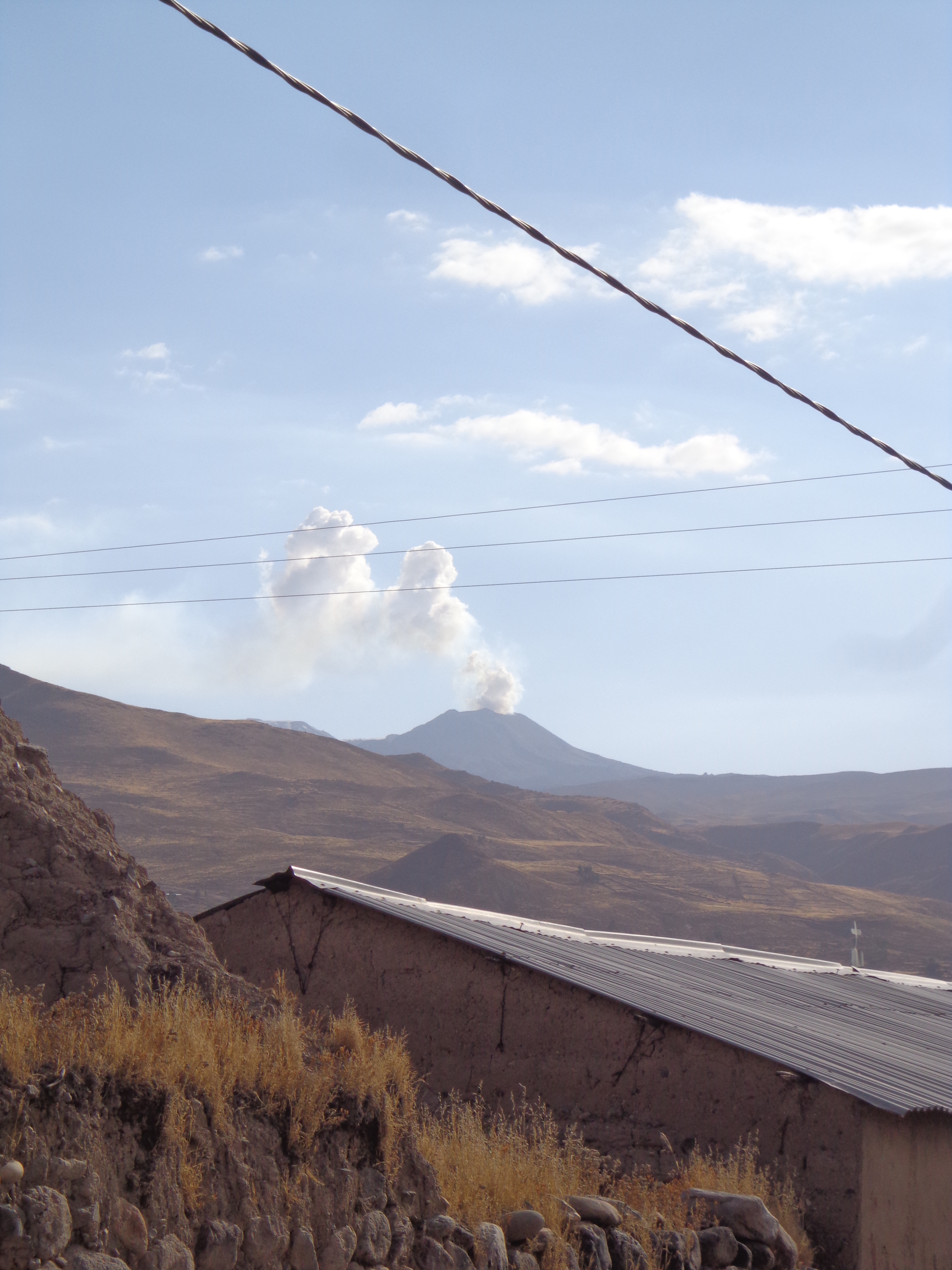
Sabancaya volcano
volcano. Our hotel was on the edge of the Canyon and had its own thermal springs – with water at 90 degrees. Allison went for a swim whilst I went to the Alpaca farm – the Alpaca bloodline had become contaminated by interbreeding with Llamas and between different colours of Alpacas. The hotel was part of a project to rectify this.
21 October The 3.30 departure option was the one chosen! Neither of us slept much; I was thinking of our electrical system and would it cope with the load of two fans and the lights (which weren’t much good anyway).  As it happened 3.30 was not early enough! We left with one of the 4WDs and all was well for nearly 100 miles – no road blocks and we thought we were clear – until there was one. Either end of a bridge they had put rocks across the road and were adding more. 4 rally cars were the first to be caught. Then someone said there was another route so we dashed off, across ditches and through mud (the car was so well cleaned only a few days ago!). But we were through and hared for the District boundary

4300 metres – and safely out of Cusco District
as the protests were limited to Cusco district.

The bleak high plateau
Desite going quite quickly and getting an early start it was dispiriting yet again to be the last home, shepherded by the Sweep. So now we are at Puno on Lake Titikaka and Allison will go on a boat trip to the floating islands whilst I do a check of every nut and bolt on the car!
20 October So we set about the clutch at 8am with the idea of finishing by 9am so we could go to Cusco – it didn’t work out like that! here was a smell around the car and some slippery liquid on the sumpguard and the ground. The clutch slave cylinder had died; fortunately we travel with a spare but removing it is a messy and awkward job. We found the source of a rattle and fixed a light but still no horn. At around 11.30 after a shower we set off but not to Cusco as “events” had intervened. My understanding is that there is a proposal to privatise Machu Picchu and there are going to be mass protests in the whole Cusco region tomorrow – closing roads being part of it.

Weaving at Chinchero
So we went to a couple of local less well known Inca sites at

Chinchero – Spanish Church on Inca base
Chinchero and Moray instead

Moray – but what was this for?
as well as going to a weaving exhibition (aka buying opportunity); in case there was a call to make a dash this afternoon. The rally organiser has arranged a meeting for later this evening to advise on what we should do about the protests – a 3.30 am start being one option! To be continued with photos!
19 October Today was a Rest Day but probably more tiring than most rally days! Up for breakfast at 5.30 then to congregate at 6.15 to go to the station for the train to the Inca City now known as Machu Picchu 
 The train crawled along the river bank at maybe 20 mph (and that’s optimistic) with high mountains rising almost vertically. The guide book says to arrive before the hordes at 9.30 – we were part of the horde! There were queues for entry tickets, then for bus tickets, then for the bus. A fleet of busses carry visitors uphill for 25 minutes to the site, no private cars are allowed as there is no parking. We hired a guide and were taken round the City which, despite its fame, only functioned for 85 years was deserted before the Spanish Conquistadores arrived and rediscovered by American Archeologists in 1911.

With Phil & Keiron
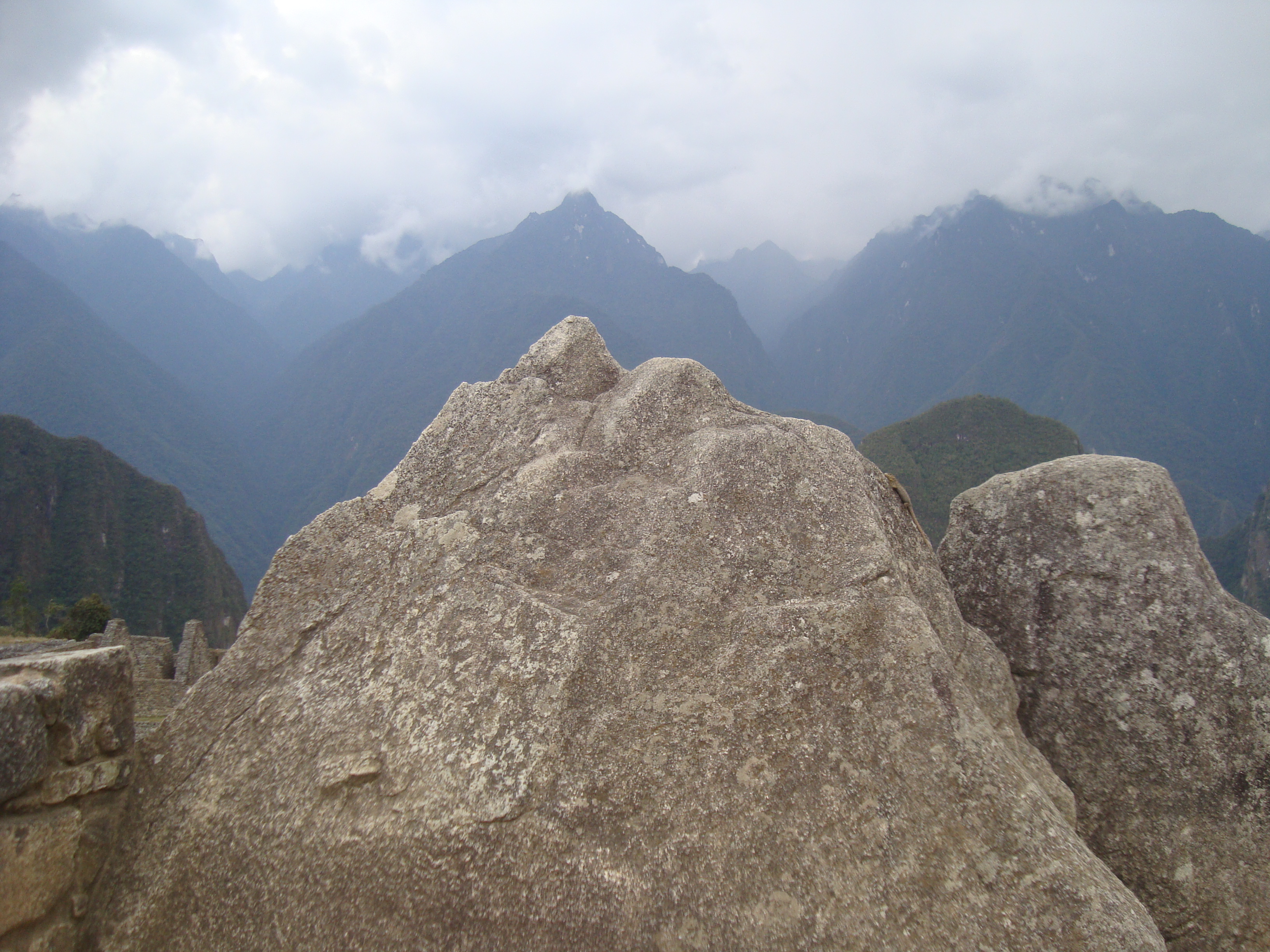
The Sacred Rock, mirroring the mountains behind
There were features straight from Indiana Jones films – like the Temple of the Sun where the summer solstice rays are the only ones to shine through the window
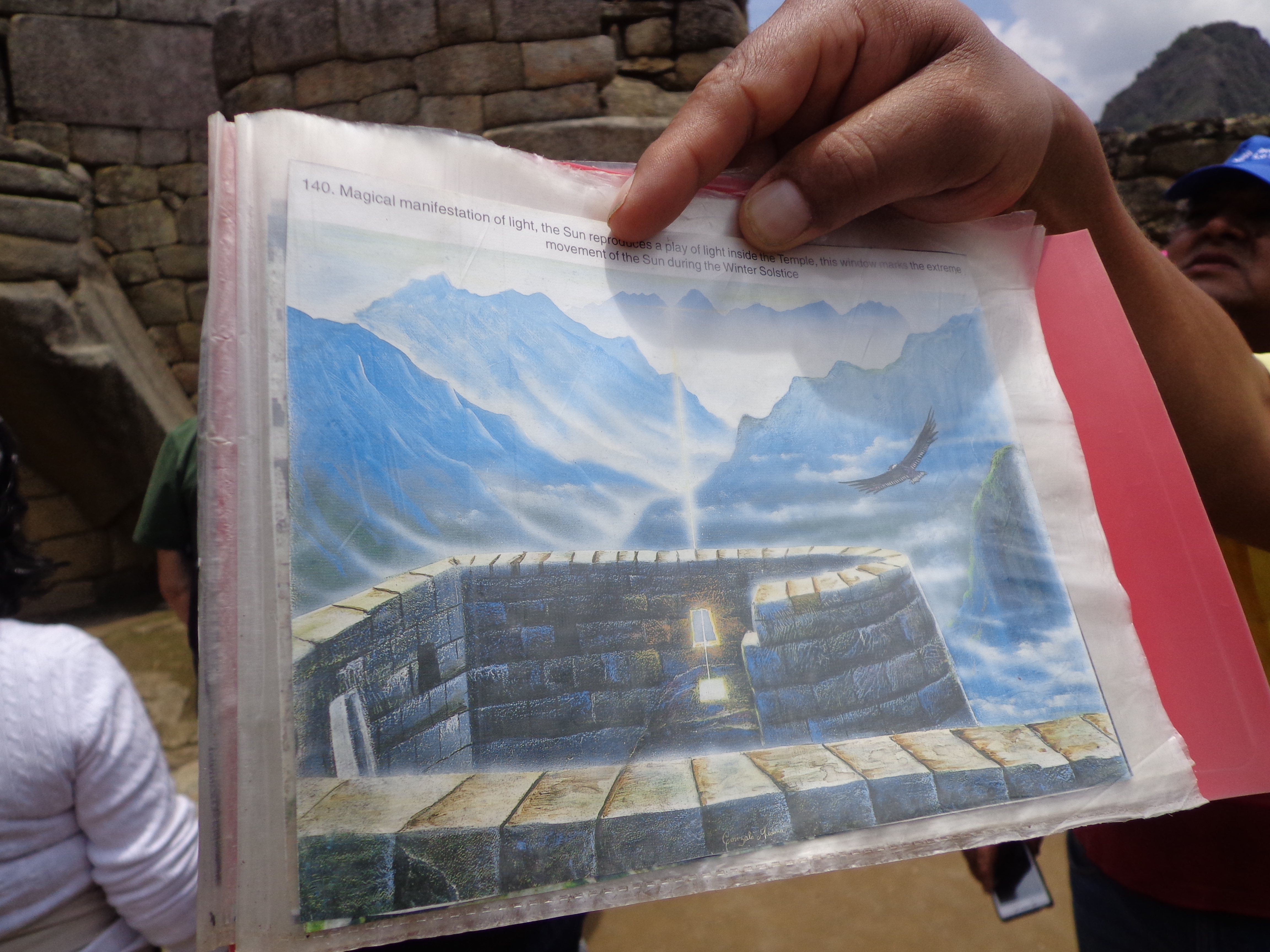
The Guide’s picture of the Temple of the Sun
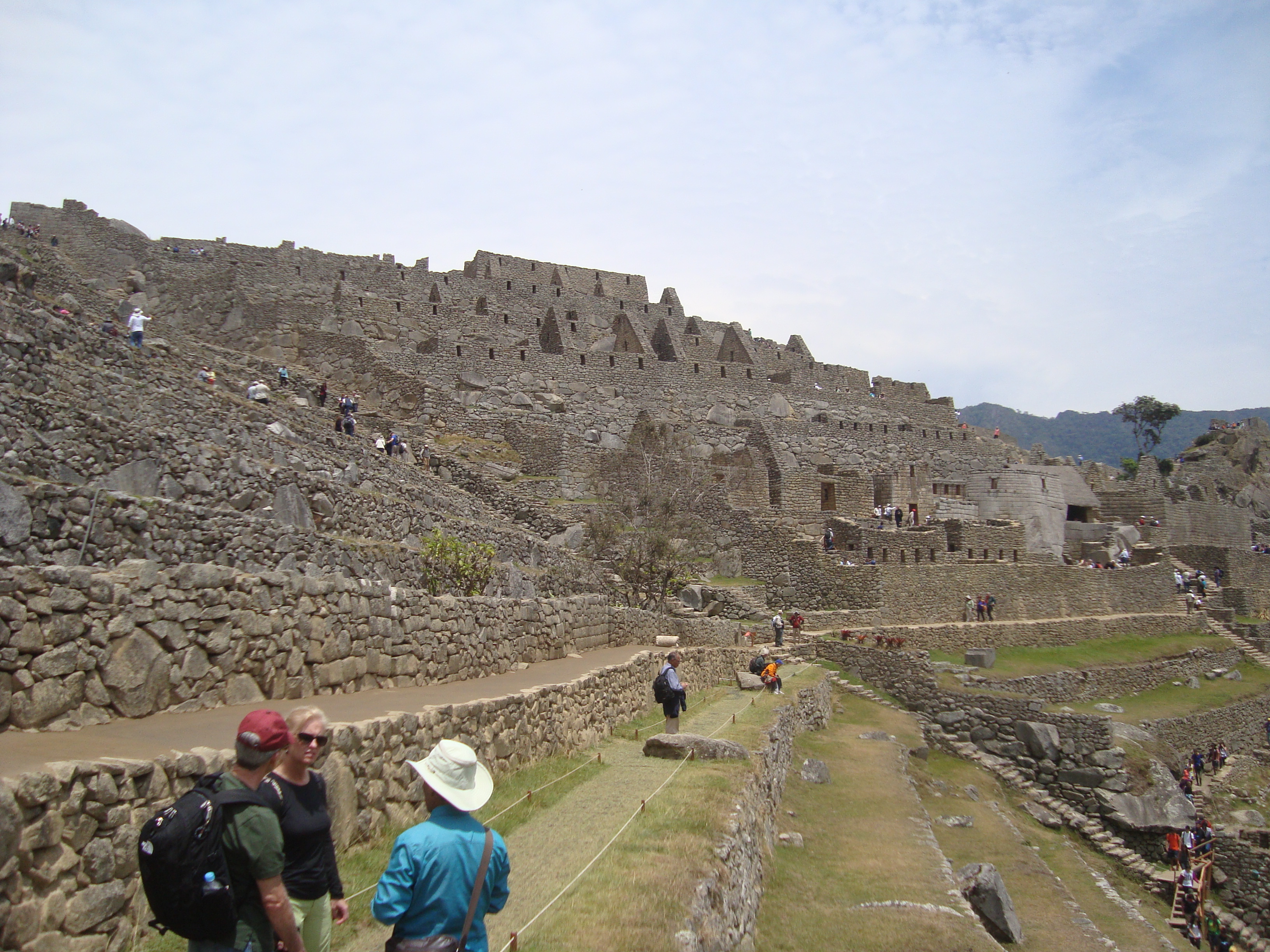

The train ride back to our hotel was “different”. They have tried to make this service 0f Peru Rail like an aeroplane – drinks and snacks are served from an airline trolley (complete with instructions to stow before take off and landing!); on the outward journey they came round with glossy tourist books of the site but on the return one member of staff dressed up in a mask and costume performing dance routines whilst two others modelled a range of Peruvian cardigans and ladies woollens which we were then encouraged to buy – I’ve never seen a fashion show on a railway train before!

Railwalk not Catwalk
We got back to the hotel at 6.30 and, no, I did not look at the car’s clutch today!
18 October and we drive towards Cusco, today was 300 miles including a climb from 100 metres to a pass at 4,800 metres.
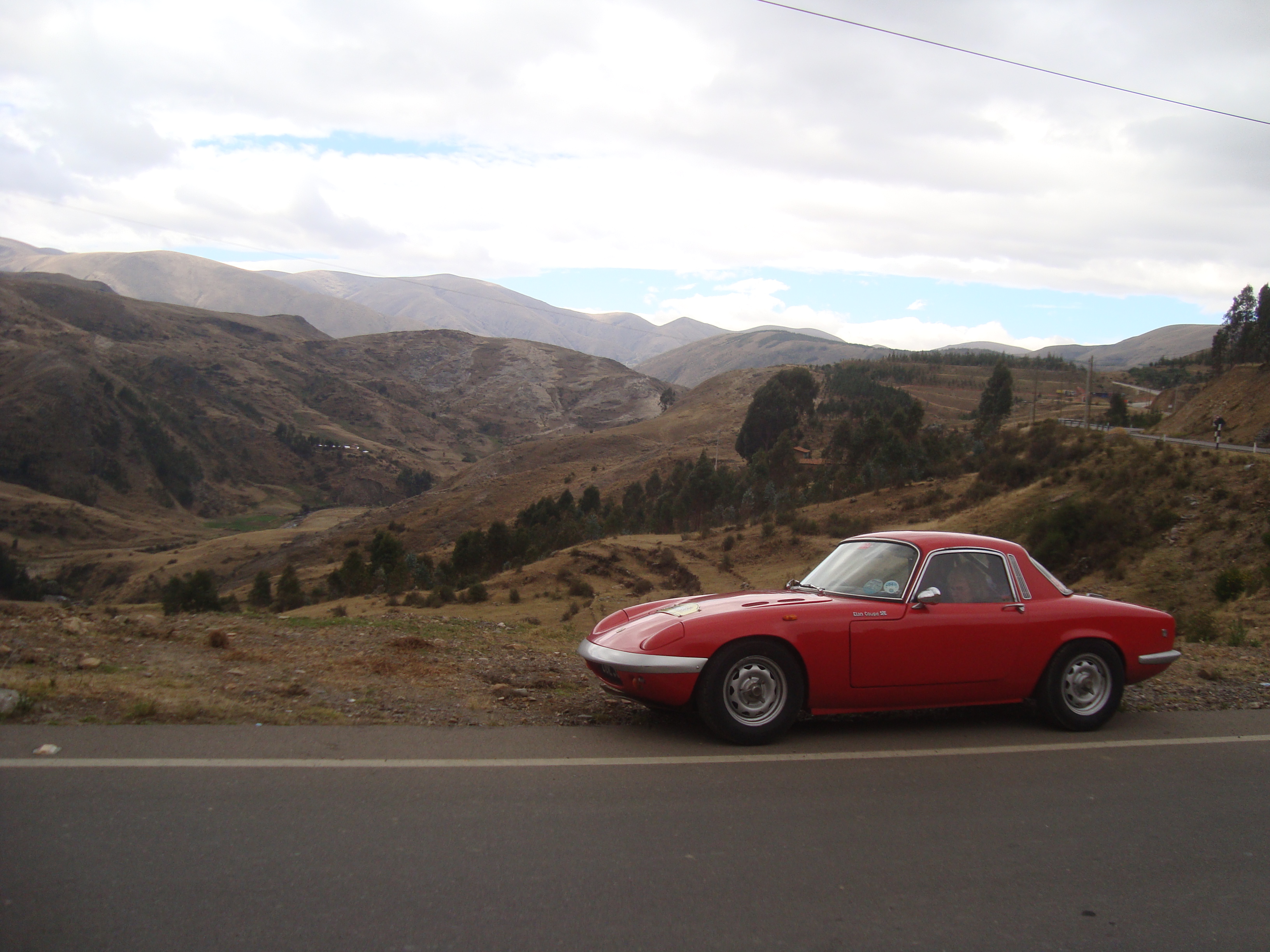
The Road to Cusco
For a change it was a cool day – very pleasant after all the heat we had earlier There were discussions as to whether the drivers needed oxygen and, in our case, if we should have brought different “jets” for the carburettor to cope with the lower oxygen density at such altitudes. In the event we had neither! The first half of the drive was fine – though the car was unhappy above 70 mph which I guess was fuel related. We passed villages busy with markets and women in traditional clothes which they really did not want photographed.  Then we started to climb. All’s well that ends well but it was stressful at the time. First there was a smell, then the clutch pedal went straight to the floor, then it became foggy with little visibility so I put the lights on, then the car reached boiling point so we stopped. The smell was electrical and Allison saw smoke coming from the regulator box; the dynamo was too hot to hold. I decided that the electrical system was overburdened by the two fans, lights and wipers and hope that we had stopped in time to prevent fatal damage to the dynamo – they cannot cope with excess load and Lotus electrical systems are notoriously suspect! The clutch problem I think was boiling fluid as the cylinder sits very close to the exhaust – and that was certainly hot. Outside the car it was cold so we soon had trousers over shorts, socks with our sandals and two fleeces over our short sleeve shirts! We cooled down, turned off the lights, double declutched to change gear (or just crunched) and carried on in 2nd gear to the top.
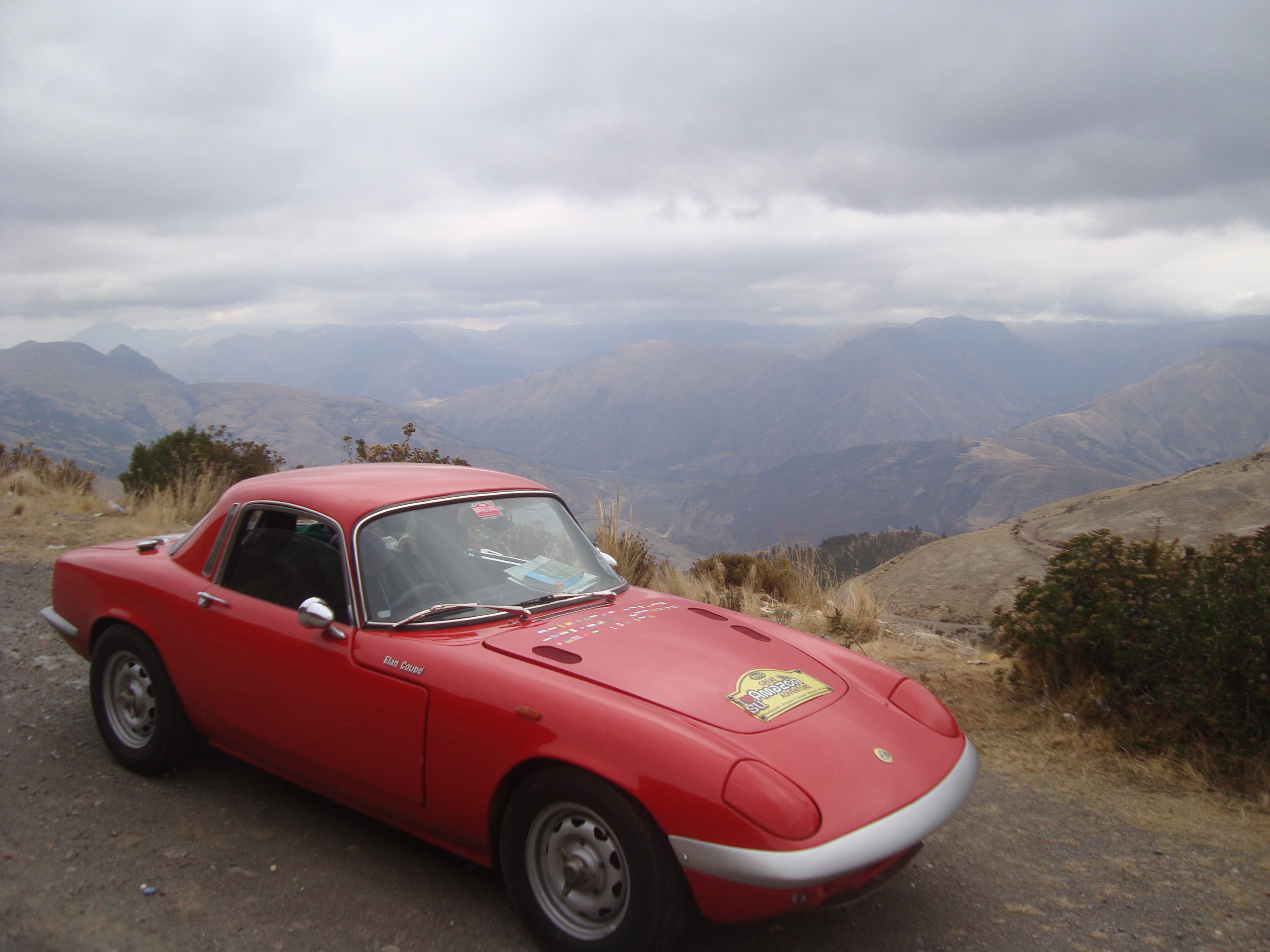
not 4800 metres but close!
We assume we got to the top because we could see nothing, but the engine said life was now easier!

Urubamba valley
We reached our hotel in the sacred Inca valley of Urubamba – in visiting distance of Machu Pichu (tomorrow ) and Cusco (the day after). At some stage I will need to tackle the clutch – but not today!
17 October – Rest Day in Puerto Maldanado so just after 6am when it was still cool and there were no crowds, I set about the points, then breakfast. Our next tasks were to refuel, get the wheel balanced and the car cleaned – the dust inside being the more important. The tyre balancer had a dedicated cleaning service and for the princely sum of £7 we had a clean car with a balanced wheel! By now (10.30) it was seriously hot – 34 degrees with very high humidity and doing nothing we were dripping.
We had signed up to a Jungle canopy walk in the afternoon so at 11.30 we were collected in a beautiful old Charabanc.  Based on a 1960s Ford it had 24 wooden seats – all with lap seat belts! – and a wooden surround holding the roof. Then a boat trip to the Jungle Centre where one could rent private lodges and have your meals served in a dining area covered with fly nets 30 metres above the jungle floor.
  Our walk started in “primary” jungle where only 2% of sunlight gets to the ground – that 2% was enough for me and I was debating at what stage I would start drinking my shirt it was so wet!
  Then up a 30 metre tower and over rope walkways – though the view was limited.
16 October Luciane took us to the tyre shop and stayed with us for the hour and a half or so that it took to fit 5 new tyres and discard all the old ones –the new tyres were a  slightly different size to the old ones so could not be mixed. Our early start meant that we were not delayed and the car’s handling was definitely improved with fresh tyres closer in specification to standard – our rally tyres were meant to give extra durability and ground clearance. The tarmac soon deteriorated (as usual) to pothole land and we snaked and weaved around the road. We crossed into Peru and were lucky that we were hardly delayed at passport and customs control. The Peruvian roads had good sweeping bends and we were happy with the good surface and no potholes. That is until the handling suddenly went off followed by the “clump” of a flat tyre. 275 kms on new tyres and already a puncture! The villages we passed through in addition to speed bumps (1st gear for us) had white painted tyres at the roadside indicating a “vulkaneroda” (or similar), otherwise a puncture repair shed – so we stopped for a repair and after he pulled a bent 3” nail out of the tyre we set off again. Fuel was the next worry – they sell 90 and 84 octane but 90 was not available. 84 sounds awful and probably is but I am told they use a different set of units and 90 is actually close to our 97 – but 84 is still awful! We reached Puerto Maldanado after dark which was tricky because the various adjustments I have made to ride height mean the headlights point at the road and not along it – and the local fashion is not to use lights or bother about being seen! To compound matters, our hotel had been changed from that in the route book, Allison as usual could not cope with the GPS and lost one instruction so we became completely lost as well as hot and sticky – not happy bunnies when we eventually got to the new hotel – and the engine was stalling and unwilling to start; normally a sign that the contact points are burnt out and need replacing. Not something I planned on doing on the road outside the hotel in the dark – but tomorrow is a rest day…………
15 October I woke up early and decided that the “turret support bar” was contrary to the fundamental concept of Lotus handling (flexibility not rigidity) and that anyway there was no evidence of any damage to the turrets – so I removed it! A 6 hour day to Rio Branco lay ahead and the last night in Brazil. In principle the roads were good – tarmac all the way – not quite! The steering was awful and we tried fixing the tracking at the hotel before leaving (tracking is to make sure that the wheels are all pointing the same way!). Whatever we did, it didn’t work so I stopped at the roadside for another attempt. Toby decided that one wheel was buckled and was giving wrong readings. We changed to the spare and the car was much happier – but both front tyres were wearing badly and did not look as if they would last the journey. It was a hot day – very hot and the car was soon saying that the temperature was about 95 – I alternately slowed and coasted to manage the temperature and eventually found the only tree for miles around where we found that the original electric fan (thermostatically controlled) was not starting – so it was “hot wired” (in both senses) and we were on our way again.
The road deteriorated and we spent time dodging potholes Ferry crossings are a daily staple in Brazil and the Lotus was the centre of attention with a member of the crew saying that he had seen the Mustang and another classic (the Mercedes). We reached Rio Branco just before dark – success! The hotel Manager was very helpful in tracking down a tyre vendor who had (nearly) the right size tyres and said she would guide us there next morning at the special opening time of 6.45.
14 October. Rest Day in Porto Velho – We left the hotel in convoy at 9am to find a workshop where the Mustang could be welded and the Elan examined. The Mercedes only needed a ramp for routine servicing and inspection.. Unintentionally, that is where we started off as our requirements had got lost in translation. We shuffled from workshop to workshop but none were quite what we wanted. Eventually we found a tyre fitter with ramps and a welder/machine shop next door – this was going to have to do. It took ages to tell the welder what was needed and the persuade him that it was feasible. Then ton look at the Elan. The chassis which we thought had suffered looked ok but the “vertical link” (also known as kingpin which holds the front wheel in place) was bent. Allison had bought one of these some years back and I had brought it with us on the grounds that it might be useful – but I thought it was the nearside. I went back to the hotel – and – result – it was the one we needed! Elation! I also had a spare stub axle so the plan was to rebuild that “corner” of the car and to manufacture a support bar to join the two front chassis turrets to give extra strength. Frustration rapidly set in when it transpired that the brand new Lotus part had the wrong size taper to accept either stub axle. To cut a long story short we left the workshop at about 6pm to go back to the hotel where we fitted the “turret support bar”. End of Rest Day!
13 October Our long day with 400kms on dirt plus another 200 on tarmac. We got through but at a price – I hit an unmarked speed bump, the car bounced over it but the front suspension is now bent so on the “rest day” on 14 October its off to the workshop to see what else is damaged and how to stabilise the position. The car is still drivable – we did about half yesterday’s distance after the bump. One front wheel is at an angle and steering is less than perfect! 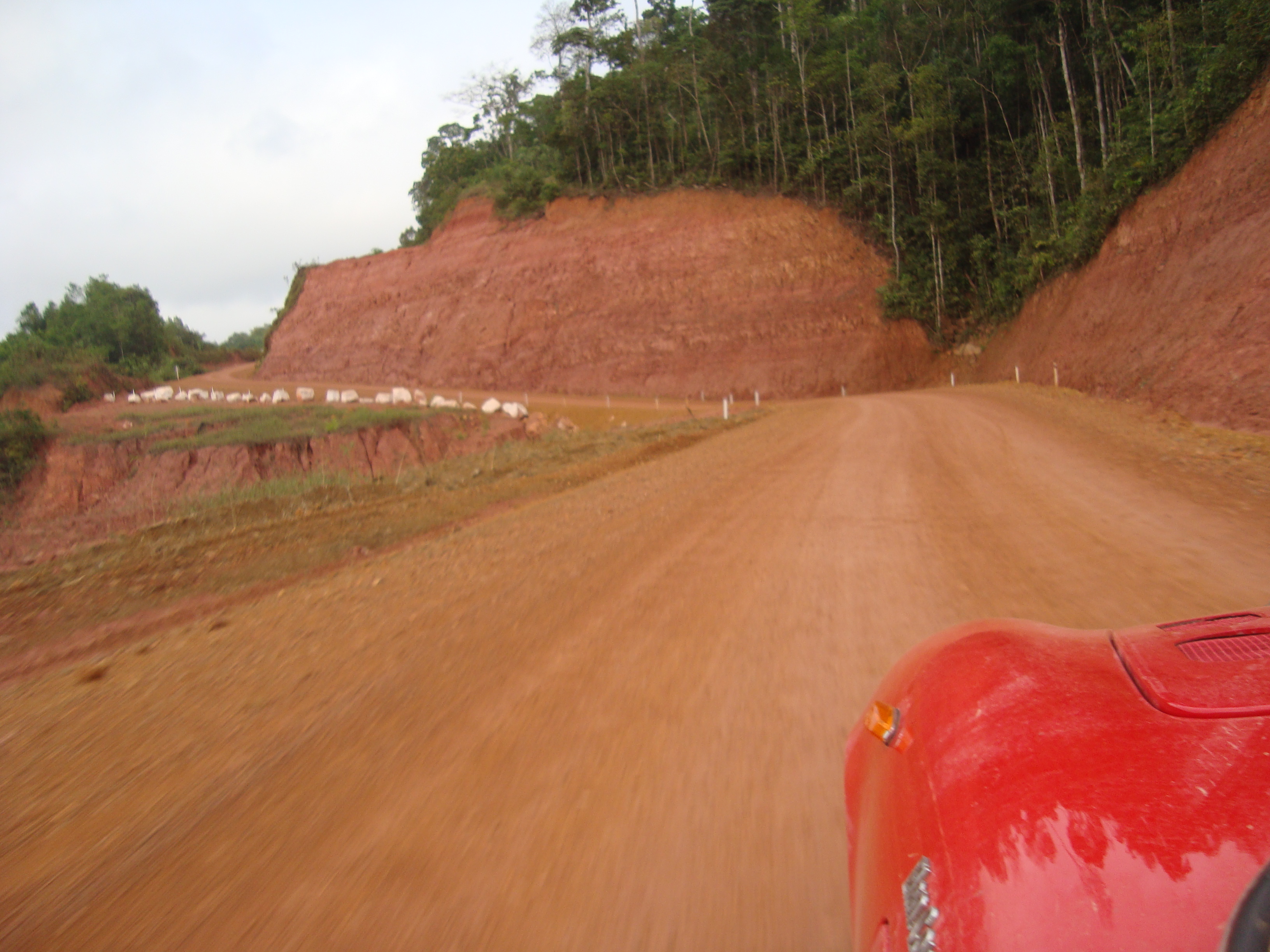 The day started early with a mostly good quality dirt road where we were easily travelling at 60+ mph The good pieces were interspersed with bad pieces – potholes and bumps and
 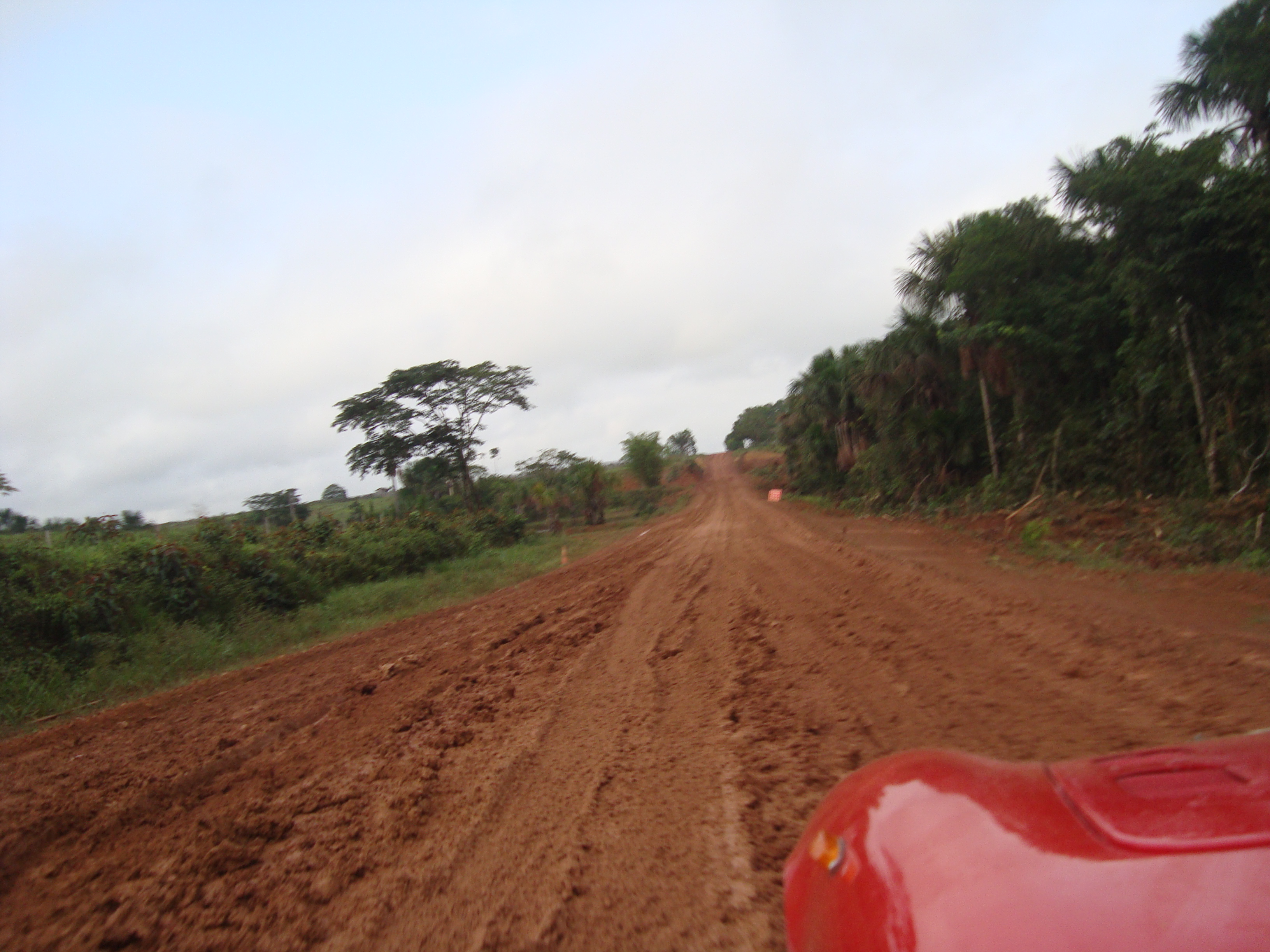 muddy pieces where the car struggled to keep on a line as the mud pulled it around. There were also road crews so maintenance was on-going though this is the first time we have seen them in action – dirt roads need constant grading to flatten out the heaps of gravel which mount up between the tracks created by the 4WD’s and lorries – and we hit if we try to follow these their tracks.
The three classic cars on the rally were the only cars on the first ferry of the day – the only time we have been so close as the others are usually way in front of us. The ferry was the standard for the area – a barge with a tug on a flexible pivot so it can push the barge in any direction  We gradually fell behind the others and at the fuel stop we were running with the organiser and mechanic. The road from here to the ferry was awful – dirt, mud, potholes, bumps and they took some of our remaining heavy items to lessen the load (spare wheel and fuel)
12 October Today was a more gentle day – dirt road all day but only 270 kms and better quality than yesterday. Allison drove and I just took photos. The journey took only 4 hours or so with no really poor sections. Despite this we soon heard the now familiar rattle of a loose sump guard. The doors also objected to the excessive rattling and we ended with one door which would not close and both would not lock. The breakfast weather forecast had promised rain and lightening – a mixed blessing as it would be cool but the rain could turn the dirt road to an impassable soup. We were fortunate that we had only light drizzle with all the benefits of cool, dust free travel – though the dark clouds suggested more rain to come. Allison tried to wash the car as I did the repairs but the prospect of 400 kms of dirt tomorrow did little to encourage her
11 October We left as early as we could after a short breakfast. The entire day was on baked mud. We were covered in dust, us, the car, all luggage, everything; it accumulates on any exposed flesh and clothes, its persistent and will not be moved! At times we had to go offline into damp mud which clung to the underside of the car, thick, heavy and stubborn. It was a long day – photos but the internet speeds here do not permit a download. We arrived in Jacareacanga in daylight (just), and found more mud in the hotel car park. We had rattled and banged and clattered our way and were far too often and unexpectedly hitting the ground with our sump guard. The “road” – Trans Amazonia Highway – to give it its proper title tended to have one track – at 4WD width. This was no good to us as if we tried to follow this track we rode on the raised gravel in the middle and the noise alone is enough to tell one this is not a good idea. So we go offline and hit all the bumps and uneven surface at the edge as well as having to fight the gravel mass in the centre which wants to dictate where our wheels should go. We hardly used 4th gear all day. he front suspension seemed unusually flexible -there is normally no up and down movement. I started my evening checks there and found that the “adjustable spring platforms” had self adjusted downwards thereby lowering the front suspension. One beer later, I had raised one side and was part way through the other when John, the organiser, and Toby, the mechanic, twisted my arm to suggest I join the Mustang at a local garage where there was a ramp and we could see what the damage was (if any) and avoid grovelling at ground level – so wee went to the garage. This was a social occasion, children, wives, girlfriends arrived to see these two cars, loud music played, the BBQ smoke drifted across the dirt floor, locals wanted photos with the handsome strangers (?) and our rally photographer wanted an interview as to why I was here and what I wanted to achieve. The Mustang had a broken axle and drive shaft so needed copious welding. We just needed some minor tweaks, a few lost bolts replacing and time to let everyone marvel at the amazing resilience of this most unsuitable car!
10 October Leaving the ferry after two nights on board was less dramatic but we were away fabout 4 hours later than expected – first on means last off! The day started with fast tarmac, followed by potholes in tarmac followed by no tarmac. The last 150 km was mostly tracks of baked dirt with potholes, bumps, washboard, bridges, a few goats but little traffic – and another ferry. The photographer spent a long time filming the Lotus from the 4WD – the two other classics are going faster than the 4Wd’s so he hardly gets to see them! It was another day when we were hot, sticky and dirty – the dust gets everywhere, But after all the shaking on the road my first task was not a cold beer and shower but an hourdoing a spanner check to see which nuts and bolts had come loose. Tomorrow promises fewer miles but less tarmac so another long hot dusty day! I will try and get the pictures up when the internet speeds allow!
8 & 9 October On 8th October we had the morning free in Macapa to see the sights or buy spares for the cars before taking the ferry to Santarem. We did both, firstly visiting the old Portuguese fort, built to protect the City from the Amazon (pictures to follow but internet speeds in Itaituba are very slow!). Then to buy a second electric fan. This took a long time and if I tell you that the taxi fare was more than the fan you will get the picture! Anyway a fan was acquired. Then we left for the ferry via the Equator line which runs through a football pitch and has a monument with an Equator line, guides and a visitor book – just that there are opinions that the monument is off centre and the actual line runs through the car park. Then to the ferry – an excellent example of the rally motto “hurry up and wait”. The Lotus was the attraction whilst we waited. Then loading was even more exciting – we had to go over a ramp between pontoons and there was no way the car could clear the ridge in the middle – so we used a seesaw! I drove up onto 2 planks then moved slightly forward, shifting the balance point, the planks went down the other side and I drove onto to other pontoon. The cars were crammed into the lower deck along with household goods, freight, fish, a caged dog, frozen fish and later furniture and a satellite dish. The Lotus was given more space than any other car so Toby and I were able to spend most of our sailing time fitting the fan, repairing the doors (they don’t like being shaken) and eliminating the brake squeal which has long been a feature of the car. It was hot but with the shade and breeze it was as good as we were going to get. We finished all the tasks and they made the next day’s driving much easier. The car now has two electric fans strapped to the radiator – one the nice Kenlowe with thermostat controls and proper fixings and then the new one with a Toby “special bodge” – its held on with tie-wraps running through discarded bottle tops and shavings off the planks – to prevent the tie-wraps bending the fragile radiator fins.
7 October – Today we hit the rough stuff! 
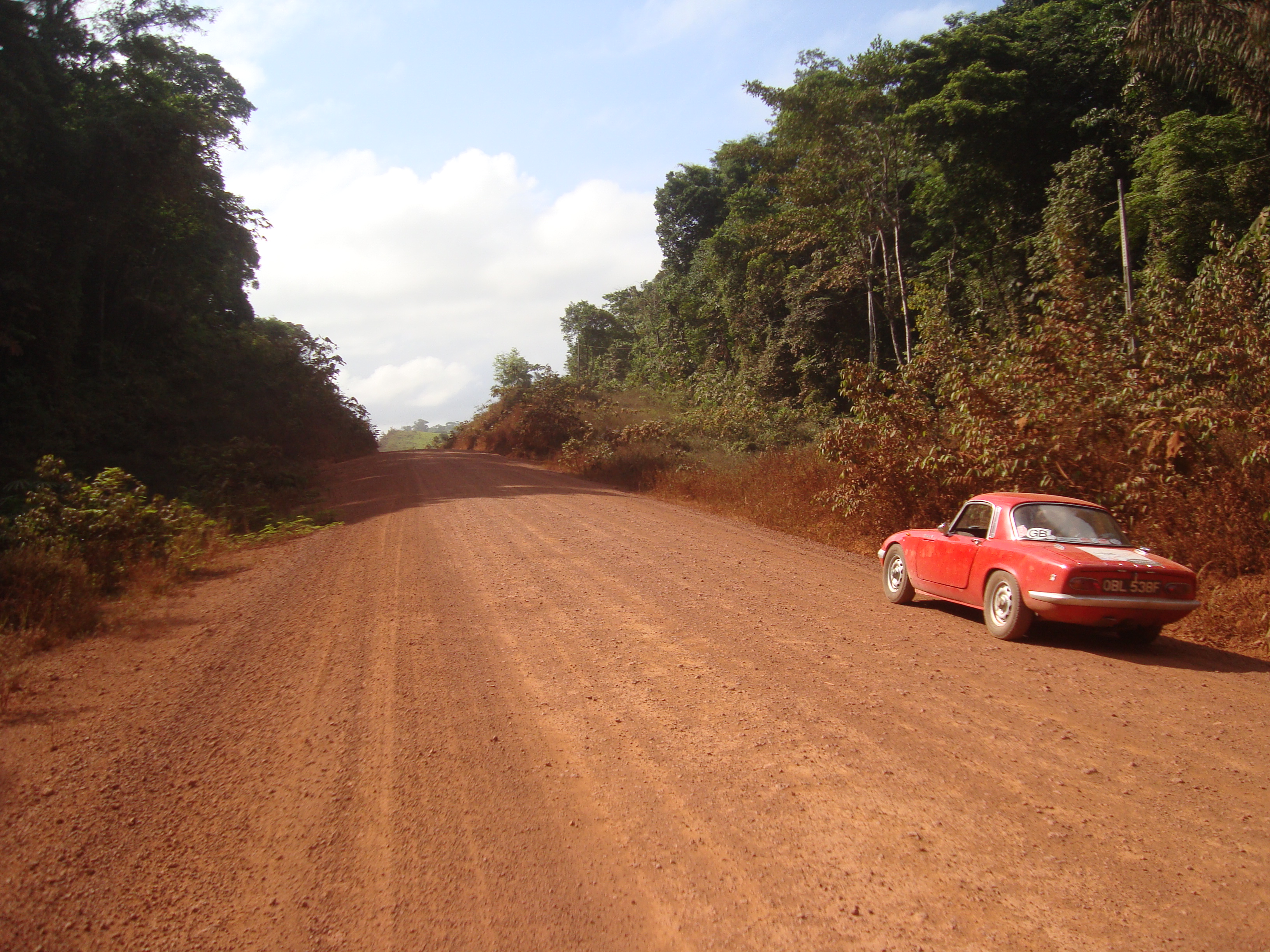
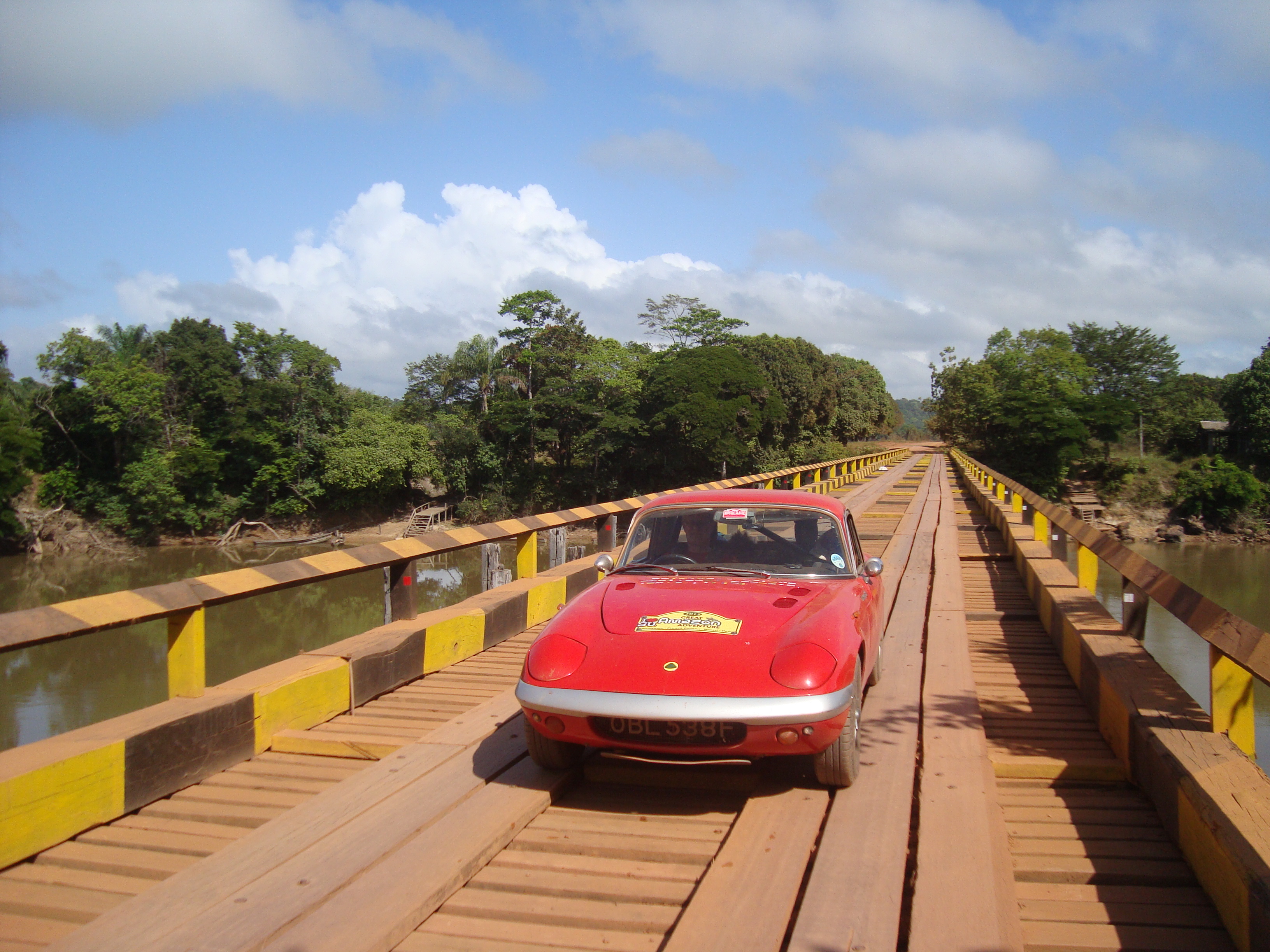
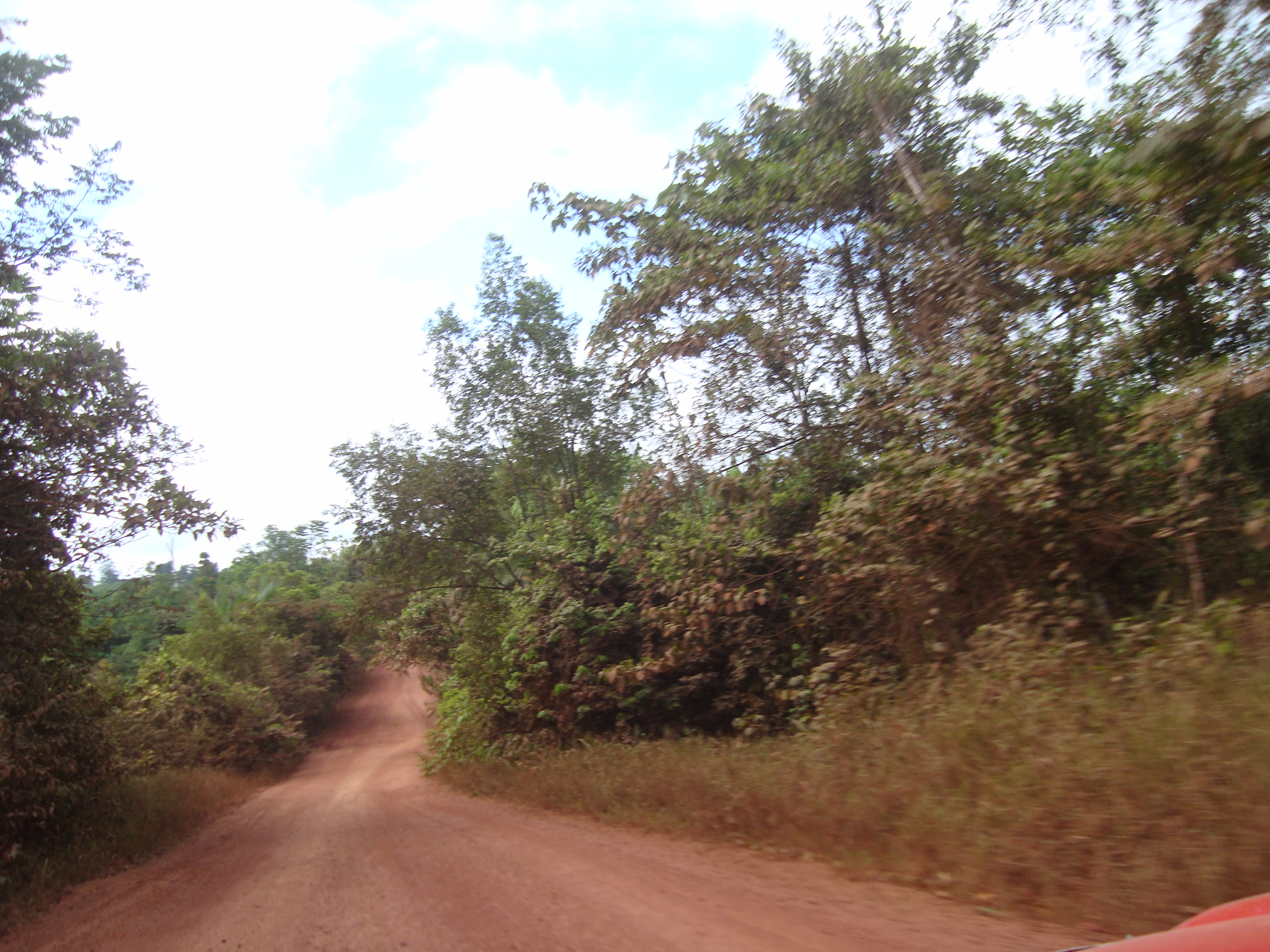
This section was good and fast – except when you were overtaken because then you could not see through the clouds of dust but the surface was good – the potholes came later! We had about 100km of this and the car was shaken and everything covered in red dust. The engine was running at about 90 degrees most of the time and the oil pressure slightly below where I wanted it. Toby, the mechanic, fixed the wiring on the electric fan at lunch but it still ran at 90 afterwards! We were relieved to arrive in Macapa after 9 hours on the road. We were hot, the car was hot, the engine lumpy (Brazilian fuel), the underside battered and the doors wouldn’t open or close – 9 hours on the road was followed by 2 hours in the underground garage, wiping sweaty forehead on oily rags, checking nuts and bolts. Tomorrow we start our 2 day ferry up the Amazon with time on board to rehang the doors…..and see if I can get some video onto this report!
6 October We set off in a slight drizzle – oh bliss – rain is cool and for once we are not being steamed in the car! It doesn’t last for long but does leave a wet dusty windscreen.

The road to St Georges
Our destination is St Georges and the river boundary into Brazil. Passport control is in a small compound away from the river and we arrived at midday just as they had gone to lunch – so a 2 hour wait, fortunately the ferry was booked for 2.30 so lunch in a beautifully faded French style restaurant with a few lazily twirling overhead fans was called for.

St Georges – the Square
We agreed with those in their air conditioned cars that we were cooling down as they were heating up. Customs was a little closer to the riverbank and their only question was whether we were taking the car with us – did they want it, or did they see a market in Lotus Elans in this part of the world? We
had met a local Europa owner in Surinam as we were leaving but nothing in French Guiana.
We had hired the entire ferry for our crossing – but it was too small so the mechanic’s 4WD was left to follow on the scheduled service, which arrived as we were still loading

St Georges – the Port

Packed on board
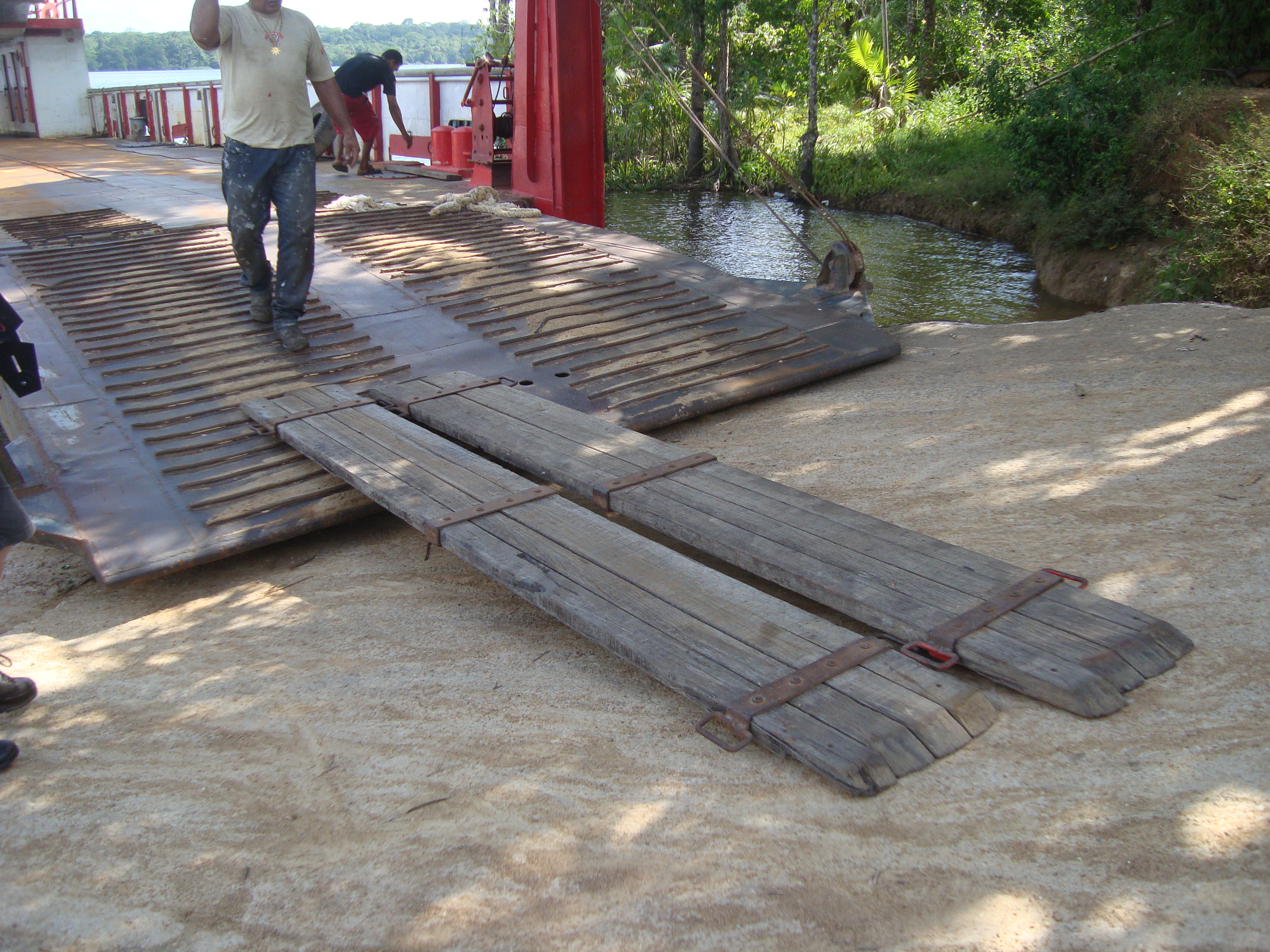
The loading ramp
Loading was a slow process though we were to find that unloading took even longer. The trip was about 40 minutes
upstream and under the new suspension bridge, built by the French (and no doubt with EU funding) but never opened as the Brazilians didn’t build the road their side

The bridge – not to be used

Oiapoque – the Port
Oiapoque as a small town but much more bustle and activity than we had met before. French Guiana used Euros but we now needed Reals but the bank with all its security entrance and armed guards did not do exchange and neither did the Cambios (closed) and as I didn’t want to buy from a money changer in the street – that had to wait! Our hotel was just off the main street and we parked on the forecourt, hemmed in by the 4WD’s which parked in the road. It was arguably the worst hotel we have used since student days but they did an unexpectedly good breakfast and we left before 7.30 next morning.
5 October – Kourou is a seaside resort and its far too hot to do anything outside – a short stroll down the beach leaves one dripping. The car is parked under the only available tree with the others clustered around. At midday we set off for the Ariane Space centre just 10 miles away.

Ariane 5 Rocket 51 metres tall

Ariane 5 Launch area

Commewijne River
4 October A civilized start of 10.30 and we headed off for the ferry to French Guiana. Two cars were stopped for speeding and one of the 4WDs lost his air conditioning. We arrived three hours ahead of the ferry departure to allow for Customs clearance – this was relevant as we had paid a 2,000 Euro import deposit to the Surinam Customs and would rather like it back!  The ferry had enough space for 8 cars and two motor bikes so one of the organiser’s cars had an hour’s wait for the next ferry – being French there was a lunch break of a couple of hours! The road to Kourou was fast and clear and not a gendarme in sight; we arrived just before dusk. being so close to the Equator, the sun rises at 6 and sets at 6 – regular and predictable.

Atlantic Ocean at dawn from the hotel balcony
. During our evening meal a deputation of 4 gendarmes arrived to tell us to move our cars from the communal parking to outside the hotel foyer for improved security – so we duly obliged. Next morning, as the first down I was harangued by the hotel manager demanding to know why we had parked in front of the doors, saying it was a safety risk and threatening to bring a tow truck to take us all away! One driver had 3 more gendarmes at his room door demanding he move the car immediately – they sure know how to impress their guests at the Hotel Des Roches!
3 October One day had been set aside in case Customs Clearance for the cars took longer than expected but that was not necessary. So we got our new wiper blade at the local Shell petrol station as well as a tankfull of fuel – and a real wake up call! The car grounded three times in a journey of a couple
of hundred metres so at 7am when it was cool (all things are relative – its 36 or so and humid during the day) I was out there winding up the rear suspension to gain an extra inch of ground clearance as well as picking out all the heaviest spares to go in the 4WDs. For the rest of the day we have a drive and boat
Commewijne River
trip to Fort Amsterdam and an old coffee/cocoa plantation.
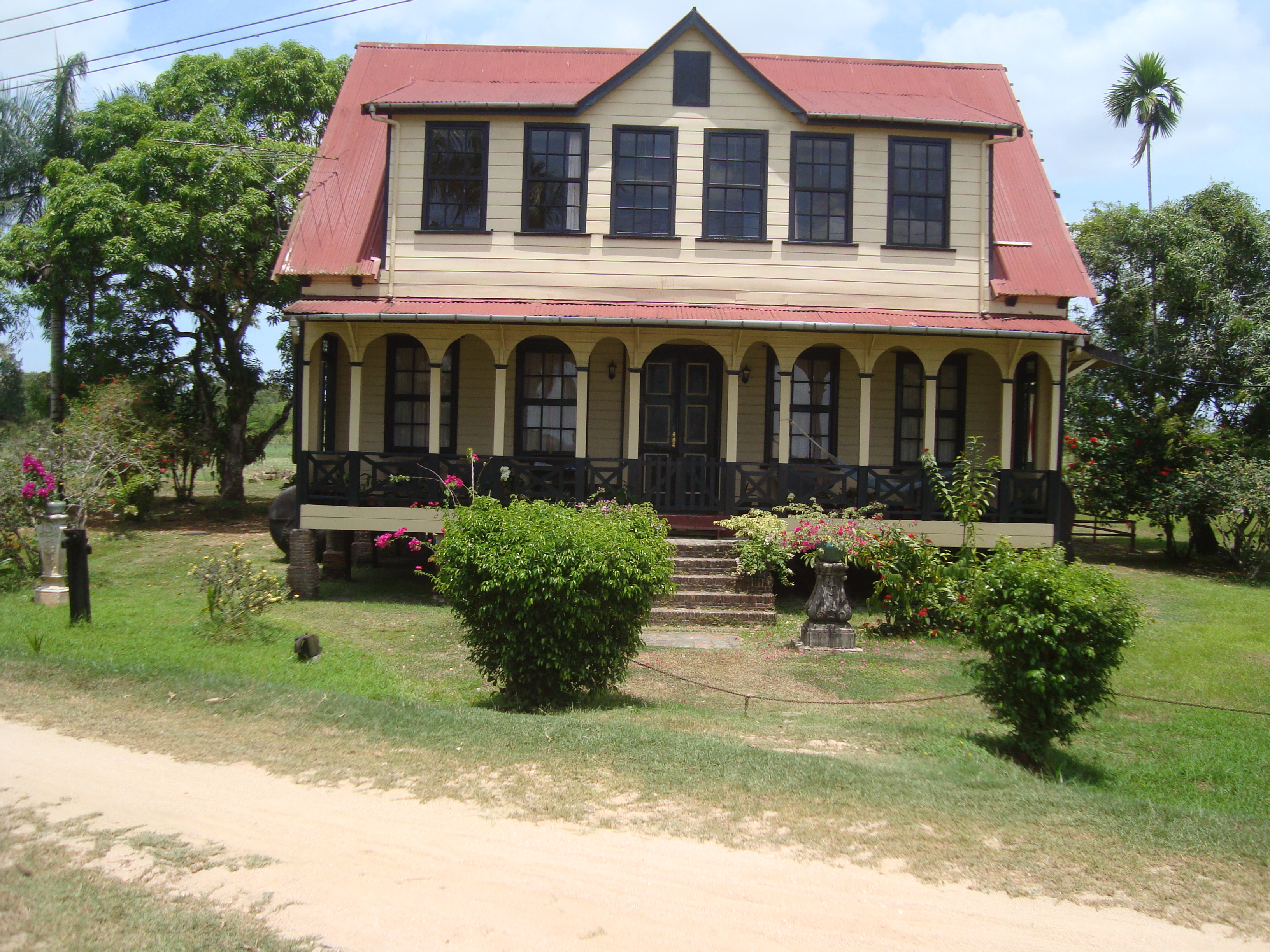
Plantation House
The Fort had a museum to slavery – the end of which killed off the plantations which were no longer viable. In the evening we were asked to go to a local car rally as the subsidiary attraction but we were taken an hour too early so all gave up and went back to the hotel bar.
2 October
Easy flights to Paramaribo and now we and the Elan are seeking a bit of cool in 36 degrees! The car brought some of the UK damp with it and there was mould on the passenger door and rainwater in the socket set in the boot. Car started first time out of the container and the only problem was a broken passenger side wiper blade – we may not need it in sunny 36 degrees – but this is the Rain Forest so can’t expect unbroken sunshine!

Lizard at Fort Zeelandia on the Surinam River
Fort Zeelandia was originally Fort Willoughby – but we lost it!

Paramaribo Cathedral
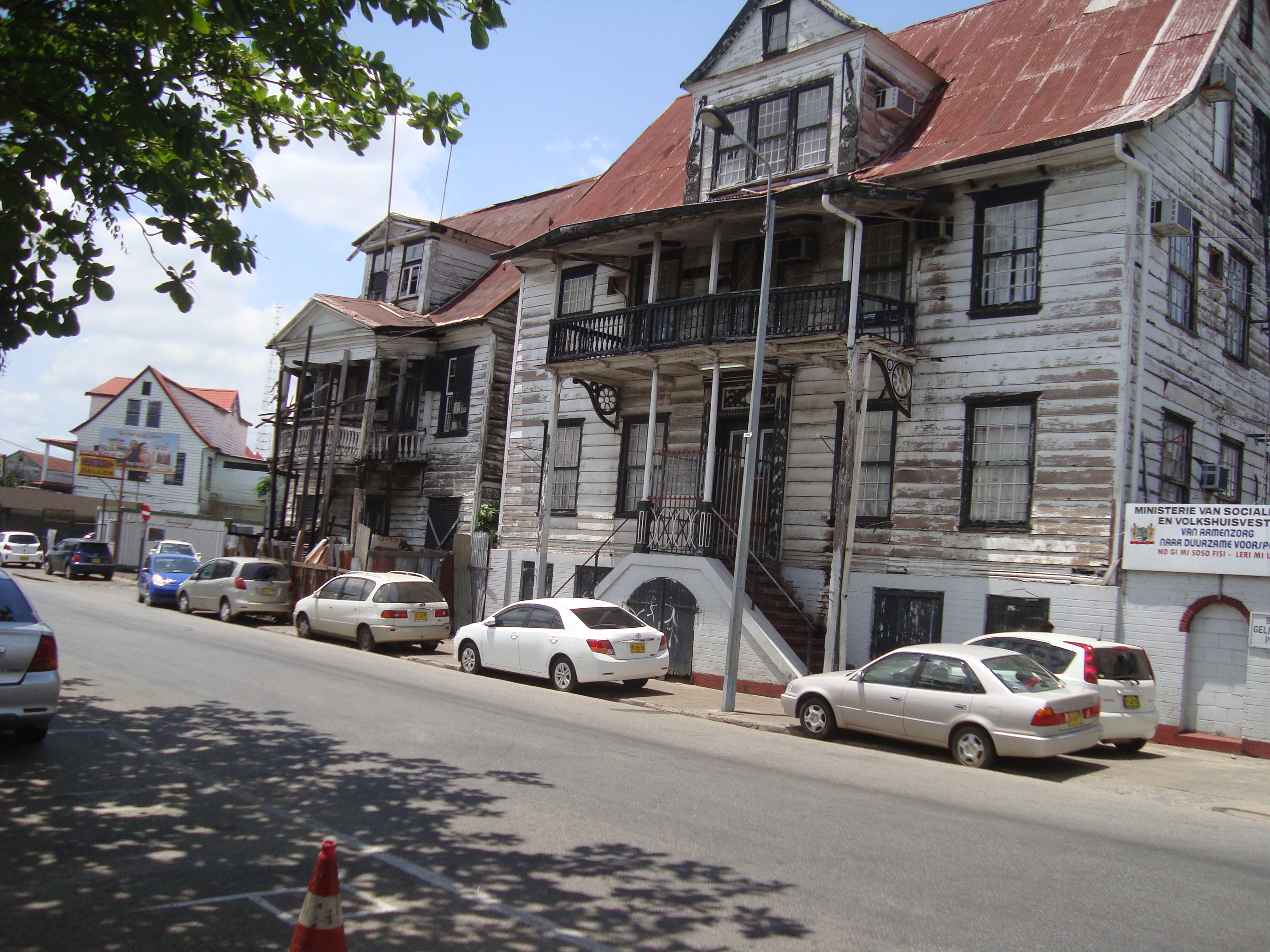
Wooden houses in Paramaribo
The rally has lost another participant so now we are six – the Elan, Mustang a Mercedes 280 and three 4WD – so that’s one tow car for each of us – we have already started farming out our clutter as the 4WD’s seemed so empty….
28 days from Surinam to Peru, 4 countries, the Amazon, the Rain Forest, Machu Pichu, Cusco, the Nasca lines, dirt roads, water crossings and the Andes. And a lot more besides! The Elan is already on its way. From little acorns, great oaks grow and the picture shows the last time we saw the car – the scenery can only improve!
We drove to Thurrock in the pouring rain with 40 limits on the M25 as there was no visibility. After a stint on the rolling road the engine is much happier, mpg is now mid 30’s – maybe it will stop stopping! Quite a lot of work has gone on recently – sump gasket, crankshaft oil seal, gear box to bellhousing bolt and (an odd one) the O ring on the oil pump. With luck the engine should keep its oil inside and be less generous in sharing it all! The rear springs and front suspension are new as are the brake pads and the water hoses. Just to cheer us all up it seems there are only 7 cars on this rally and 5 are 4×4; that leaves a Mustang and an Elan to represent the Classics!
The journey starts in Paramaribo in Surinam, then on to French Guiana. We cross into Brazil and collect an Amazon river ferry from Macapa to Santarem. Then there’s some 2700 kms through Porto Velho and along the Amazon Highway to Puerto Maldanado and Peru. Next stops Cusco and Machu Piccu followed by 1900 kms to Lima, where we end.
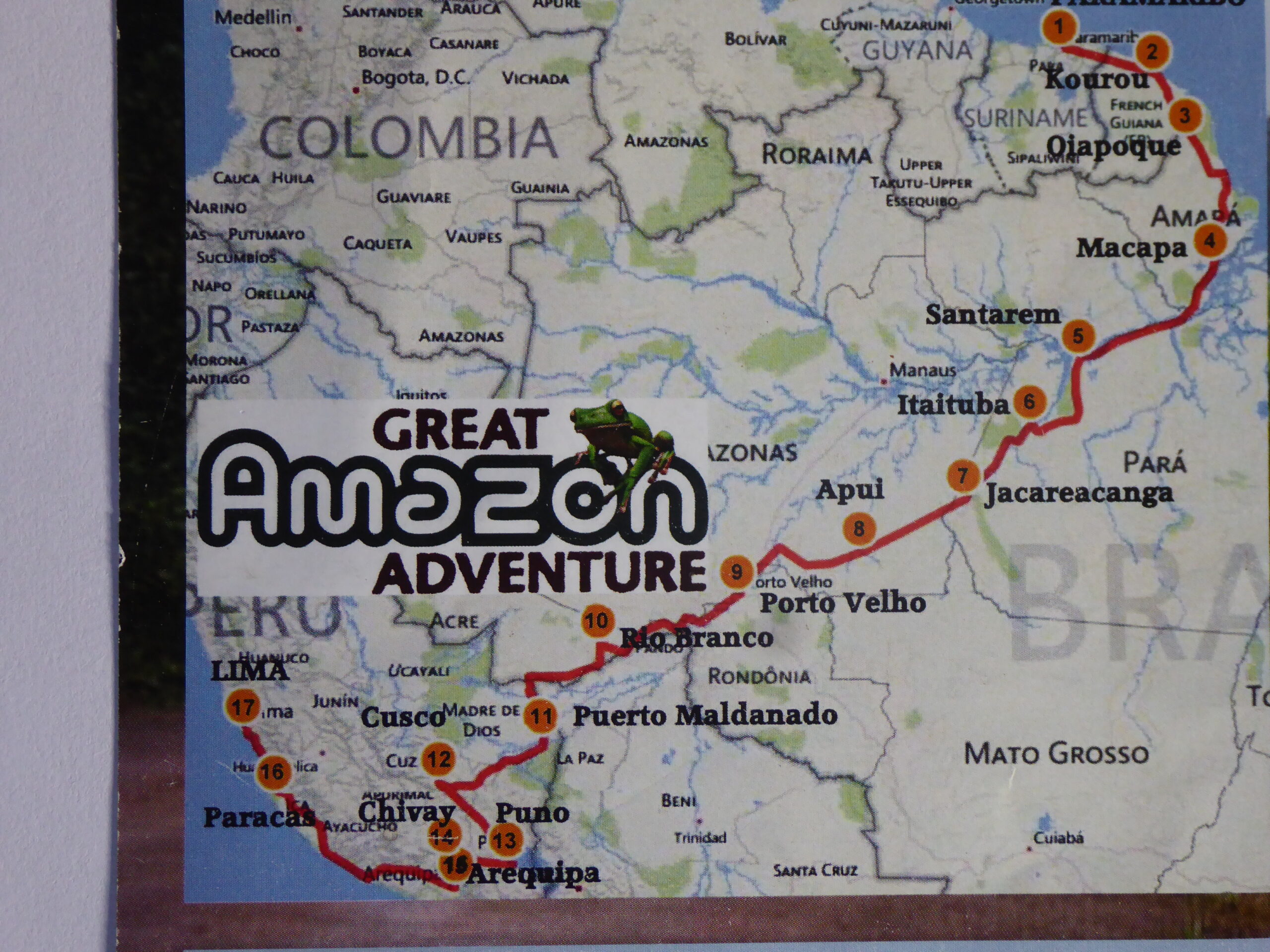
Map’ of the Route
Patagonia East, South, West
Posted by Peter in The Americas on December 21, 2025
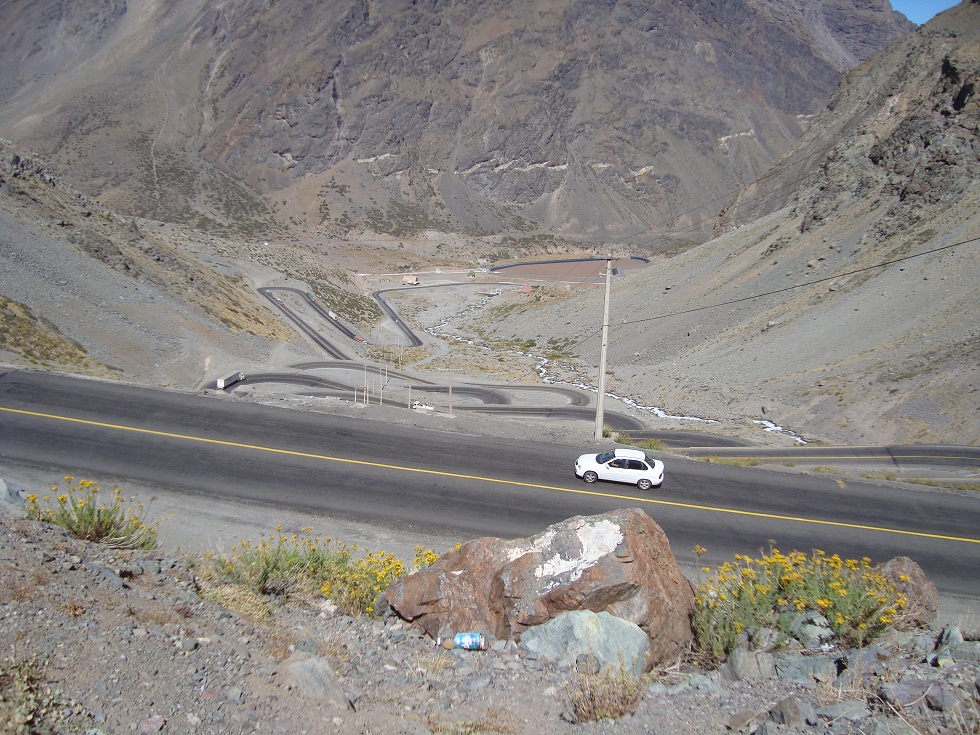
 17Mar – we’ve reached the rally hotel in Valparaiso – End. Yesterday evening the support landrover arrived on a low loader and this morning we heard that Conrad’s Alfa had arrived in Mendoza. We set off earlyish for the border with Chile. Leaving Maipu there was a holdup on the dual carriageway – the problem was a sit-down protest against the national oil company – with deck chairs in the fast lane! A great drive up and over the Andes to 3250 metres with dramatic scenery and the engine seemed fine (hope I can still say that tomorrow!). The border crossing was ok as it wasn’t too busy (we’d overtaken them all!). Roadworks meant there was single file traffic both to and from the top of the pass and we were lucky not to be delayed. Then a run through the cities of Vina del Mar and Valparaiso to find the hotel in the old town with steep narrow streets; again we were lucky that although the GPS gave up we found the hotel. Others must have had a problem as only 3 cars have arrived so far and they arrived 3 hours ago.
We’ve done over 6,100 miles at an average of nearly 29 mpg, we’ve turned the car upside down, put it back on its wheels and carried on driving and problems – very few, replaced a trunnion and solved a starter/charging problem left over from before. They say Loti are sensitive, fragile cars – not true. As for the engine – fantastic, apart from adding a little oil we’ve done nothing to it; not touched timing, points or plugs. What a car!!
 16 Mar – a gentle day all tarmac 430kms. At breakfast we heard that there had been a tremor overnight and Livvy woke to hear the lights rattling. We also saw that Patrick had arrived – at 4am. So all the participants cars are up to speed and running and the two causing concern are the organisers! Conrad’s Alfa may arrive in Mendoza with the mechanics who are repairing it, whilst the rally support landrover has only two gears and may die at any moment.
Our destination was Maipu, south of Mendoza in the wine heart of Argentina so we had to visit an vineyard and the
 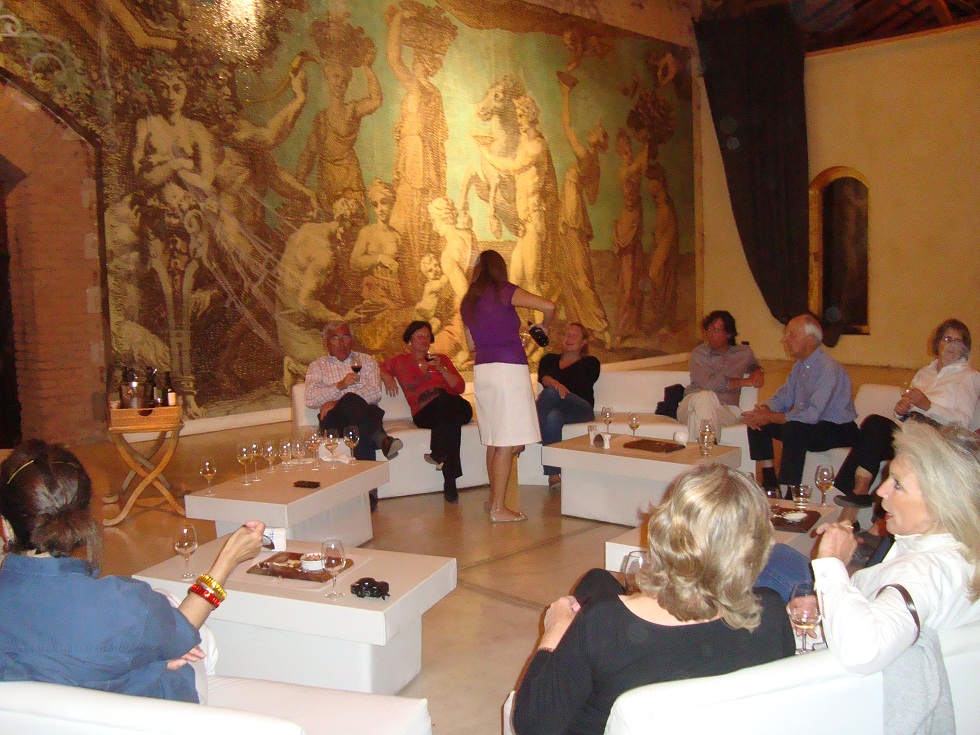 hotel has arranged a tasting session for later this evening. Tomorrow we head for Valparaiso in Chile and on Thursday the docks – end of rally!
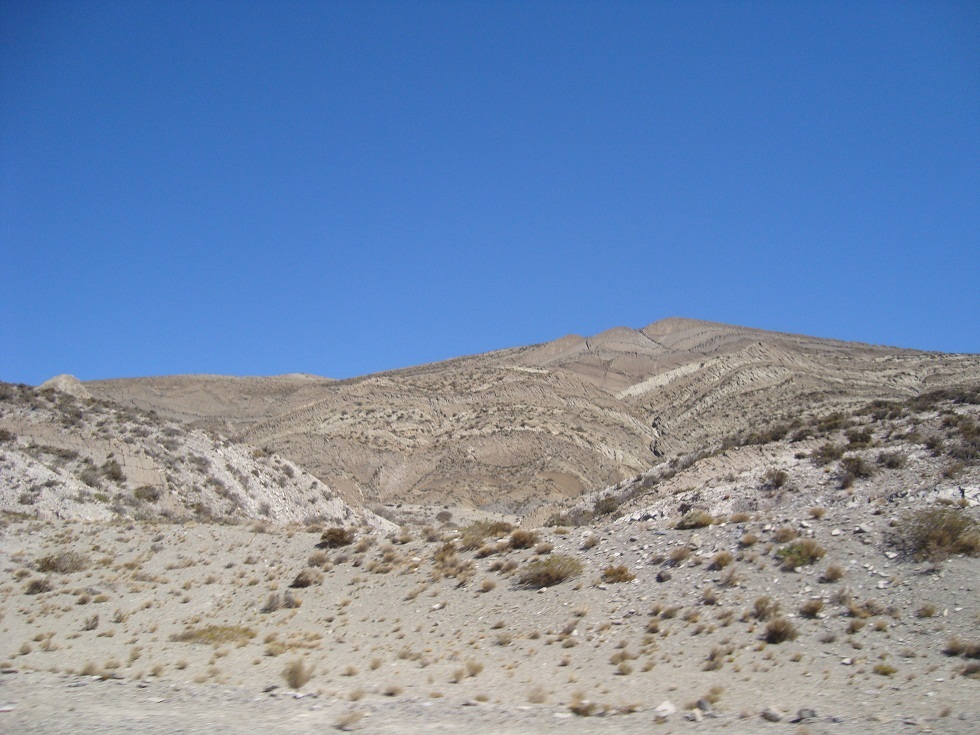
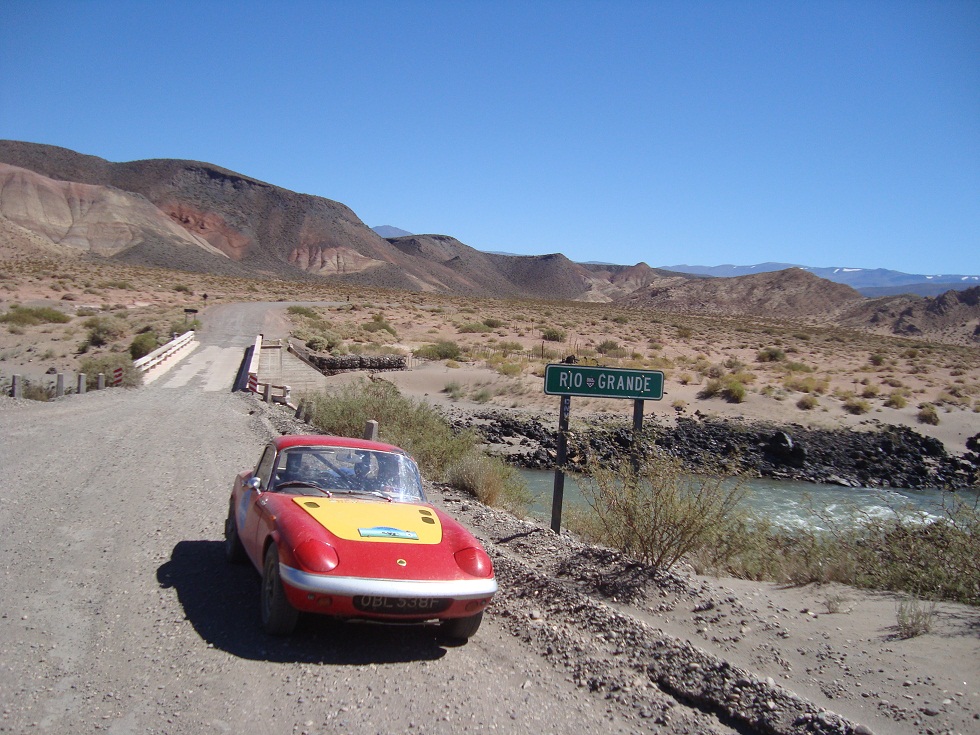 15 Mar – we were now down to 5 cars as Peter/Sue were heading south and Patrick and Conrad’s cars had not caught up. We later heard that Patrick, having solved the wheel bearing problem had set out with Conrad but lack of fuel and a smashed radiator meant that they spent the night in sleeping bags in the car. The landrover did arrive at the hotel but not till midnight.
Our day started with the problems of heading east into the bright, low morning sun (and the perspex screen) so my head was soon out of the window. There were some navigational problems as we were on the detour with no GPS and several cars took wrong turnings. It was a long day and the ripio was dustier than usual and the fastest car took 9 hours for the 560 kms. The landscape was mostly barren rock and we passed numerous old volcanoes and odd rock formations – some looked like slices of bread.
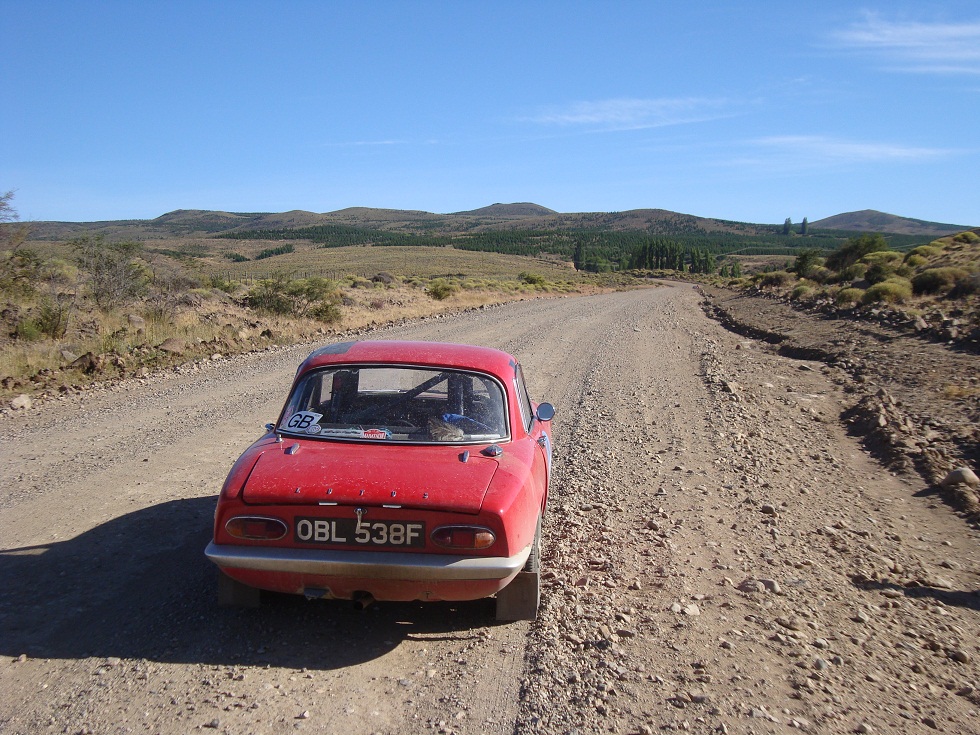
 14 Mar – Another short day 220 kms with tarmac and ripio. Early news was that Conrad’s car was not repairable in the time available as it was still blowing out coolant. Met up with Peter/Sue and Klaus/Maja for a roadside coffee stop on the ripio and later passed a monkey puzzle tree plantation. Our hotel was on a peninsular into
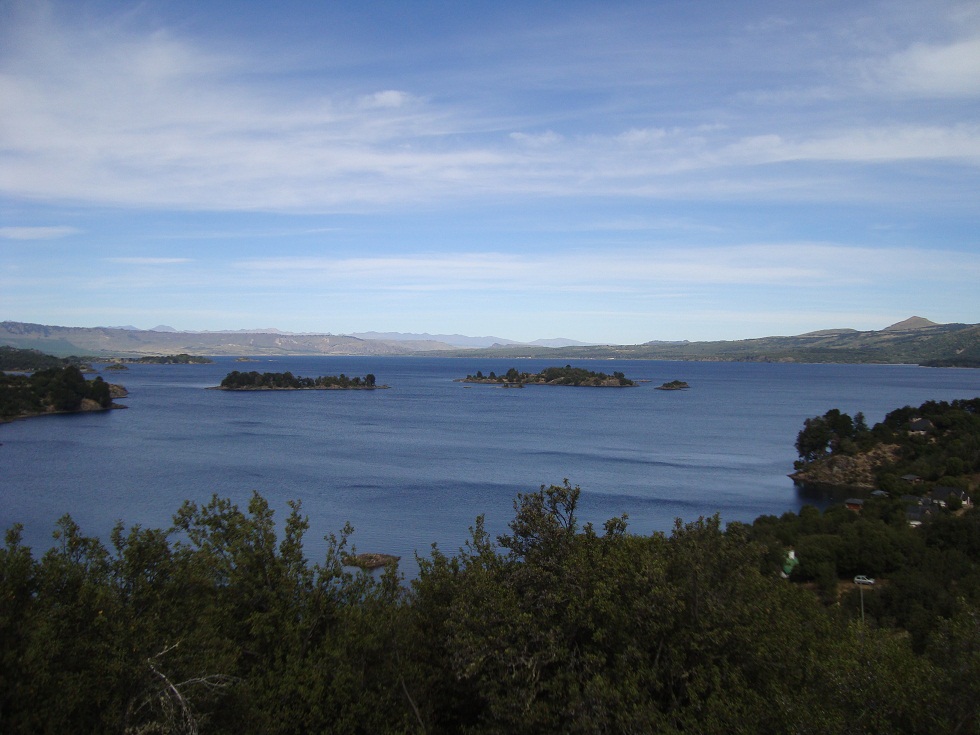 Lake Alumine and our room looked straight out west onto the water – so Allison can have her setting sun. Tomorrow is a long day – 600kms on roads the rally has not driven – this is our detour around the earthquake area of Concepcion.
13 Mar – a short drive 200km to St Martin los Andes but first we heard that they had been working on Conrad’s car till 1am and it still wasn’t working – no compression. The Alfa is similar to the Lotus, Webers and twin overhead cams with a timing chain. I offered to help. We found that TDC had not been identified and after some searching we found the marks on the pulley and on the front cover. Allison found the internet forum and we located the corresponding cam shaft marks; one shaft was out by one tooth so that was adjusted. There was a spark but it would not start and the rally mechanic was convinced there was a fuel problem. We left them to it and set off (hours after the others).
It was the coldest day of our journey and threatening rain as we passed the more-than-usual police road checks and reached Angostura for coffee and cake. Then alongside the lakes on the ripio (poor quality), the scenery less spectacular in the gloomy low cloud. Klaus and Patrick passed by as we stopped for lunch.  Then 2km along the road there was Patrick with the front wheel off. The wheel bearing repair had failed as the bearing was the wrong size. The boss of a road repair team took us into Angostura but it was 3pm on Saturday and everyone was closing for the weekend. The best option was to take the car on a loader back to Bariloche. We resumed our route and were the last in with just a few a few nuts to tighten up.
12 Mar – a rest day in the most impressive hotel in Argentina, the Llao Llao. A late breakfast, a canoe on the lake, lunch by a brook and the afternoon trying to do some (work) work over the internet. Giancarlo’s Volvo needed work on timing and mixture, Patrick’s Chevvy needed a new front wheel bearing whilst Conrad’s Alfa blew its head gasket

 11 Mar – there were two routes to Bariloche, the scenic ripio route through the National Park and the tarmac route. We chose the later and visited Maiten and the railway engineering workshops before having lunch in the “hippy” town of El Bolsen where Allison bought a stone to replace one lost from her bracelet. Our hotel is on the Llao Llao peninsular where we were happy to be rejoined by Peter & Sue, back from England with spares for Conrad and Patrick (but his immediate neede is for the spares they did not bring….! Changed the Elan’s oil filter but apart from that………..what’s not broke, don’t fix!
10 Mar – the first of two gentle days driving with a stop in Esquel and on to Bariloche and a rest day to follow. The landscape was arid Patagonia relieved with occasional oases of green. Esquel has two features – the nearby Welsh settlement of Trevelin and La Trochita –the old Patagonia Express, a narrow guage railway designed to open Patagonia for settlers. 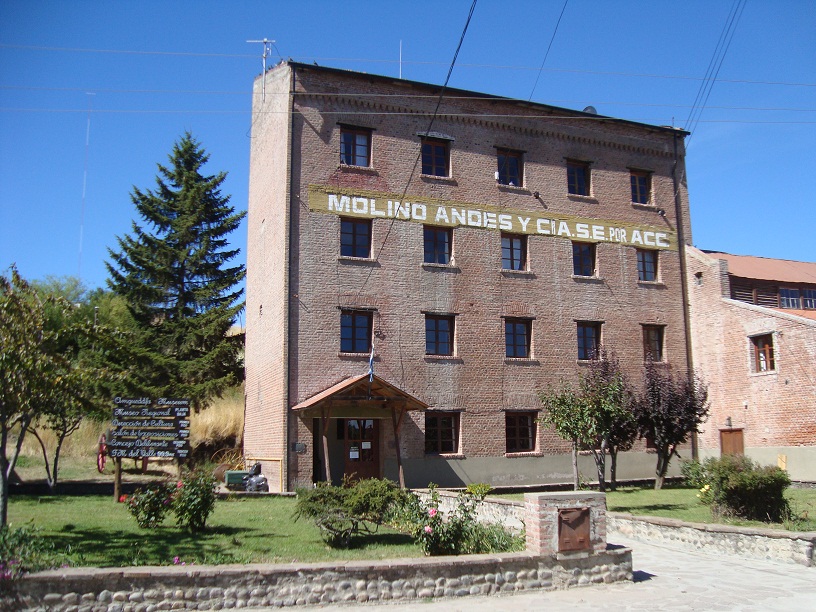 We visited Trevelin for a large “Welsh Tea” in one of the many tea houses and watched the smoke from a “field” fire (they have big fields!) fill the ring of mountains. Others went for the train and helped shunt it round the sidings before putting it into its shed until Saturday.
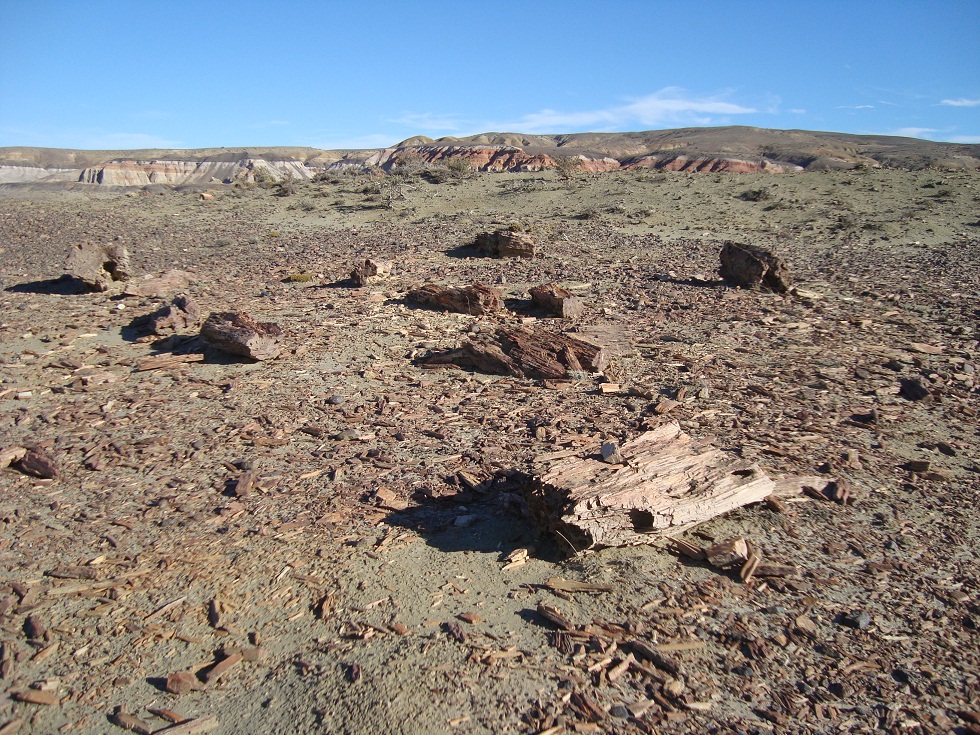 9Mar – 300km due east to Sarmiento. The day started badly with the low sun straight into our eyes making the perspex windscreen impossible to see through. We had scoured Coyhaique for brasso last night – and found a tin. Now in the middle of the ripio we tried using it to clean the screen. It worked to a limited extent – but we made more progress when I drove with my head out of the drivers window! (hair now full of dust). Progress was slow with the lack of visibility and poor surface. We passed through the border and for a moment believed that Argentine ripio would be better than Chilean – not for long and we were soon in 1st gear again. We had the best part of 150km on ripio, generally in 2nd and 3rd gears and 4th only on rare occasions . Towards the end the combination of boredom and a better surface saw us at 50mph – but driving on the sumpguard as much as the wheels! After an unexpected lunch in Rio Mayo where we treated ourselves to a peaceful hotel meal, quiet, cool, dust free we found
 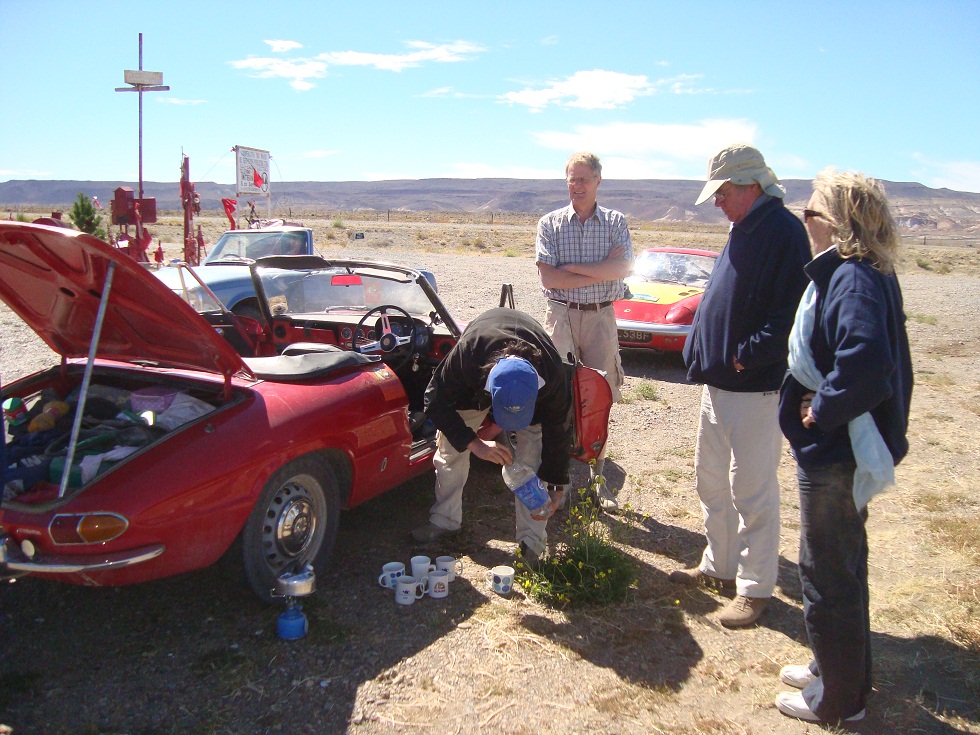 Conrad at the roadside and had tea – what else? We checked the car after seeing the petrified forest; the car was fine apart from the water temperature sender unit which had broken off half way along the morning’s ripio.
 8Mar – a gentle run away to Coyhaique 270 kms, about 2/3 on variable ripio and then some super tarmac at the end as we climbed up to 1120metres from Cerro Castillo and then dropped down to the valley. An excursion to the Cave of the Hands was a disappointment as we laboured over rough tracks to find that the original hand paintings were destroyed by a volcano 20 years ago! Giancarlo had more problems; this time shock absorbers but now repaired. Tomorrow we return to Argentina and stay there until we head for Valporiso to return the cars to their containers.
 7Mar – a rest day at El Maiten on the shores of Lake Carrera. We checked the Elan yesterday and its in amazingly good shape. We’ve now travelled 4,000 miles, used 600 litres of petrol and only 2 litres of oil. Giancarlo got his car mended and reached the hotel yesterday evening. We awoke to rain but by 10.00 after a log, late breakfast it had cleared to give a bright sunny but windy day. A new route has been identified for March 15-17 to avoid the area around Concepcion (hit by the earthquake). Instead we go to Mendoza and from there to Valpariso.

 6Mar – a short day (300km) with a border crossing the Chilean ripio was as bad as we expected but was relieved by the spectacular views of lake Carrera with the snow capped Andes behind; with views like that and a reasonable arrival time you can forgive the ripio. The border crossing was enlivened by the need to get through before a particular Chilean customs official started her shift.
 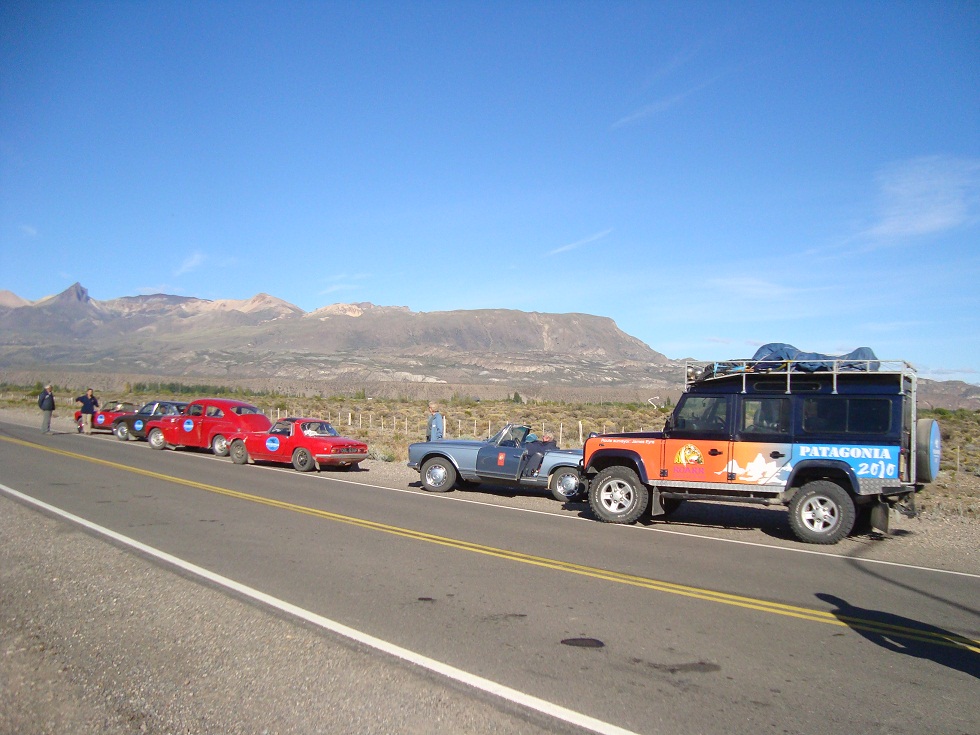 In the entire section of Argentine/Chilean crossings she is convinced that right hand drive cars are not permitted and the helpful Argentine officer told us she started at 12.00. Late news that Giancarlo in the Volvo has a broken wishbone and the car has been transported back to Chile Chico. Tomorrow is a rest day so hopefully he’ll rejoin then.
5 Mar – An early start (6.30) for a long day – and it was very long; nearly 600km mostly on ripio, whose quality varied from poor to bxxxxy awful! The two worst types were where there were mounds of gravel between the tyre tracks, fine for higher cars but just positioned to continuously catch the underside of a low slung Lotus. The other was the hard lumpy rocks which pounded the front suspension and at least one wishbone bush needs replacing. It took 11 hours, the landscape was bleak and as hard as the track. We stopped for coffee 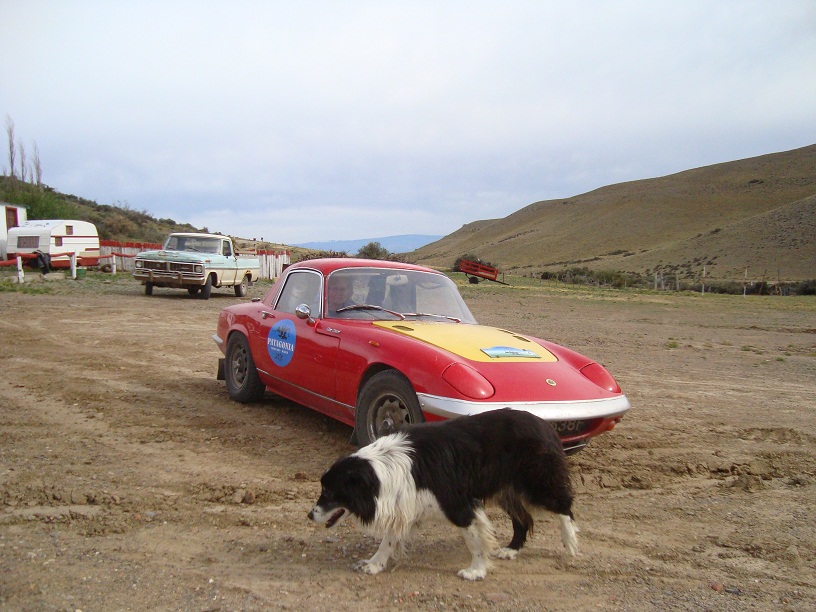 at “Siberia” in the middle of nowhere and Allison insisted that this collie photo is included – there are collies everywhere and she’s missing ours. At the end of the day we crisscrossed the brand new ribbon of tarmac but looking was as close as we got. The Estancia we stayed in looked run down, power was from a generator, the welcome reluctant but a small group meal with copious bottles of wine made for a good end to the day.
4 Mar – a gentle 300km mostly on good tarmac on Ruta 40 (Argentine equivalent of route 66). Time to stop to see some cave painting (not worth the exorbitant charge), for photo opportunities and a civilised mid morning coffee and cake with Livvy, Denise and Robert. The petrol station in the small town of El Chalten was occupied by 5 rally cars when we arrived, waiting for the promised 2pm opening – which it did! We had restricted ourselves to 60/65 mph so the car was happy and I used sunglasses so there was no glare from the perspex windscreen.
In case you wondered what an upside down Elan looks like – its this! (thanks to Cathy for the photo as we were otherwise occupied!)

March 2/3 – a gentle run from Torres del Paine national park to El Calafate and the world’s largest glacier – Perito Morino………..err no!
About 50km into the day’s 400km run, Allison misjudged a corner on the ripio, lost the rear end, slewed across the road – and we ended up on the roof in a ditch. Its very disorientating hanging from your seatbelt, trying to work out how to sit on the inside of the roof, switch off the engine and open the door. The passenger’s door opened and I crawled out, the drivers door was trapped in the ditch so I had to pull Allison out of the passenger’s door feet first. We were unhurt, not even a scratch.
We started to remove stuff from the car because petrol was dripping from the fuel cap and we couldn’t get to the battery as the entire boot would empty first! Patrick, Rod and Cath appeared in the Chevvy and we unceremoniously righted the Elan – none of this gentle lowering of the suspension, it was roof, side upright. Everything looked ok, the wheels were all vertical, undented, no oil had leaked out so we repacked everything, started the engine and continued. Ok we had no windscreen, both door pillars were broken, there was a large hole in the roof (where my head might have been?), the passenger’s door had split in two and the lower hinge broken and the side of the car a mess. We drove on to the border where we found the support crew who applied lashings of ducktape.
Progress was slow as I was terrified of losing the rear screen. We did the remaining journey at 35mph through some howling winds, both dressed in fleeces, windproof jackets, hats and gloves – and were still cold. In El Calafate, we were able to find a glazing company who agreed to take the car next morning and fit a temporary perspex screen.
 3 Mar – we dropped the car off and took a hire car to the glacier – tourists for a day. This huge glacier is the reason this town exists and is spectacular; the 30 metre high vertical cliffs of ice stand out into the lake and periodically pieces crack and collapse into the water sending slow surface waves and more substantial ones underwater so that more distant shores feel the swell but with little visible cause.
We picked up the car and found a new screen – noisy and with distinctly imperfect vision when driving into the sun – its better than no screen at all – the car rolls on………….

 1March – a rest day after the group meal last night. Time to check the car, give it a quick wash – there was dust everywhere – then a wander through the park – to a waterfall, watching the reflections of the mountains in the now still waters and listening to the sounds of avalanches from the snowy peaks above us. So quiet and unbelievably spectacular scenery made for a memorable walk. The hotel had a very rickety wooden ramp for cars so put the Lotus up on part of it for a gearbox oil check but as it looked a bit doubtful took it off again.
28 Feb – no grease gun so plan B and by 9am we were on the road. We had been told of a classic car museum just off our route between Punta Arenas and Puerto Natales. We thought that maybe they’d have a grease gun –they did but the nozzle was too big and we ended up with a puddle of grease. We carried on. There was a strong cross wind and keeping the car in a vaguely straight line at anything over 60 mph was very difficult. Leaving Punto Natales our GPS was confused by the in/out routes preloaded and intended to give a circuit round the Torres de Paine National Park. We found the correct (anticlockwise) track and moved from Tarmac to ripio – couldn’t stop laughing at the sign “incipio ripio”. The park is a mixture of mountains and lakes and our hotel was perched on a small island in lake Pehoe.

27 Feb – woke up early thinking that there was a one hour time shift between Chile & Argentina so maybe the 14.00 boat was actually 13.00 – no the time shift starts on 14 March. The run was easy, borders quick and ripio good so we arrived well before the ferry sailed. Two cars elected to take the longer route with a normal start time – but no-one knows where the landrover with the mechanics went. Television news is of a major earthquake in Conception where we are due in 16 days time – the organisers may need to re-route…….
Checking the car found that the near side trunnion was worn – fortunately we carry a spare – but incredibly no-one has a grease gun and all the car spares shops are closed…..plan B is take it apart and apply grease by hand.
26 Feb – rest day in Ushuaia.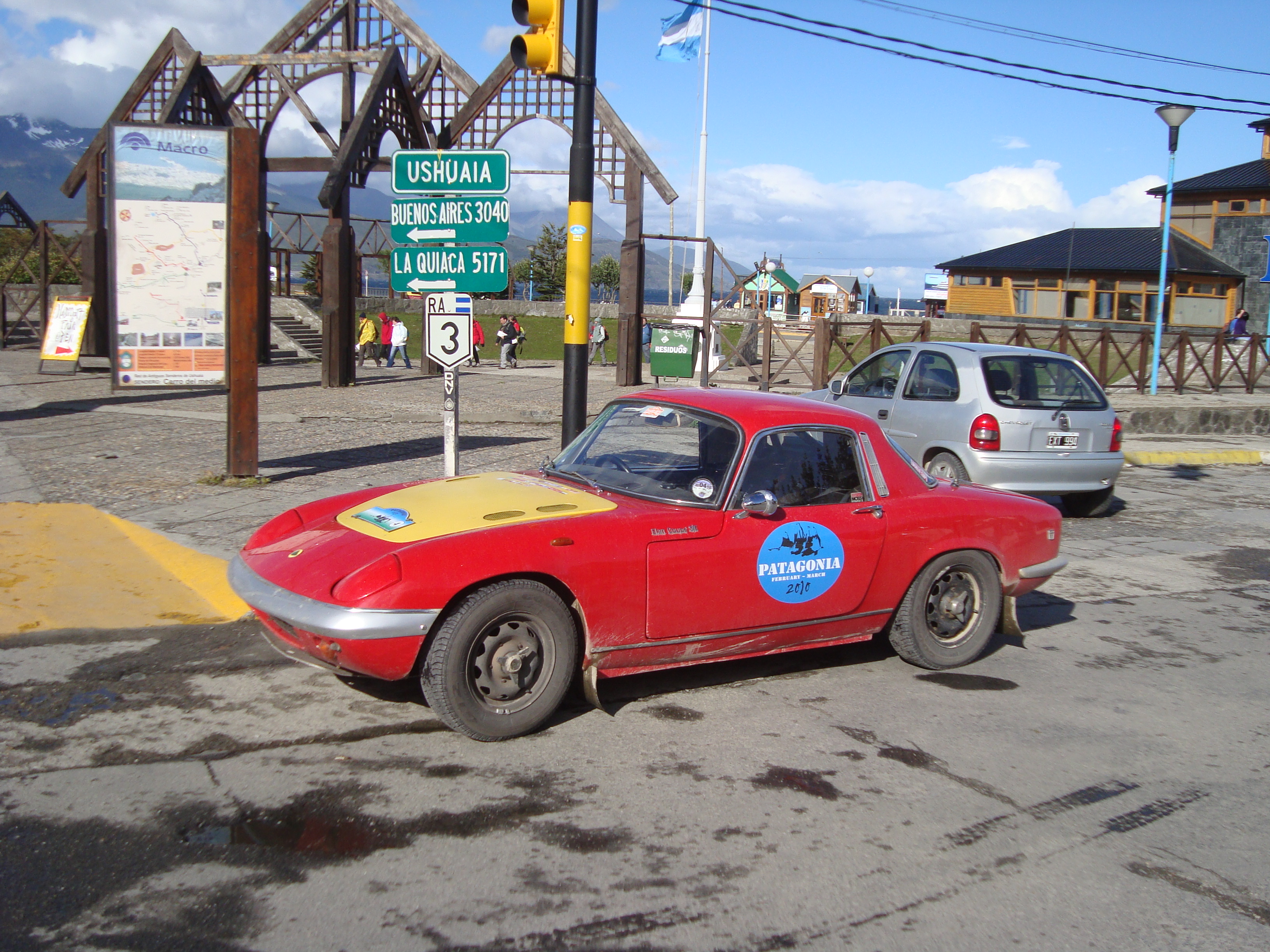 A boat trip along the Beagle Channel in the morning followed by the museum of the End of the World and civilised lunch. Then another museum – housed in the old prison. Early night called for as we get up at 4.30 tomorrow to catch the only boat of the day at 14.00 and to get there we have one border crossing and 450 kms with 150 km of ripio – more dust!
25 Feb – Ushuaia and the end of the world and we are there! The day started with a rammy over an early breakfast and by 7.15 we were all on the road heading for two border crossings, 120kms of ripio and a total of 600 kms –  and a ferry across the Magellan Straits. Now sitting in our hotel bedroom looking south over the
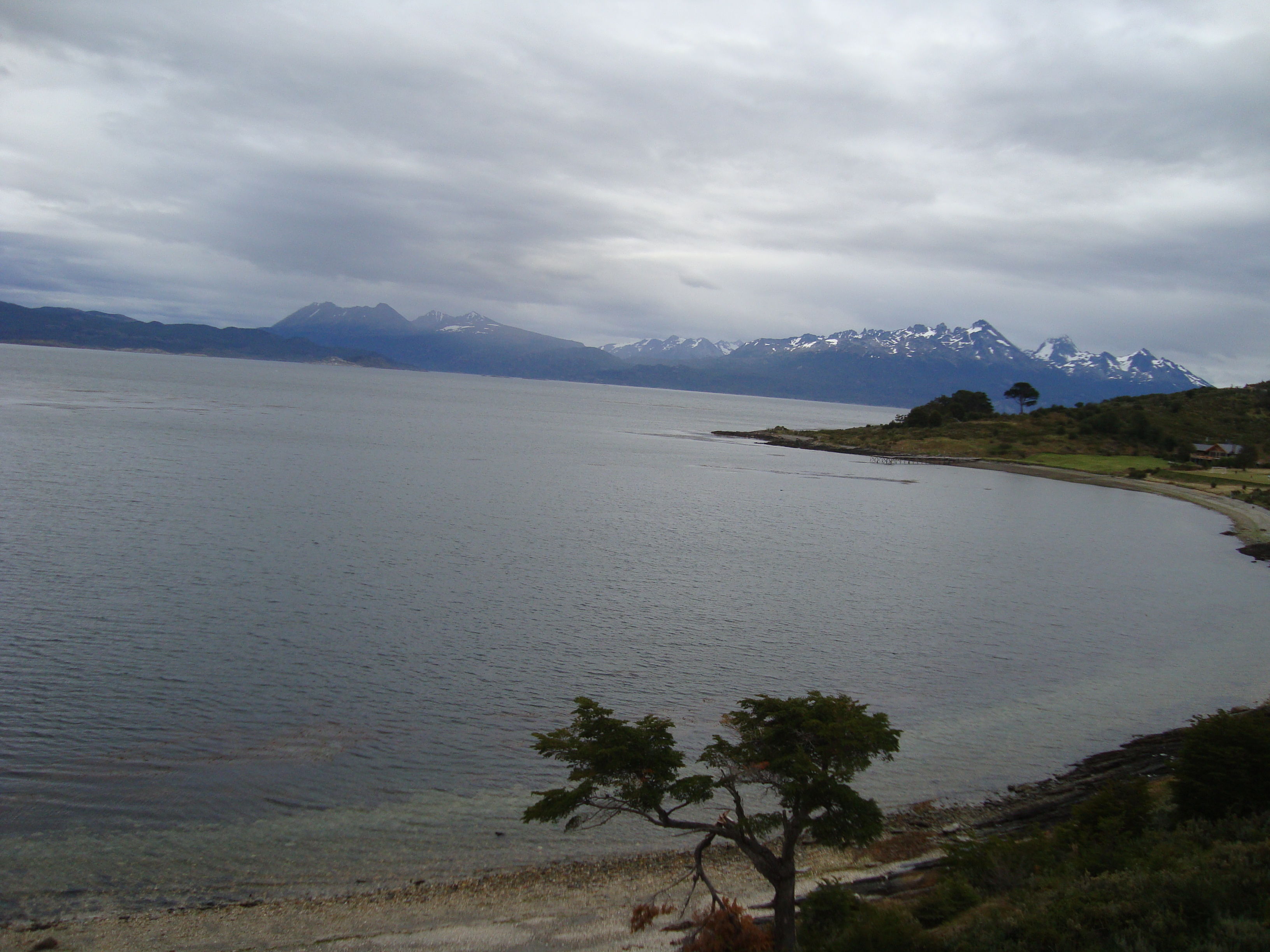 Beagle Channel towards snow capped mountains and way beyond that the Antarctic. The car is full of dust as we are but both it and we are in one piece, despite our best efforts to shake it to pieces at 50 mph on the gravel. (Argentina has better gravel standards but Chilean border controls are more efficient!) Tiera del Fuego is surprisingly
 green with trees and lakes and jagged snow topped mountains – what a contrast from the flat, dry and desert-like mainland
24 Feb – no news of petrol so we set off in an early group of 4 cars; we had as much fuel as anyone and easily reached the filling station 120kms away.  Allison has a thing about penguins so we left the main road and onto the ripio to find the 4th largest colony of magellan penguins. Car was fine and I was happier as I’d tweaked the voltage regulator box again (the setting from Feb 21 produced a very hot battery and cooking batteries is not a good idea!). Then an easy run into Rio Gallegos – a town founded by English settlers in the 1880s.
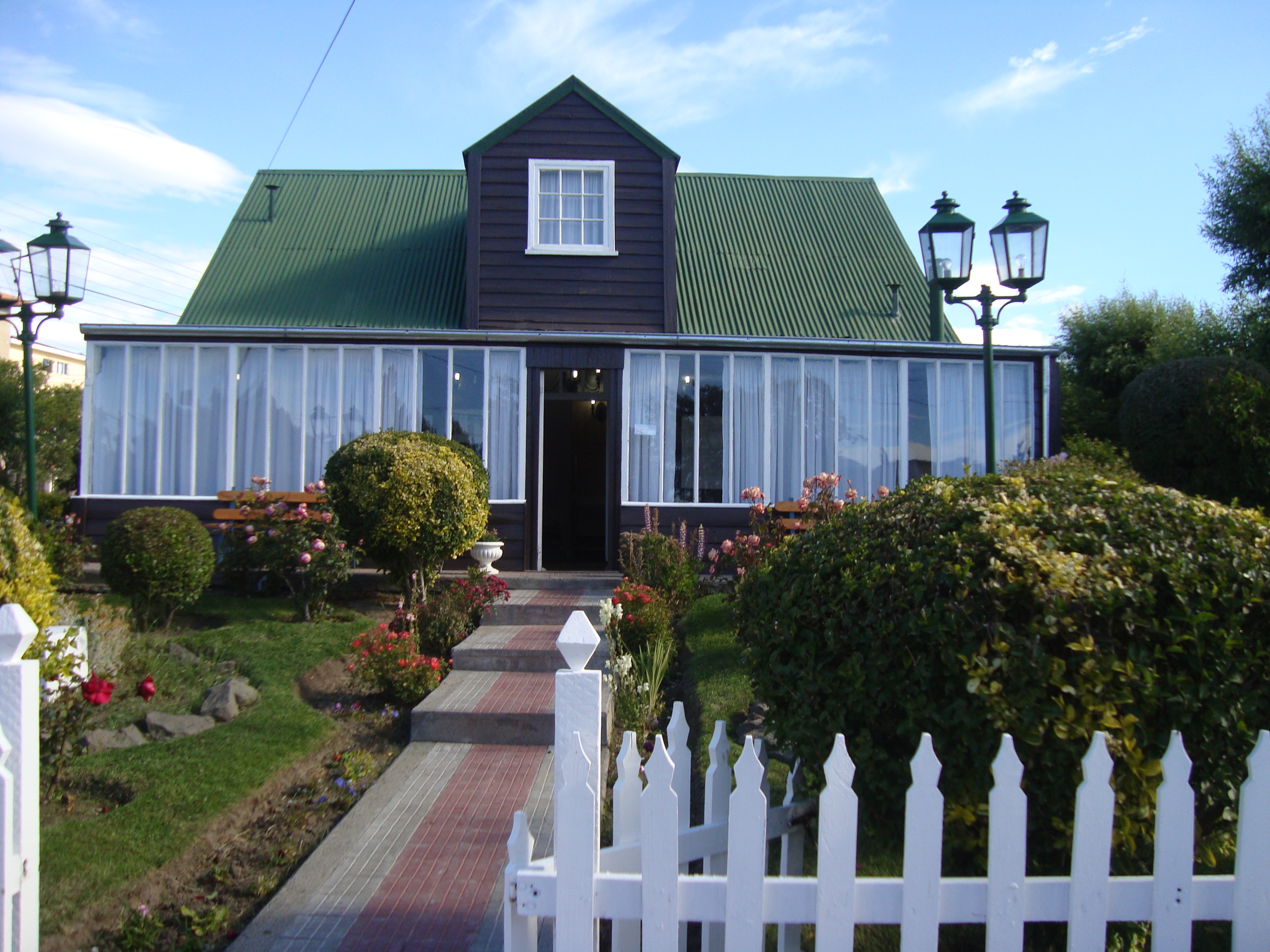 En route we fell off lovely tarmac onto rough and dusty gravel and the car complained – nasty squeaks from the back end. The shock absorbers have become weak and the noise was the springs grinding against dust – we live to drive another day!
23 Feb – now that we’re further south its cooler and windier. For most of the day we were driving into a strong headwind – so strong that at times it was difficult to stand up. The landscape is ever less hospitable and more like barren desert. Our route was through the oil area with nodding donkeys to one side and the Atlantic Ocean on the other. The land is sparsely populated so fuel stations are few and far between with the result that we stopped more often to keep the tank full. 50 km off route was the remains of a petrified forest with trees 140 million years old; 
we were the first visitors of the day but one other rally car made the deviation on the (gravel) ripio – it was worth the trip, the landscape was spectacular, what the moon should look like with almost no vegetation, a dried up lake and an extinct volcano.
Returning to the main road the only filling station was short of fuel and rationed us to 15 litres – easily enough to get us to the overnight stop. But there we were in for a shock. The are 3 filling stations but none had any petrol – its due in tomorrow…………
22 Feb –  600km to Comodoro Rivadavia passing the Welsh towns of Trewlew and Gaiman. Trewlew had a power cut and Gaiman seemed to be largely asleep – there are plenty of Welsh tearooms – but all are closed in the mornings. The only bank refused to change sterling for Pesos – US dollars only. Then a long haul south through an ever more desolate countryside with less and less vegetation to the oil town of Rivadavia.Car now starting and charging happily – now its drinking water – someone said we were driving too fast…………what’s a Lotus for? It is a little unhappy on the open roads where the ruts and wind deflect it. Also on the ripio where the heaped gravel catches the underside and can give unexpected changes of direction.
21 Feb – a rest day so time for some tourism and our first taste of ripio – well graded gravel – but slippery and with ruts which can deflect an Elan. It had rained hard last night so some roads were closed but in the morning there was less dust. 
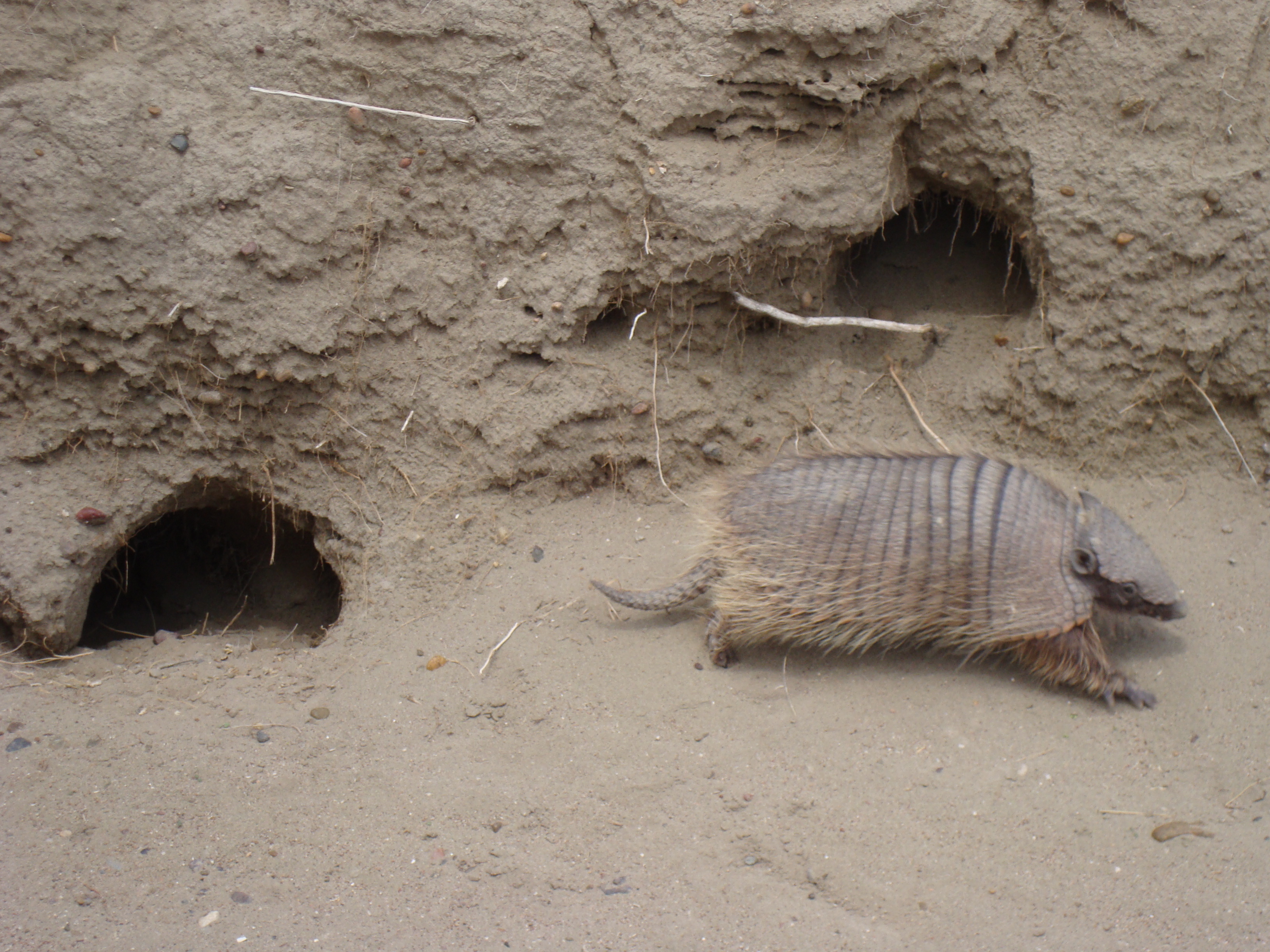
 We saw penguins, elephant seal cubs, sealions, armadillos, foxes, hares and rhea plus plenty of birds. I should add that the foxes (wild animals in a nature reserve) were waiting outside the kitchen of the café awaiting the chef’s whistle for scraps whilst the armadillo was searching the car park for crumbs). The rally has now regrouped but we’re down to 6 cars plus the organiser’s – and 5 of them are red! The car started every time today and the battery is charging nicely (I thought too nicely at times – burning out the dynamo by over doing it would be a very bad idea).
Some statistics – fuel costs less than 50p a litre and we are doing 28.5mpg (just to keep the units inconsistent). Updated mpg to allow for larger tyres)
 20 Feb – an unexpectedly short day as we were now 180km further east than planned. It was just 320km to Peninsula Valdes – a nature reserve with whales, sea lions, shunks and penguins – though the whales are absent at this time of year. The car started every time – so maybe there was a starter problem and now it’s a charging problem…….
19 Feb – we woke at 6.15 for an early breakfast and a long day – 710kms and it was raining. – heavy rain. The car started so that was good but progress was slow with the combination of the rain and the ruts. Our route was west to Bahia Blanca before turning south to Carmen de Patagones. Things went wrong at the first fuel stop when the starter did – nothing, we were travelling with Klaus and Maja who helped push. At the second fuel stop it was the garage owner who pushed……………..problem not solved! The roads were straight and the scrubland went on seemingly for ever. There were periodic road checks to prevent the movement of fruit and meat and at one of these, just 150km from our destination we were told that the road ahead was blocked as two bridges were down – one featuring on the front page of the newspaper. We turned round and faced a 700km detour if we wanted to get to the night’s hotel (we decided to pass on that). Klaus and Maja had now joined us and we set off back the way we’d come. As we went we “collected” all the other cars except for Patrick’s. The one person we couldn’t get hold of was the organiser!  We reached Las Grutas after a hard and fast drive and the rally Doctor, who speaks Spanish, arranged hotel rooms for us. It had been along day and a beer was called for!
18 February
The minister of tourism flagged us off on time and after a stop go exit from Buenos Aires we made good time until stopped by police because we did not have out headlights on. Lots of document scrutiny and then off again past many other police checks. All went well until after our lunch stop when the starter motor went on strike just like Morocco. We really thought we had cured it. Back to bump starting and after that it gave no trouble. Balcarce, the birthplace of Fangio, was the overnight stop so we visited the well presented museum to him. It also has a large collection of run down Art Deco buildings. What to do about the starter motor? I found that the shaft was loose – so maybe the problem was that in certain positions there was no electrical contact. The Argentine rally mechanic took me round the town looking for a bush, then some emery paper to sand it down to fit – whilst all the while the car was sitting on some garage ramp. Total cost Ps 24 (about £4) – here’s hoping!
17 February
It took 5 hours to get the car from the port today but we were lucky as 2 cars coming from Genoa took 9 hours because they were not started upon until those from the UK were cleared. The car started first time but the exhaust must have been knocked as it is a bit noisy. We did manage to fit in a visit to a modern art museum and some tunnels under a Jesuit church.
 An unusual street scene is the Dog walkers – they take dogs for walks (obviously!) but not just one or two!
16 Feb
We arrived in Buenos Aires late Sunday 14th. Looking for currency exchange on Monday morning we saw a Lotus 7 and rushed over to say hello. Carlos explained that he’d owned it for 5 months and had broken down and was waiting for a tow truck – not a good omen!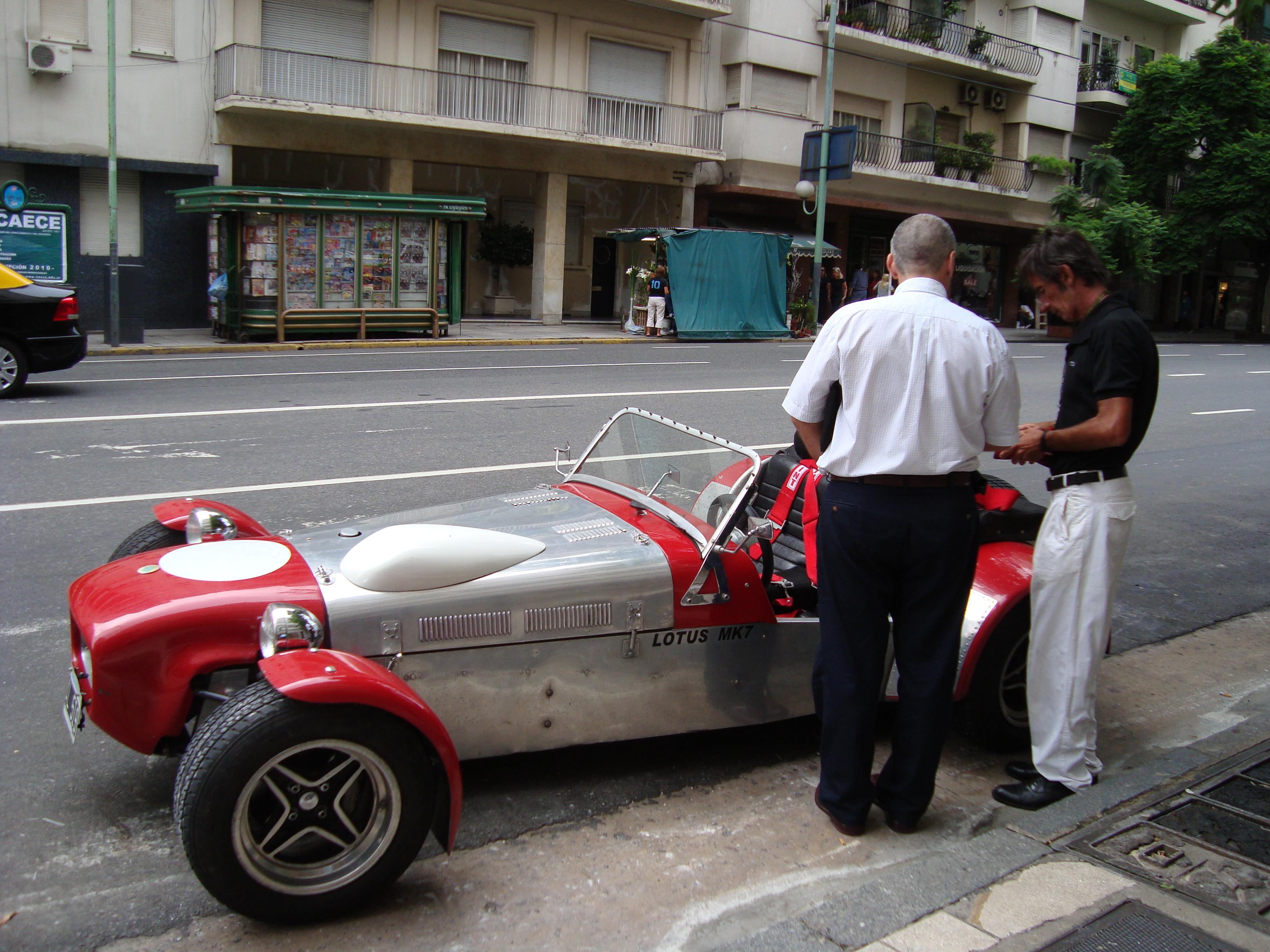
We’d been told that we could get the Elan out of Customs on Monday, then Tuesday morning. Tuesday afternoon was spent on paperwork and we hope to see it on Wednesday prior to leaving BA on Thursday morning – though as the Minister of Tourism wants to flag us off we can’t be sure!
5 Feb – updating the technology! Now a new laptop so hopefully we will have the means to report progress.
The 2009 Casablanca Challenge required more repair work than we had expected before we were ready for Patagonia 2010. There was damage to the passenger’s door which had to be repaired and then resprayed and to the footwell – but that has had to wait till later. The major problem was electrical – the starter failed in Morocco but even a new battery, new starter and a thorough check of the electrical supply didn’t help. We had to return to a repaired old starter and a new Optima battery which proved to be a better combination.
Casablanca had consumed points/condensers like never before so there was a new distributor and a reduction in the dynamo cut-in voltage which we hope will help – though in truth we don’t know why so many points burned out so quickly.
A new` differential output shaft, seal and bearings were required – along with a clean-up of the rear-end which was coated in the oil we’d been leaking for the past 1,500 miles. There was a brake squeal to attend to and new front wheel bearings. Then with the MOT a day away, the wipers failed – there’s an underlying electrical problem somewhere that wasn’t there before and I haven’t found it yet.
It passed the MOT and on 18 January we dropped the car at the container terminal and hopefully we’ll see it again in Buenos Aires in February.
Route 66
Posted by Peter in The Americas on December 21, 2025
2 November, the day started chilly then it rained – not a good day to visit Newport CA and Balboa!

Lucy on a wet and deserted Balboa Beach

Balboa may look pretty in the summer sun
We walked on Balboa Peninsula beach and it gradually stopped raining and got passably warm.

Bird of Paradise plant – Lucy does horticulture

Warmer now at Huntingdon Marina Beach
Then up Highway 1 to Huntingdon Marina for lunch, a stroll on the beach and then to Los Angeles Airport where Lucy packed and was last seen heading off to airport security. Tomorrow I take the car to the shippers and fly back. Not sure when the Elan will arrive as its currently booked as “awaiting a share” for its container. We have done over 8,000 miles without losing any time on the road apart from one fuse. All the other mishaps have been identified in the car park/garage. Its running rough, though tick-over and starting are fine. Various things need attention – guess where I’ll be over Christmas!
1 November – a short day only about 80 miles. First stop was the Getty Center

Getty Center
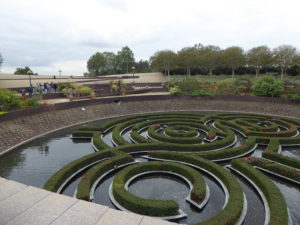
Getty Gardens
(actually the slow freeway but we’ll gloss over that – traffic in the LA region is awful). I was geared up for sun but it was chilly and overcast. we visited the Central Garden where Lucy carelessly assumed that the Garden Guide would know about plants – but as the original garden designer knew nothing about plants why should the Guide who was more interested in the artistic combination of colour, shape, texture, size than what the plants might be?

Lotus meets Queen Mary

Queen Mary – the deck
Our next stop was the Queen Mary – we had crossed the Atlantic on this ship in 1956 or so – a visit was mandatory; Lucy was thrilled that her memory of the childrens’ play area was correct.

Engine Room

Engine Controls
As a sign of changing times we had coffee and muffins at Starbucks on the main deck! That was it for the day so on to our motel (very down market for Lucy’s taste). On the freeway (at dusk), a fuse blew and we lost the camera, fuel gauge and more importantly the TomTom – as we had little idea where we were or where we were going this was bad news. Fortunately it was just a fuse and once replaced, normal service was resumed – phew!
31 October – where did the day go? We didn’t leave our hotel just west of Yosemite that late; our route was to the southern exit with a detour to Glacier Point – it required a lot of climbing as Glacier is 3000 ft above the valley floor – which is why the views are worth the 32 mile detour

Misty morning above Yosemite

Above Yosemite

Looking down on yetserday’s waterfalls

Half Dome, dead tree and Dutch Admirers!
Then a slow descent through roadworks and a long run into Fresno. We grabbed lunch in the ten minutes before the café closed at 2pm; Fresno seemed dead and its only claim to fame was a memorial to the Lao people who fled the incoming Communist regime after the Vietnam war. A long fast run (interrupted by traffic jams) to just outside Los Angeles where our cheap motel is extra security conscious – its the only place where we have both been required to show ID and our passports scanned to the LA Police. The local fast food restaurant also needed ID before serving beer – Lucy didn’t have hers but mine seemed ok for both!
30 October – a day in Yosemite;

Its a big place

Vernal Falls on the way up
we climbed to the Nevada Falls, passing the Vernal Falls on the way.

Nevada Falls

The top of the Nevada Falls
Our descent was confusing as we followed the “easy route down” – the John Muir Trail, which went uphill in a series of hairpins before eventually turning into a gentle in contrast to the steps on the way up. Someone had invested heavily in the footpaths, building them rock by rock up the hillside.

Nevada Falls from Clark Point, John Muir Trail
The walk took us nearly 7 hours in moderate temperatures.
29 October – Yosemite! We set off from a dull Petaluma onto Highway 101 and over the Richmond Bridge – a two tier structure with eastbound (us) underneath and westbound on top – looks good though!
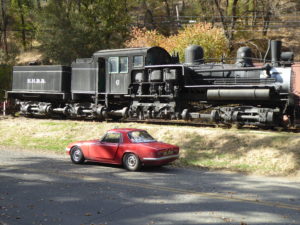
Loco #6 of the Hetch Hetchy line
We had to climb to about 3000 ft over a ridge to get to Yosemite and the car got hot but not too hot; I had already swopped my shoes for sandals – we had found the sun we had come south for! First stop was a post office to post some cards – and conveniently there was a 1920’s stem loco waiting to be photographed! I was aware that on this trip to USA I had failed to take a photo of that workhorse of the westward migration.

At the gates of Yosemite
Then to our hotel, just outside the National Park (inside costs a fortune whilst outside is merely expensive). We had coffee and cake on the balcony before visiting the park to take advice and plan tomorrow’s trip- now that I have a steam loco photo, I am missing a waterfall; we visited one
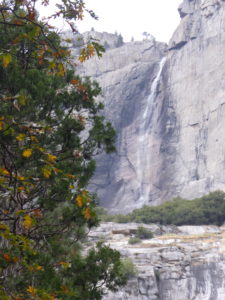
Great waterfall but its bone dry!
(the Yosemite) but it had dried up – no rain! The valley is formed of a flat floor with tall pines vying with each other tto reach the sky and high steep cliff sides, some with waterfalls and others with groups of shrubs and trees clinging on in desperate search of life. The autumn colours (late this year) add another dimension. 
Our early evening stroll gave some great sunset photo ops – how about this one of

Sunset on Half Dome
Half Dome or the clouds over the western entrance?

Skies over the western entrance
28 October – another slow start with a drawn out breakfast at 9.00 and a walk round a very cloudy Westport so we didn’t leave until about 11.30.
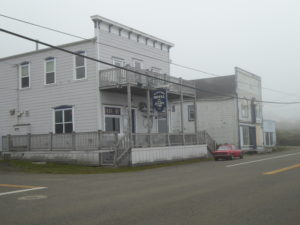
Westport Hotel
Westport had been a logging port in the 1890’s with timber jetties extending far beyond the shoreline to enable the logs to be loaded onto coastal schooners for onward shipment. All that construction is long gone – a pattern repeated along this section of the California coast.

Laguna Point – 100 years ago this was a timber jetty with tramways
At Fort Bragg (our intended overnight stop from yesterday) Lucy dragged me round the botanical gardens. Then on south chasing the elusive sun which showed briefly at around 2.30 for half an hour. At a fuel stop we came across two people who had owned Lotus in the past and gave a reminder of how little interest the car has generated; (in a village 14 miles earlier a motor cycle loving garage owner had suggested we didn’t buy his “regular” gas as the next stop had “premium”) we also saw a frog eye sprite (“bug eye” in American) who waved enthusiastically.

Nearly sunny!

California coast
Our last stop was Fort Ross – once a Russian trading post supplying furs and

Fort Ross
provisions to the Russian Alaskan settlements, bought by the Americans in 1841. The fort had 40+ cannon not for use against the Indian tribes who were their trading partners but the Spanish further south. This largely reconstructed fort still flies the Russian flag,

Information panel in Russian
has information panels in Russian and sees itself as a link between Russia and USA.

Sea mist
The last couple of days on the coast road the Lotus has showed what it was designed for – the electrical problems seem behind us, the car starts happily even though we have the lights and wipers on fairly continuously in the cloudy gloom and the too frequent late night travel (not today as we set 6pm as a deadline); the handling is much better with higher tyre pressures – currently 34 psi but I want to try 36. We are one of the faster cars on the twisty hilly roads – tomorrow our drive to Yosemite will show how it copes with high speed motorway travel. Carry on car – you’re doing fine! But the lasting impression we will take away is the universal friendliness of everyone we have come across – even the most stupid and basic questions receive a friendly response. Another impression is the early closure of everything – we have been the last to leave almost every eatery in the last few days – today was 8.30 which we were told was local licencing laws but 9.00 or 9.30 are common place even in large towns.
27 October – a mixed day.

A sense of proportion
The motel didn’t do breakfast so sister was dragged to the only open breakfast vendor – a well known brand – and is not keen to repeat the experience. I checked the tyre pressures to see if the handling issues might lie there. 3 tyres had lost about 20% of their pressure and the 4th was nearly flat – the inner tube valve stem was leaking. So off to possibly the largest tyre shop chain in USA – not an experience I want to repeat! There was zero interest in getting me on my way – each customer was taken strictly in turn, even those who had left the car for the day.

Clustered stems
I had to be registered on their system – my phone number and post code didn’t fit into the system so that was a bit pointless. It took the best part of 2 hours before we left – and I had to supply a new inner tube as they had none in stock. The handling was definitely improved.
Today was to be Redwood day so we moved between Redwood forests, pausing only in Eureka for a very late lunch.

Elk
We saw Elk and Deer – and Redwoods. Our last visit was nearly an all night affair as we

A Giant – 16 ft in diameter
lost our trail returning from the Giant Redwood on the Avenue of the Giants – it was after sunset and dark in the shadows of these great trees. all of which look the same after dark! But we found our way back, using a fallen tree as a bridge over the stream. Then it was night driving to our hotel. We had not booked and had more or less resigned ourselves to either supper or a bed (unlikely to get both as everything closes so early) when in a tiny village on the scenic route south (not very scenic two hours after dark), we found a very smart Victorian era hotel who had both bed and supper! A real stroke of luck.
26 October – today started well, I retarded the ignition and the car started without the “grinding” of the past – and the exhaust was less smelly – happy car = happy me!

Misty morning on the Oregon coast
Never mind all this checking exact timing- does the car start? That’s the best timing position! Ok it meant that the engine was likely to stall at any junction but nothing’s perfect! We had a late start and it was misty and overcast. We went to see the Giant Spruce – 550years old, 185 ft high and 40 ft girth – yes the Redwoods are older and taller but they are in the future.

the Giant Spruce

The Oregon Dunes
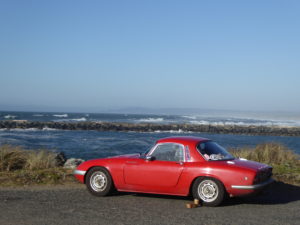
Chill wind at Bandon

Rocks and reflections at Bandon
We continued down the Oregon coast to our overnight stop at Brookings; the car was fine except for the steering but there were serious cross winds and the steering is fine just the suspension isn’t and at the 55mph speed limit what’s the problem? Generous curves, straight stretches…excellent Lotus territory.

Sunset on the Oregon coast
This picture was taken just before the sun went down below the horizon, we got into the car and a minute later the TomTom switched to night-time mode – spot on timing!
25 October – another wet day!

Astoria County Jail

Pacific Lotus
The car didn’t want to start, which was not good. We planned to go to a house museum but being “winter” it didn’t open till 10am so we went to the Maritime Museum. We then planned on Fort Stevens – a military base with a long history – but it looked desolate so I decided I should have someone look at the insufficient charging of the battery. After several “no thanks” phone calls we found a garage who were available at 1pm. Result – inconclusive! The system was charging and the battery just passed one test and happily passed another. They suggested we leave the car overnight so they could try it cold; this was not in my plan so I bought some jumpleads instead.
Damp Beach
We ventured into the rain missing all those golden, sandy beaches and Lucy had to made do with the motel swimming pool. Maybe the car will start tomorrow and maybe the rain will stop……..
24 October – the good news is that the speedo now works! I am concerned about the electrics as the starter grinds and its not charging as it was before; it seems that the battery charges when going uphill more often than otherwise – sister is convinced there is a correlation – so maybe electricity flows down from the front to the back?
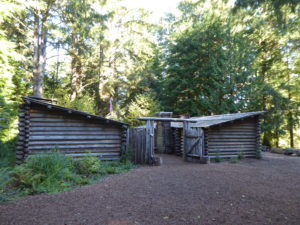
Fort Clatsop
A short day as we only drove for about three hours to Fort Clatsop, The spot where Lewis & Clark over-wintered in 1805/6 when they arrived at the Pacific. There’s nothing left of the old fort, just a replica. Up to 1985 the area was a bustling logging station where logs were assembled into “rafts” before being loaded onto ships for export to Japan and Korea. Now its a state park and all peace and quiet, particularly out of season (winter here started on 1st October).
We then got as far as Astoria where we had a late lunch and decided to spend the night. Its another town with steep hills on its grid system – one is 47 degrees! (we were going down it)
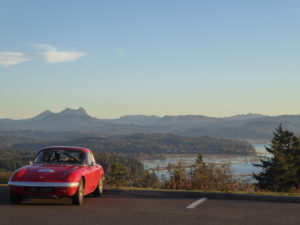
Looking South from Astoria Column

The Columbia river
Lunch was at a craft brewery and the strangled screeching we heard was the Sea Lions who use these shores to rest on the rocks and sea level pontoons which humans have so thoughtfully provided.

Sea Lions in Astoria
The Astoria Column (erected by a railway baron in 1926) gave fantastic views in all directions (once you’ve climbed the 163 steps).

Boats and the Columbia River Bridge
21-23 October – with friends south of Portland where we saw another USA – farmers markets with an extraordinary range of choice in vegetables,

Self service choice
a supermarket with aisles of self service in different varieties of flours, grains nuts and more,
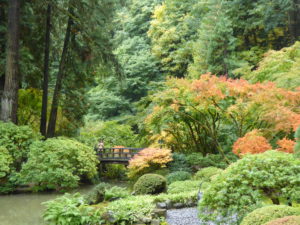
Japn in Portland

Covered Bridge – some have sides
a Japanese garden in Portland where each turn brings a different shade of shape and colour; then out to the Cascade Mountains where we saw a covered bridge (an effort to keep ice off the roadway),
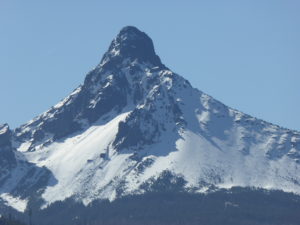
Mount Washington
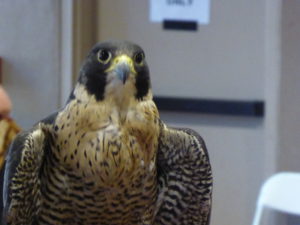
Peregrine Falcon at High Desert Museum
a lava field at Newberry (last eruption 1300 years ago) ending in a craft brewery.

Lava Field at Newberry
I was abe to instal the speedo cable which my sister brought with her – today will tell if that makes the dial come to life!
20 October – before leaving Ellensburg I restored the connections to the rev counter so there was now only one dead dial on the dash. I also checked the website for the Boyer Bransden connections – both had been disconnected in our attempts to solve the points problem.

Umtanum Valley
I was much relieved when the Boyer Bransden unit resumed as my stock of 3 new points was now exhausted – one causing trouble, one not fitting and the third in use.
We followed the route given by the motel to a waterfall – just it wasn’t there! So we had a short walk along a valley coloured by the yellows of autumn. From here we dropped down to the Columbia river and the Lewis & Clark Trail (theirs was the first expedition to cross the western USA from St Louis to the Pacific in Oregon in 1804/6).
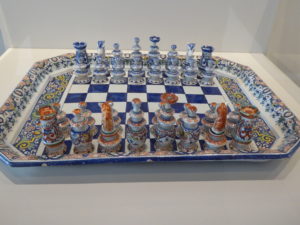 We stopped at the Maryhill museum, once a railway baron’s mansion and now an art museum in the middle of nowhere. Garage spaces designed to hold 24 cars now showcase Rodin sculptures but it was the variety of chess pieces and sets that really caught the eye.
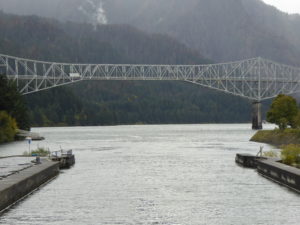
Columbia River – once Rapids now a Dam
On to Cascade Locks, once fearsome rapids but now under the waters of the dam. After that the rains came and the road to Portland became a river and very difficult driving with road markings invisible under standing water. In Portland we met up with friends for a beer and a Courtney Barnett concert. The Elan was left in a weekend garage as we were whisked away in a 4WD for a night’s sleep.
16/19 October We continued our journey up to Vancouver Island where Bill and Janet had very kindly offered us a bed, We spent two nights there and after a leisurely breakfast decided to “attend” to the car. I have never spent such a frustrating time changing a set of points! Something somewhere was wrong and it took me all day to get the ignition to function again. Bill was very patient but we lost the chance to explore the beauty of the Island. Then, having spent a day of glorious sunshine on the car we set off in the wind and rain to return
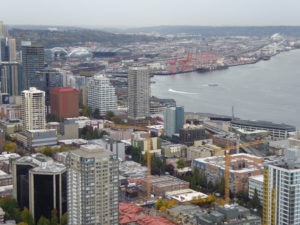
Seattle from the Space Needle

Pike Place Fish Market Seattle
to Seattle where my sister was waiting to join the tour

Chihuly Glass Exhibition
and Allison returned home to see the dogs.
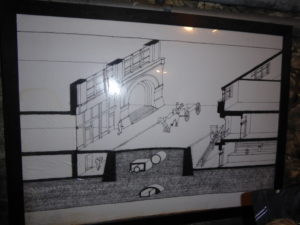
Elevating Seattle’s streets
We had time to visit the hilarious Underground Seattle tour showing how Seattle’s streets were lifted by a storey after the great fire of 1889. I decided I had had enough of the rain and cold, with the car being blown off course in the dingy spray of the Interstate – I was heading south for the sunshine! We endured more Seattle traffic and crossed the Snoqualmie Pass and what was surely beautiful scenery had I been able to see it! Sister said it was spectacular!
14/15 October – two days long on driving and low on photos! On 14th we went to a meeting of the

GGLC cars and members

Showing how we treat Elans!
Golden Gate Lotus Club hosted by Status Autos of Redwood City (www.statusautosinc.com). Our Elan was clearly the scruffiest car there, no great surprise! I guess that after I had shown some slides of what we do to Elans, they probably thought the car was in remarkably good shape! We left our friendly hosts and took the scenic route over the Golden Gate Bridge in the general direction of Seattle. First choice would have been the Pacific Coast highway but its about 5 hours longer and we didn’t have that in our timetable. Second choice was Highway 101 but that runs through Santa Rosa, which has just been decimated by the California Wildfires. We decided on the boring but practical Interstate 5. It wasn’t all bad and the scenery round Mount Shasta where we stopped was spectacular but very cold – seriously cold! We put the heating in on our hotel room.

Church at Golden
Day 2 we had 400 miles ahead of us, stopping only at two sites from the “50 Great Drives Book”. One was a wash out – the “Oregon Vortex”, the second was the goldmining ghost town of Golden where just a couple of buildings remain and the creek, carefully cleared up by teams of volunteers – it was hard to see this peaceful valley as a goldmining location with powerful water jets pulverising the rocks and polluting the entire downstream.
Peaceful Creek
13 October – a day in San Francisco. In the evening we checked the car and put some spacers to stop the sump guard hitting the exhaust – maybe it will now be quiet

Start with a Cable Car on a turntable

Looking back
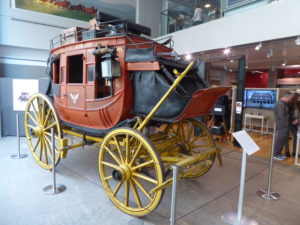
An interesting bank exhibit

The Powerhouse of the cable car system

Up and Down

The “Painted Ladies”
11/12 October – First stop was the Santa Barbara

Santa Barbara Mission
Mission, the pearl of Missions. An imposing set of buildings with a clear view to the sea, this must have been impressive in the late 18th Century when the Spaniards started converting the indigenous peoples.
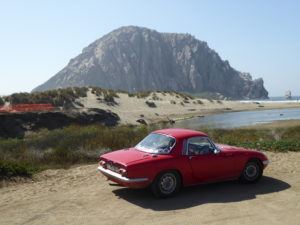
Morro Rock
Then on along the Highway to Morro Rock and Hearst Castle,

Neptune Pool Hearst Castle
where we had the Grand Rooms Tour of the newspaper magnate’s Hilltop

Hearst Castle
Mansion full of antiques bought largely from Italy. Our overnight stop was in Salinas. I drove the car over a kerb in the dark – yet another thump on the unfortunate sump guard. The car is now making some very nasty noses which I hope is only the exhaust banging against the sump guard – if its not that then it may be more serious!

The Big Sur coast
The second day we set off for The Big Sur – on the northern section of the Highway – sadly a mudslide earlier in the year has cut the Highway into two sections and the missing link will not be repaired until early in 2018 – so we had to approach Hearst Castle from the South and the Pfeiffer Canyon from the north. The bridge at Pfeiffer is also down – due to be re-opened tomorrow – so we went to the nearby Andrew Molera State Park for a lengthy walk before returning to the eccentric Carmel and its famous 17 Mile Drive. We were slightly later than planned into San Francisco – and the evening traffic was something else! We had over an hour of stop start darkness driving on the Freeway with an unhappy Lotus but somehow the TomTom kept us on track and we reached our overnight stop – exhausted!
10 October – where did today go to?

That’s why you come to Malibu

The Coastline
It is 90 miles from Santa Monica to Santa Barbara – we took a long route but it still took all day! We started thinking that our hotel booking for Santa Barbara was just too close then realised that we needed time on the car so spent some time driving round various “shops” until we found a friendly wash/lube who let us use their pit to check the underside of the car and all those nuts that want to come loose in the course of a long journey; then there’s gearbox oil level and oil filter. I reckon the diff oil level was ok as the whole area is completely dry whereas the gearbox is like an oil well!
That done it was the Pacific Coast Highway to Malibu for breakfast which became brunch – a roadside burrito for me followed by a chocolate cake in a swish restaurant for Allison.

Ventura

Mission Church – bless those Halloween pumpkins
We continued to Ventura and then Stearns Wharf in Santa Barbara – not even time for the famous Mission but we did visit the Mission in Ventura.
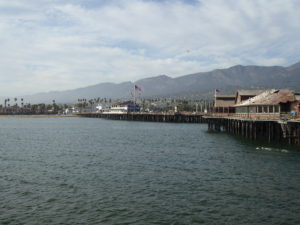
Santa Barbara frrom Stearns Wharf
9 October – The Pacific. A short day of just over 100 miles – well perhaps! We left at around 8.30 and arrived shortly after 5pm.

Wigwam Motel
There were plenty of detours and Route 66 things to see and cafes to stop at. We followed some (now) dead end alignments, including one that has a Mormon Trail Marker indicating the route they took from Salt Lake City to the west. Over a summit and alongside a creek we found our way to San Bernadino – definitely the back end of this town with the strong wind throwing dust at our open window (the other one remains broken).
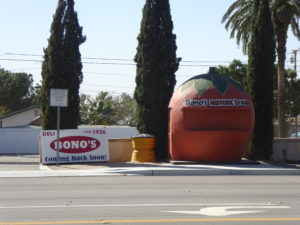
Roadside Orange
We visited a Wigwam Motel – that would be interesting if our tour company had not already booked us into the “safety” of well-known chains, a Giant road-side orange, a restored petrol/gas station,

Stagecoach Inn – not very busy

Monravia – fuel station
a couple of closed Inns, cafes and a 1915 pharmacy, now a café/gift shop. We drove round various parts of LA – both planned and unplanned – as well as various side trips to try to get a photo of that “Hollywood” hillside sign and the Lotus.
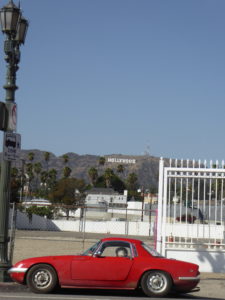
Lotus goes to Hollywood
Then on to Santa Monica where we visited the “official” end of route 66 – at some traffic lights – and the unofficial end on the pier where haze again dampened the photos. The Route ended with a paddle in the Pacific.

Officially – the End
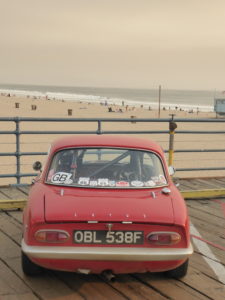
The Pier Santa Monica – the End
Without a speedo I cannot be sure of our mileage from Newark but I think it was just over 3,800. Now on to the North and Vancouver………..looking forward to meeting some of the San Francisco area Lotus owners next weekend.
8 October – to California.

In Sloan Canyon
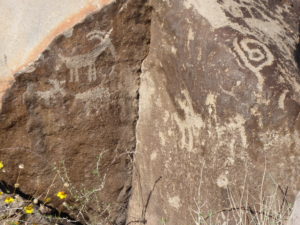 What should have been a short day got longer! We started a little later than planned and then headed north rather than south; having sorted that out our route to the Petroglyphs at Sloan Canyon was interrupted by the construction of a new gated community there’s an awful lot of new building just south of Las Vegas.
Heading south once more we left the Interstate for the 5 miles of the Zzyzx road  which goes to a dried up salt lake and the Desert Studies Centre – cars aren’t allowed on the lake bed but we are and Allison found a tennis ball stuck in the dry mud – house joke as we always find tennis balls when walking the dogs at home in the lush greenery of the Norfolk Broads.
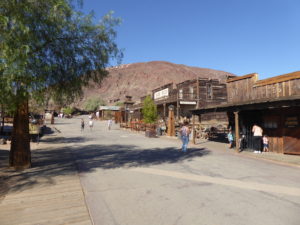
The Street, Calico
Further south we came to Calico Ghost town – a silver mining village abandoned in the 1890’s when the price of silver plummeted – now a theme park.

Calico – the mines
As

Fuel costs a little more nowadays!
temperatures moderated from the day time 35C we regained Route 66 near Barstow.

Sagebrush Inn, a Roadhouse – what you saw was what you got!

Elmer’s Bottle Tree Ranch
We reached our hotel in Victorville at around 7pm – a long hot day.
7 October – in Las Vegas. By way of contrast to the extravagance of Las Vegas we visited the Las Vegas Springs Preserve. This was the origin of Las Vegas – the Springs which provided the water which made life possible when Las Vegas was an oasis in the South Nevada desert. It was only recently when excess ground water pumping reduced the water levels that the Springs dried up. Now water comes from the Colorado river – and tourism is only 5% of the usage – a figure I cannot understand seeing all the massive hotels in the town!

On The Strip
In the evening we toured The Strip. 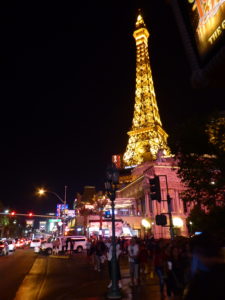

6 October

Seligman

More Seligman
Checked that fan belt again and decided that it did have ½ inch play and didn’t need attention (too tight and the water pump is damaged which is a major engine repair job). Leaving at 7.30 ish it was chilly – and the car felt it (doesn’t like the cold!). Spotted 9 or 10 of the Borgwards we had last seen in St Louis; they were heading towards Grand Canyon, their trip had taken them to Phoenix, which was not on our route.
At Williams we rejoined Route 66 and a few miles later followed what the book describes as the start of 159 almost uninterrupted miles of pristine route 66> The road was empty until Seligman which was full of tourist busses, whose occupants were more interested in the kitsch than a live Lotus Elan – shame!

Hackberry General Sore
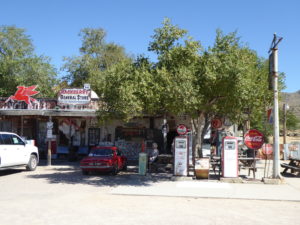 Then to Hackberry and a general stores full of things only tourists would need. One feature here were sets of five “Burma Shave” (a brushless shaving cream from the 1920’s) roadside adverts. At Kingman we chose to detour off the direct route to Las Vegas by tackling the Sitgreaves Pass, a narrow but now well maintained road which used to terrify previous generations who paid the locals to drive their cars up and down the 3550 ft mountain pass.

Sitgreaves Pass

Oatman Hotel
This took us to Oatman – it looks like a wild west town

Oatman
but is lined with modern tourist cars. An actor plays the sheriff and discussed with us whether we should be fined for having our steering wheel in the wrong place!. Then across the desert to Las Vegas, experiencing the extremes between the empty expanse and the clogged urban motorway system. Somehow the car coped with both. Our hotel, the Luxor, is huge; checking in was as if we were at an airport with snaking lines of guests shuffling forwards and took over half an hour.
5 October – rest day at Grand Canyon.

The Descent
 An early morning descent about half way down the Canyon and twice as long to get back up! Its very chilly before the sun’s rays warm you up, then its too hot.

The Mule Train – balast to repair the paths


4 October . 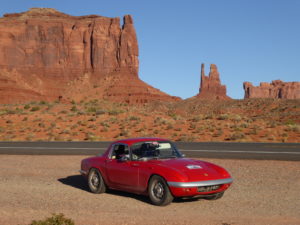 It was an early start to meet at ten past six for a sunrise tour of Monument Valley (the bus arrived at 6.30!).

Early morning Monument Valley
We meandered around a trail in the valley, spending quite a lot of time at a “hogan” (anglicised spelling) – a native Indian woman’s house – of a lady who sold horse riding tours and various crafts – am I cynical?
Breakfast was late and slow so we didn’t hit the road till 10.30. Again there was a direct route to Grand Canyon and the scenic route via Page and the Horseshoe bend where the Colorado river tries to do a 360 – or at least 270 – on its way to Grand Canyon.

Horseshoe bend
Research had shown that none of the walking trails that we could do in the time available in Grand Canyon would give us a view of the river – so we joined lots of Chinese tourists at Horseshoe bend.
We then traversed plenty of hot desert with a few

Little Colorado River in a baby canyon
baby canyons reaching Grand Canyon to find that the day had just got longer – we had crossed another time zone and our early start now seemed even earlier.

View fromThe Watchtower
The eastern entrance to the Canyon National Park brought us in near the Watchtower – which gave good but hazy views over the Canyon.

Car at the Canyon
I almost managed a photo of the car and the canyon! Tomorrow is a rest day before we head off to Gambling World – otherwise known as Las Vegas – and no its not on Route 66.
2/3 October

Recognise this scene? Its the way we are going – Monument Valley
We went off-route to visit some friends in Colorado, rejoining the tour at Monument Valley. Our route was north west from Albuquerque to Durango and on to Lake Vallecito (7200 ft). The speedo failed as we left and despite my efforts to revive it there’s no sign of life – so if anyone asks how far we went – I don’t really know! I tried fixing it the next morning- but failed – the TomTom shows my speed so I should be ok with speed limits. I also tightened the alternator belt which had screamed at me yesterday – it was about right at 8am when the sun was down and it was 3 degrees but by late afternoon when it was somewhere over 30 degrees it felt rather tight – have the pulleys expanded?

In 4 places at one time
We left late for 4 Corners – the meeting points of Utah, Arizona, New Mexico and Colorado.

Valley of the Gods
A great disappointment – sales opportunity for Navajo Indian tourist ware and apart from that a disc in the concrete. Then to the Valley of the Gods and on to Monument Valley. The latter probably the most recognisable image of the Wild West – sadly for my photos we were there at the wrong time of day and it was hazy. 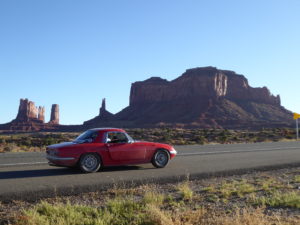
1 October Rest day in Albuquerque – the best laid plans…….. I had planned to spend some time on the car this morning to check the brake squeal. I had not planned on replacing the clutch slave cylinder in the hotel car park – but that’s what I had to do as the clutch pedal went straight to the floor when I tried to move the car to a less busy area. Not my favourite task but I do carry 2 spare cylinders and looking on the bright side – we had the time, it was not raining, it was warm and I had a secure place – so all in all it was a “good” thing! The last time I replaced it was in Peru in the Urubamba valley after visiting Macchu Pichu – maybe hotel car parks and clutch cylinders have something in common?
We then visited a museum (coffee and cakes by way of contrast to the tarmac car park!).
NewMexico landscape looking west
Then eastwards along the newer (1950/60) track of route 66 through Albuquerque and the “music road”. There is a small eastbound section where if you drive at 45mph with the wheels on a particular strip you get “America the beautiful”. Its true!! Though Allison says it was flat – maybe I drove at 44 and not 45?

Albuquerque Old Town
We returned on the Interstate and were tourists in the Old Town – and the clutch reservoir is still full!! Tomorrow we leave the route to visit friends in Colorado and after that its Monument Valley and then two nights in Grand Canyon – photo ops to be sure!
30 September to Albuquerque. There are two “alignments” of Route 66 between Tucumcari and Albuquerque. One is the direct (later) route which is largely the current Interstate and is a direct east/west line; the other has east/west, north and south elements – we chose the latter via Santa Fe.
Blue Hole
The rain cleared before our first stop at the Blue Hole of Santa Rosa – one of a series of linked lakes, connected by a natural underground system with a constant supply of clear water, very popular with divers. Then we crossed the flat lands of New Mexico to Las Vegas (not the Nevada version!).

The Other Las Vegas
This was not on route 66 but was used as a source of provisions by travellers – so we had morning coffee in the genteel surroundings of the Plaza Hotel.

Post cards at US Post office near Starvation Peak
From modern comfort, the route took us past Starvation Peak – a place of fear for the settlers heading west.

Not that way to San Jose
We visited a couple of Route 66 dead ends and dirt tracks – and were surprised to find so many US Post Offices tucked away in remote corners – you have to try pretty hard to find any back home! We followed a dirt track of old route 66 (4 WD only the book says) but did decide against the all-mud options after our previous efforts. The area was full of history – the Santa Fe trail, the Old Pecos Trail, Civil War battlefields and Indian Reservations.
Santa Fe Cathedral
We stopped in Santa Fe, the oldest (State) capital city in USA with its Spanish Churches, arched walkways round the Square and its Adobe style architecture.

Santa Fe Loretto Chapel
Then with the skies darkening and “precipitation in sight” we headed for our overnight stop in Albuquerque, deviating only for an Indian Trading Post – which was closed when we got there! Dinner was accompanied by the rumble of thunder, pity the car leaks.
29 September to Tucumcari – a short day of only 115 miles – but we took a longer route! Today was also the day that we reached the halfway mark when we passed through Adrian, Texas
On the Mid Point
1139 miles to go (precisely inaccurate!).
We started with Palo Duro Canyon, the second biggest in USA.

Palo Duro
After the rain, the trails were closed but we were able to drive to the bottom and tried to find some stunning photo ops – limited success. Then to the (in)famous Cadillac ranch 10 Cadillacs standing nose first in a soggy, muddy field where people are invited to add more spray paint to what is already there. I’m not a fan of getting needlessly muddy in a small, car!
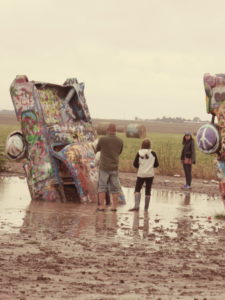
Mud and Spray can
Texas has a couple of ghost towns which were more interesting than the Cadillacs. One at Gruhlkey Road has a beautiful tarmac road with central yellow lines leading up to a dead end. The other

First/Last Motel in Texas
at Glenrio, which straddles the Texas/New Mexico border has a dual carriageway in one State and in the other a derelict motel which was once the first (or last) motel in Texas.

Please rescue me!
Before Tucumcari, we found yet more fields of rusting cars crying out for restoration – and this time they are for sale! We arrived around 3pm (after another one hour time shift) to find that most of the museums had just closed. So spent a little time on the car, neglected up to now apart from fluid checks. We are losing water somewhere, the brakes are squealing, the handbrake needed adjusting and the passenger’s window is best left were it is. Otherwise all seems ok – mileage since leaving home 2600.
28 September to Amarillo. One of our first tasks was to find a car wash and clean off at least some of yesterday’s mud. Next stop was Fort Reno, part of the Red Indian resettlement program in 1860/70 but we were too early and it was closed. Then to more scenes of abandonment – a restored  gas station and the aptly named Canute which the guide book says “is worth the detour for all the remains of old businesses”. Just before that we visited the Oklahoma Route 66 Museum – described as mandatory by the book and there we met the other half of our tour – its only taken a week!
One feature of the road is the quantity of old, abandoned cars which in UK I am sure would have been snapped up for restoration.
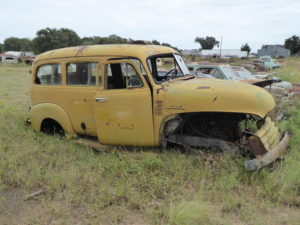
Rotting peacefully
I parked in a driveway to take photos of a field; the owner drove up and, having asked how I get a gas can in a car so small, said that he put the cars there for people to take photos – but they were not for sale.

Murals in Shamrock Texas
Continuing west we entered Texas and it started to rain just about the time we got caught in the “Jericho gap” – an 18 mile section of the route now in private ownership – we returned to the Interstate – not fun in the spray and standing water. We had to visit the “bug ranch”

Bug ranch
– a satire on “Cadillac ranch” which comes later – 5 VW’s dug into the ground. Our evening meal was at the Big Texan – a cross between showbiz and a restaurant. Limos whisk you from your hotel (ours was about an hour late) to a two storey hall where all staff wear Texan hats, there are 500 covers and they consume the equivalent of 14 cattle per day.
27 September to Oklahoma City – we knew today would be a long one – 295 miles if travelling direct and Route 66 is not direct and is stop/start, seeing things and using byways, towns and villages (and “unplanned detours”) – anything but the Interstate. We left at about 7 am and arrived 12 hours later.

Paris Springs – early and damp

Kansas and still damp
Most of the day it rained and was fairly chilly but we set out with shorts and T-shirts for yesterday’s weather!
Kansas may have only 13 miles of the route but we spent some time there in Galena, where the Gift Shop was about to close for the winter and at the coal mining museum –

Galena Mining Museum
once a railway ticket office but picked up and moved to its new location on the main road.
Oklahoma provided plenty of interest – the Sidewalk Highway,
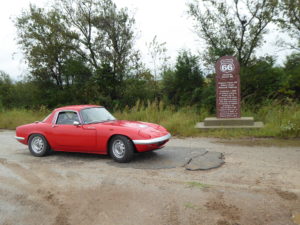
9 ft highway
a 9ft wide stretch of tarmac road, the Blue Whale, a brick paved bridge,

At Shoe Tree Trading Post
the Shoe Tree Loop where folk have hung shoes on the tree at the entrance and a stretch of the Ozark Trail – not to be attempted in the wet (it had rained all day so not the best of our ideas!).

Must wash this tomorrow
The attractions we missed were many times more numerous than those we visited – but with such a long day. Museum visits sadly are not an option.

They started with 5
26 September – the 5 Borgwards from yesterday have now become 13; seems that one as already had an engine transplant shortly after arriving.

Meramec Caveens
Our first site today was to a Jesse James museum – but as it was now winter, it was closed.

Meramec Caverns (with coloured lights)
Then to the Meramec Caverns – a 24 mile complex of underground caverns, stalactites, rivers, outlaws (Jesse James again) and Civil War battles. This took a good chunk out of the day.
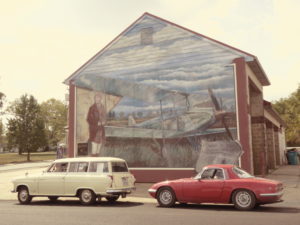
Cuba, mural, Borgward
Then on to Cuba – town of murals – before some Route 66 dereliction

Bridge at Gasconade River
and on to Lebanon before ending in the rain in Springfield. Our route book was written by a route 66 expert who encourages tourists to visit the “mom and pop” businesses along its length. One such was a motel in Lebanon where we stopped to buy some souvenirs but I was struck by the anger of the proprietor towards us because our tour hotel was in the big city of Springfield rather than using her motel – understandable but unwanted.
25 September St Louis, hot.

St Louis in the Shadow of the Arch

St Louis River of Bridges

St Louis Gateway Arch
A group of 5 Borgward cars travelling from New York to Los Angeles had arrived at the hotel when we returned from sightseeing – how often do you see one let alone five?
24 September – Today was one of the lowest mileage days of the tour – but when we followed the meanderings of the Route – it got extended! We tracked back into Springfield to find one of the “Giants” at Lauterbach Tire. Then we had to decide which “alignment” to follow as today the 1920’s route was about 12 miles away from the 1940’s.

The Old Brick Road
We chose the 20’s and drove the “old brick road” – a section of just over a mile of brick surface. In Virden we found a memorial to the 1898 battle between coal miners and the mine owners. Our

The concrete road
guide book described the next section as “an evocative concrete road like the snaking course of a river” as the road followed a series of right angles through the cornfields. After the brick square in Carlinville we changed allegiance to the 40’s, visiting the Route 66 shrine to “Our Lady of the Highways”.
Our Lady of the Highways

Soulsby’s Shell Station at Mt Olive
Further on we had to visit the “Pink Elephant” Antiques, complete with more Giants – this was top class kitsch!

Pink Elephant Antiques
Our last visit was to Chain of Rocks bridge. This steel and concrete bridge carried Route 66 over the mighty Mississippi for 30 years till 1965. Its famous for its bend – it’s a mile long with a 22 degree bend in the middle – and the scene of many deaths over the years. Now the bridge is deserted and all the roadside stalls, cafes and businesses have disappeared and its a wildlife park. There were just 8 pedestrians and a cyclist when we were there. 

Bridge with a bend
One of them gave us a good tip for our evening meal – and we still haven’t met the other members of our party! Tomorrow is another rest day in St Louis.
23 September – This weekend saw the annual Springfield car show with 1,000+ cars on display in the centre of the City.
The interior Capitol, Springfield
We had booked to be on display but turned up without any driving licences – you have to show a driving licence to be able to put the car on display – hmm! We were in two minds about the display as we don’t “do” static displays but it was close to the main historic sites – based round Abraham Lincoln, President of USA during the Civil War and whose family came from Norfolk. So we displayed; much of the time we were off visiting but when we were there,
Springfield Show
we had groups of people wanting to talk about the car and its travels. It was another hot day – temperature records were being broken as we sweltered at 94F.
22 September Our objective was to follow Route 66 – but there are challenges;

The Story of Route 66 – Road Ends!
Route 66 now longer exists and has been superseded by the Interstate network, Route 66 had various adjustments over the years so its course moved and finally much of it has been removed.

Gemini Giant, Wilmington
Various people have documented the Route’s history and each State has its Route 66 Preservation Society who have put up road signs – and helped the huge tourist industry riding on the Route 66 name.
So we were provided with a comprehensive set of route notes, noting

Two Cell Jail, Gardner
the major attractions, and the definitive Route 66 Guide. I had also downloaded a complete set of tracks for the Route for the SatNav – it was when the directions diverged that the fun began……..!
Our hotel was not on Route 66 so the SatNav took us to the nearest point on the route – and may have landed us in hot water as this included two roads with auto toll booths and we didn’t have the correct card or change – so we paid more but the Stop sign still lit up – hmm!
Much of the world was on Route 66 today – Canadians, Portuguese, Americans and Brits – including a party from Caister which is about 6 miles from home in Norfolk. The people we didn’t see were the others in our tour group.
Amongst the features of the

Ambler’s Texaco Station, Dwight
road are preserved petrol stations from years gone by, many painstakingly restored and now museums/souvenir shops.

Sprague Super Service Station, Normal
Others have been demolished and others turned into homes.
21 September – the tour starts today – so the organiser says! I arrived in New York late in the evening 4 days ago to allow two days to get to Chicago – about 800 miles – and one day in case there were Customs things to resolve. In fact there were none and I left the warehouse about 30 minutes after I got there. They thoughtfully brought a battery pack but the Elan started on its own. Everything seemed to be where it should be, the car was undamaged and off we went. I did nearly 450 miles, mainly on Interstates and around the same speeds as everyone else but faster than most of the “semis” (artics). Overnight near Erie. Then on towards Chicago but using highways today. Decided that Chicago hotels would be pricey so stopped in Valparaiso – having been to the Chilean original at the end of the Patagonia trip some years back. The similarities stop with the name! It was seriously humid and sticky – the temperature was about 90F and I was dripping. The local attraction is the Indiana Dunes, a National Park based on the dunes and coastal vegetation.
Then to Chicago – parking was the problem – measured in $$$$.  But I did find the end of Historic Route 66 and the Start. Seems that the original westbound Route 66 is now one way eastbound hence it is the end if you are travelling east! The current start is now on a parallel road one way west bound so I drove the first 15 miles or so before leaving to find the first night hotel. As on our last Tour with Scenic there is just one other car – why is the take up so low? Haven’t yet met Ronald and Angela – but have seen what I guess is their Ontario registered Mustang in the parking – we have about 20 days to find them!
If you look at the map at the foot of our home page, there’s a large area without a little red car! The USA. So in 2017 we aim to rectify that. Getting to the “Land of the Free” has certain hurdles to overcome – first a full visa (having Iran in our passports is not a good start) but a trip to the Embassy solved that. Then car insurance – UK insurers won’t touch USA and the Americans aren’t too keen as we don’t have a USA postcode – and if we did the car won’t be registered there. However there is an insurer who will cover us for a “Collectors Car Event” – the Route 66 Tour – and after that we have 40 odd days to do as we please (60 days maximum all in). Now we know the rules, we can play the game!
The Classic Persia rally was very gentle on the car, the sump guard was the main casualty having had too many close encounters with the frequent road humps (into, out of and through most towns). That has been fixed (reshaped with a large press) so we are good to go! Route 66 here we come!