Archive for category Asia
Sri Lanka 2023
We start at Waikkal and go clockwise round the island. Allison’s father served with the RAF at Batticaloa during WW2 and she has been in touch with a very friendly tourist office there and exchanged emails and photos – a deviation from the route so we’ll see if we can trace any connections there.
Now Wednesday 18th and everything looks good! We spent the first night on the west coast then a night inland near Anuradhapura, a one time capital and now north of Trincomalee on the east coast. The first thing to report is that from what we’ve seen so far there are no shortages, no demonstrations and fuel is available but rationed. The concerns we picked up from TV reports and FCO advice are allayed. Its difficult to tell if there are fewer cars on the road than normal but there are certainly very few tourists. We have been to many sites with large car parks, lots of vendors but few visitors. At our hotels, our 11 cars and support team make up the majority of the guests.
Our departure from Waikkal required a good luck dance routine and the presence of a senior official from the Ministry of Tourism

Dance troupe
 Allison was determined to start her sight-seeing asap so we had no sooner arrived at our hotel early afternoon when she wanted to be off. It was actually quite a challenge to navigate a journey on our own when we started in the middle of nowhere, had conflicting directions and couldn’t read most local road signs so it was an achievement to get to one of the outlying temples in Anuradhapura – and back to the hotel and with a full tank of fuel!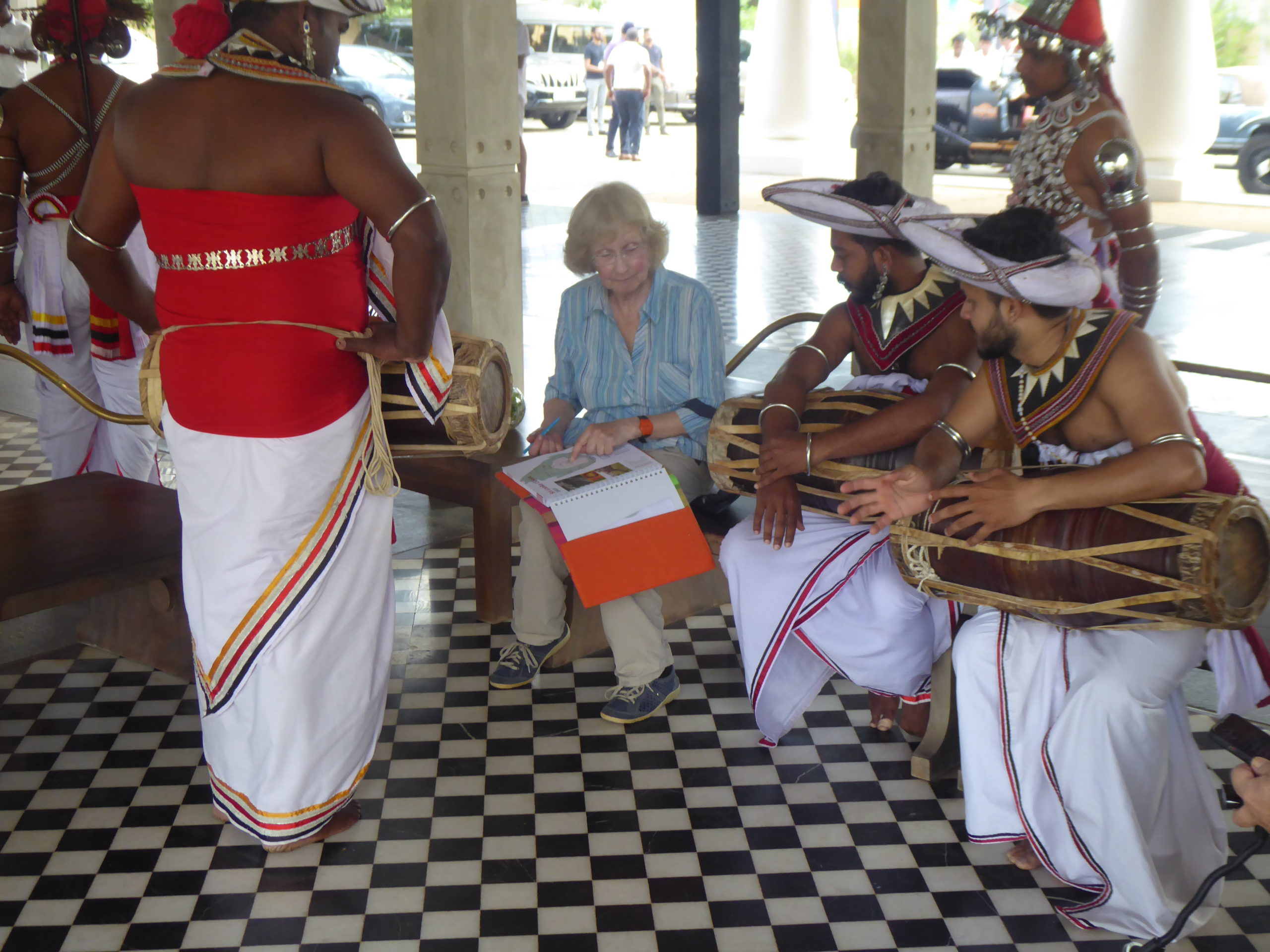

a deserted Isurumuniya temple, one of the most venerable temples
Wednesday we followed the group route up till lunch,

Paddy fields at the hotel
the feature was a tour of the main ruins at Anuradhapura (the island’s capital up to the 10th century), starting with the Jethawanaramaya Stupa – said to be the larges stupa in the world, solid and made from 93 million bricks. Originally plastered using crushed sea shells but now suffering from an incursion of scaffolding – and no plaster, or tourists! 
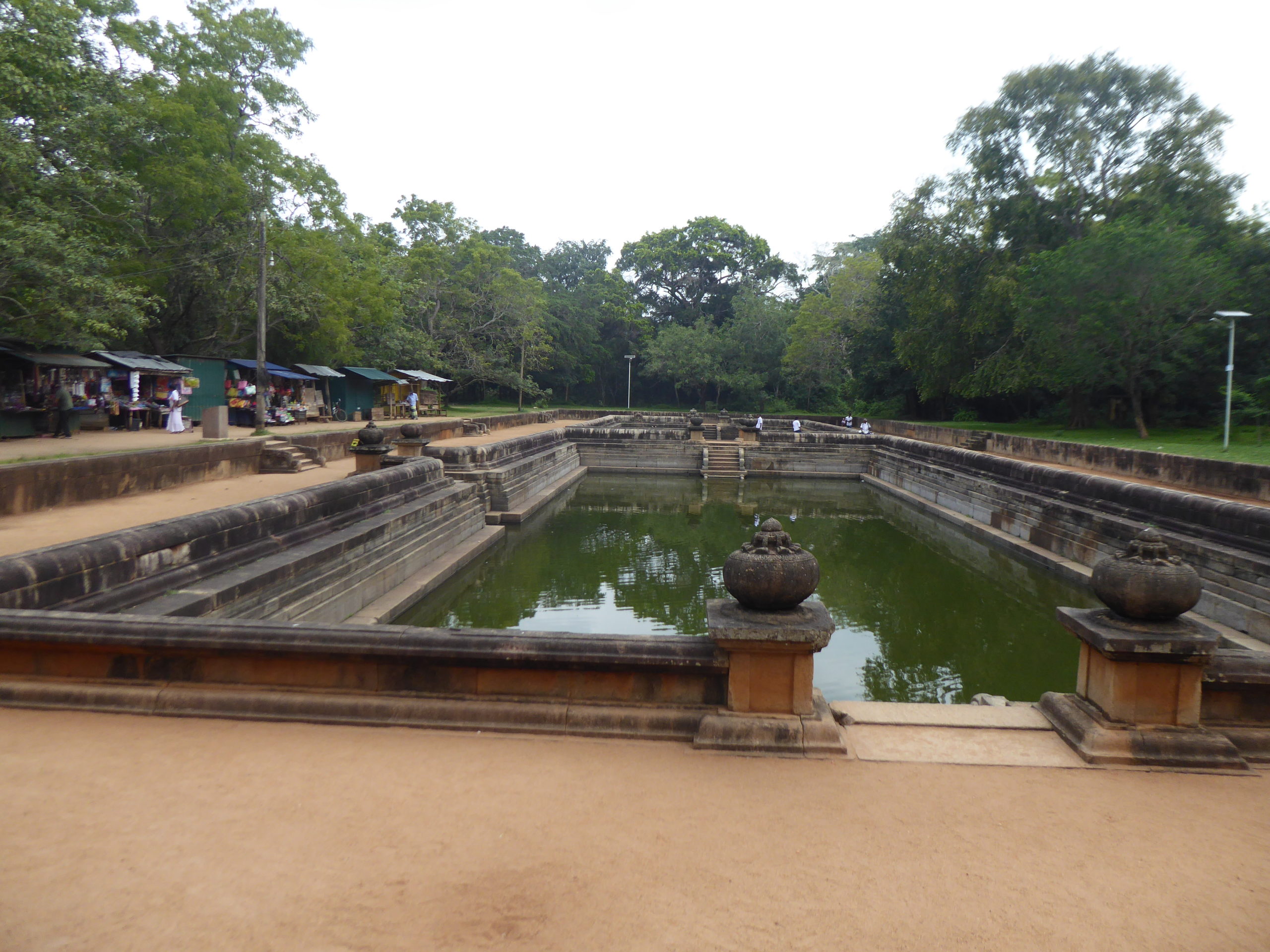
Twin bathing ponds for the 500 monks at the complex

The Guardstone
After lunch we headed for the next day’s tour of Trincomalee as we had other plans for that day. We started at the Naval museum where Allison was hoping she might find something about the RAF but not to be; then to Fort Frederick

Temple at Fort Frederick
We particularly liked the accurate timing of the discovery of this sculpture (3pm).

Nanthi Thevar
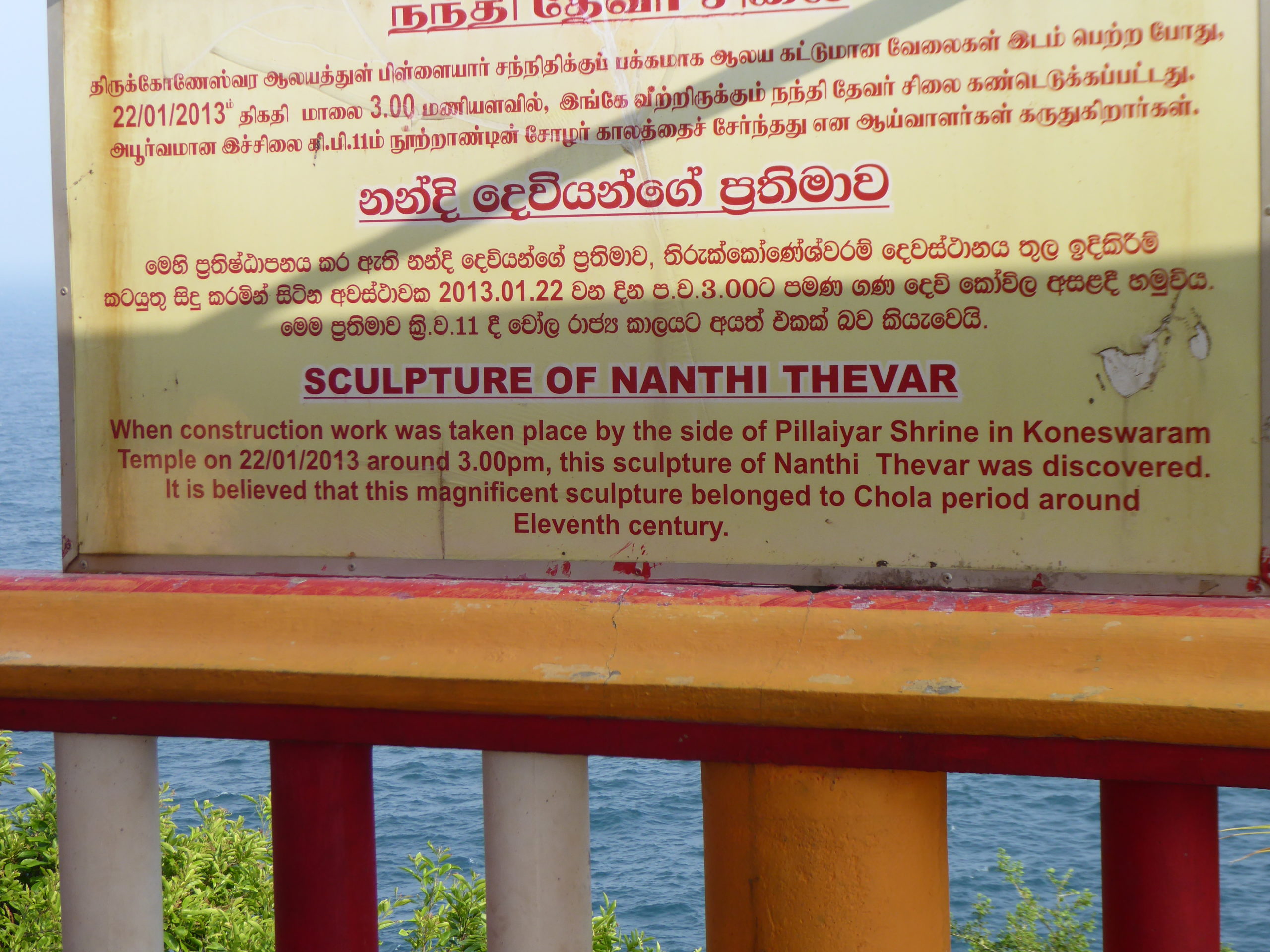
At 3pm
There were plenty of vendors at Fort Frederick – just a lack of tourists  We started early on Thursday so as to get through Trincomalee and on to Batticaloa, avoiding the majority of the day’s rally route. There we met Sandrine who runs a tour company and who recognised the one photo out of her father’s collection of 20 or so which Allison had happened to email to her. It was of the old Mosque but the fountain in the foreground, the railings and the tree (now cut back) were unchanged. It turned out that the Mosque did not have a photo of the previous building so the photo was of interest and would also show the location of the old building.

Batticaloa with the new Mosque behind from the same angle as the 1942 original

The Imam and Mosque Trustee viewing the car
Then a blast to catch up with the Rally which was now 100 km or so in front of us. The roads were good and traffic much lighter than in the morning and we had time for a very quick tour of the ruins at Polonnaruwa (after much navigational challenge as there are no street signs in English).

Polonnaruwa Council Chamber

Polonnaruwa Sacred Devalaya

Polonnaruwa Shiva Devalaya

Polonnaruwa Stupa Rankoth Vehera
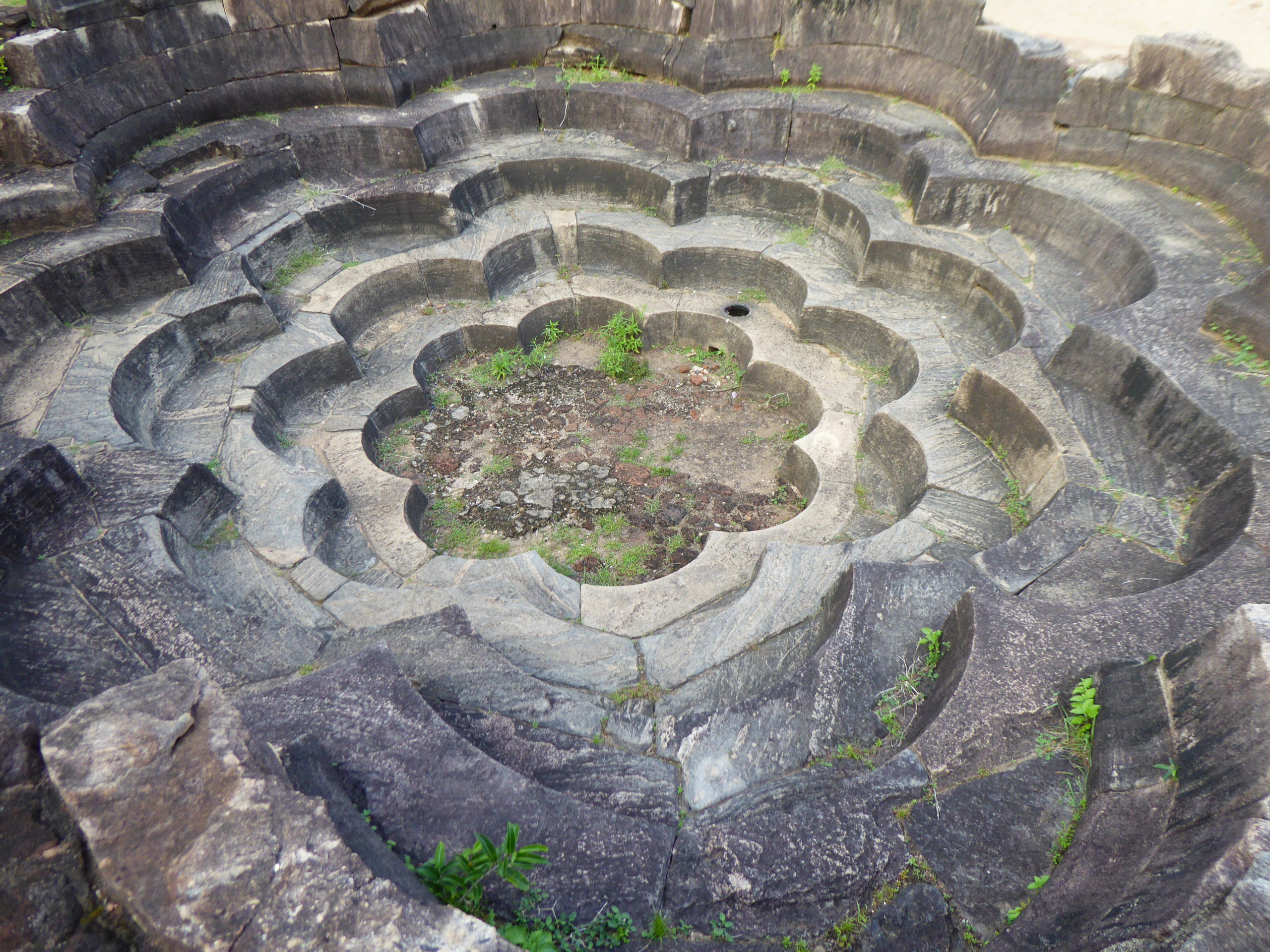
and …..the Lotus pond
Friday, a rest day, required an early start to get up the Sigiriya Rock – visible from the hotel when the haze clears but a tuk-tuk ride away. The summit contained a Palace complex from 490AD built by a king who was in constant fear after killing his father before his brother killed him some 20 years later. The rock is 300m high and modern stairs make access much easier than all those years ago!
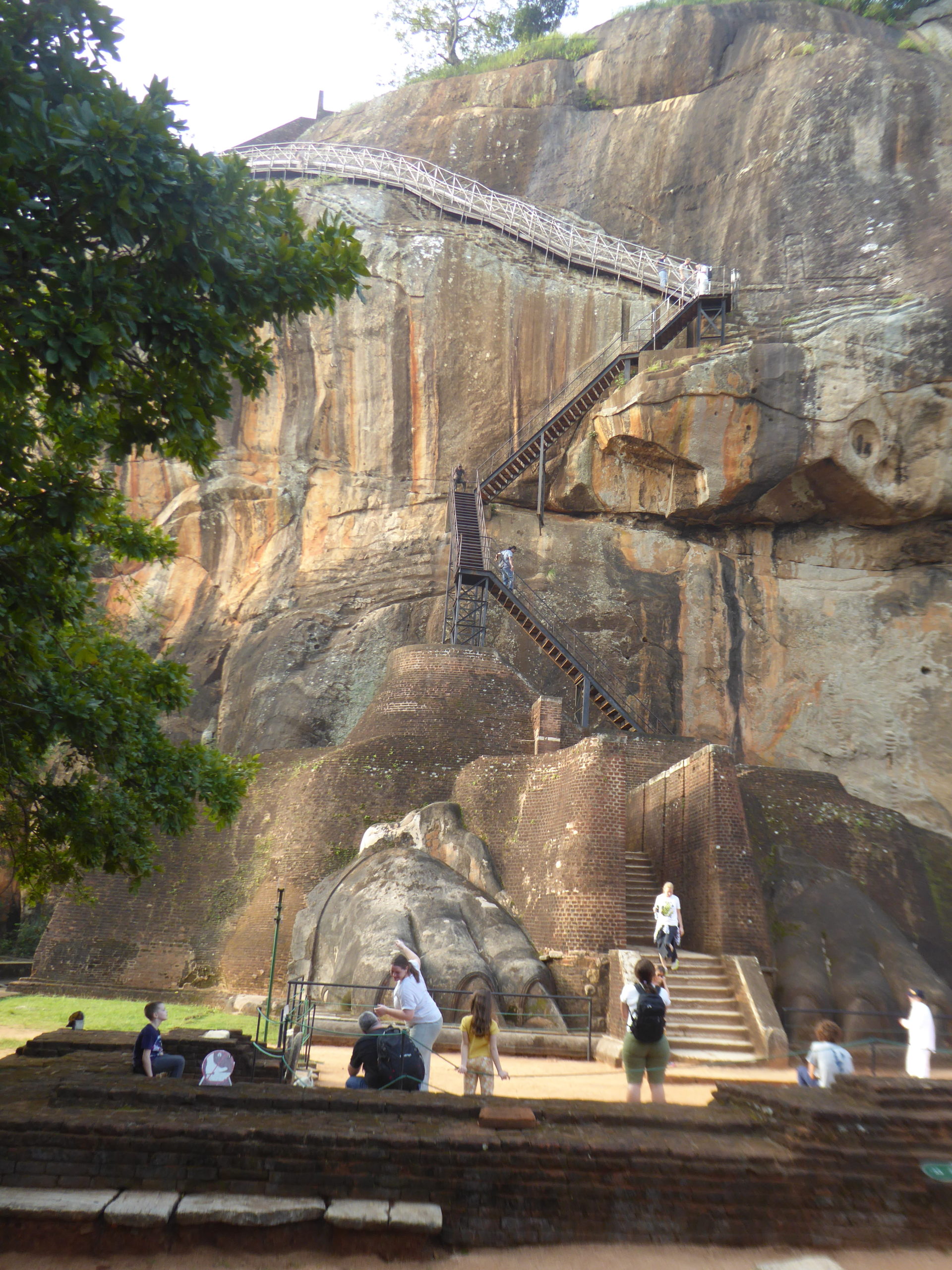
Sigiriya Rock

From above (in the road book)
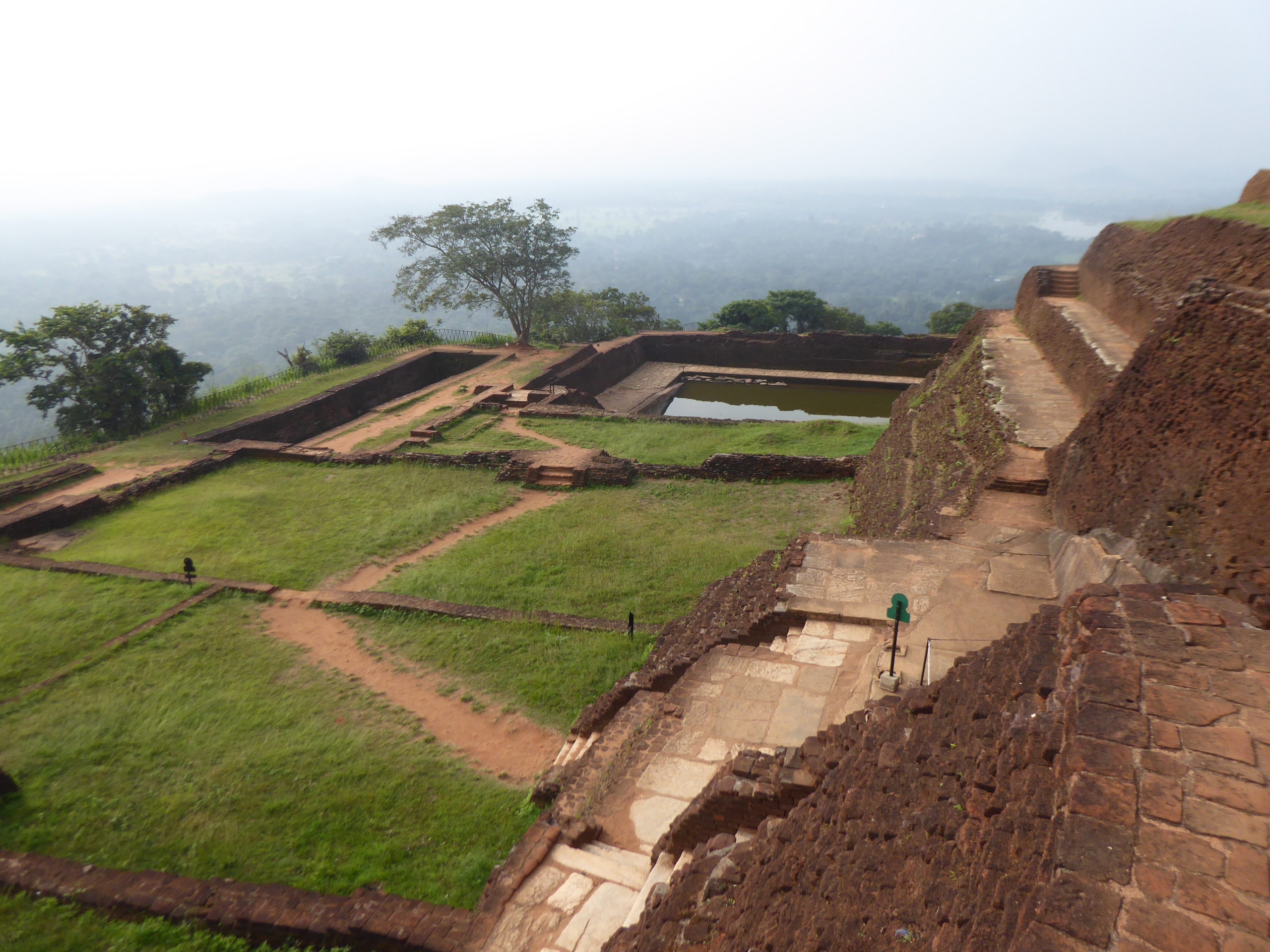
At the summit – bathing pond
In the afternoon we went to Dambula Caves – though actually it is an enclosed rock overhang and not a cave. The Tuk-tuk ride to get there was interesting because of (wild) elephants on the road. This was significant because the day before, one of the Bentleys had stpped near an elephant to take photos. Then a tuk-tuk started up, the elephant charged the tuk-tuk, whose driver jumped onto the Bentley’s running board as they pulled away asking to be saved. The elephant trashed the tuk-tuk. So both we and our drivers were at bit concerned at having to drive past two elephants. The elephants were more interesting than the caves.

Elephant at roadside

Dambula Caves showing the rock overhang
On our way back, one elephant was still there and seemingly trapped, unwilling to fully cross the road but with a fence behind him.
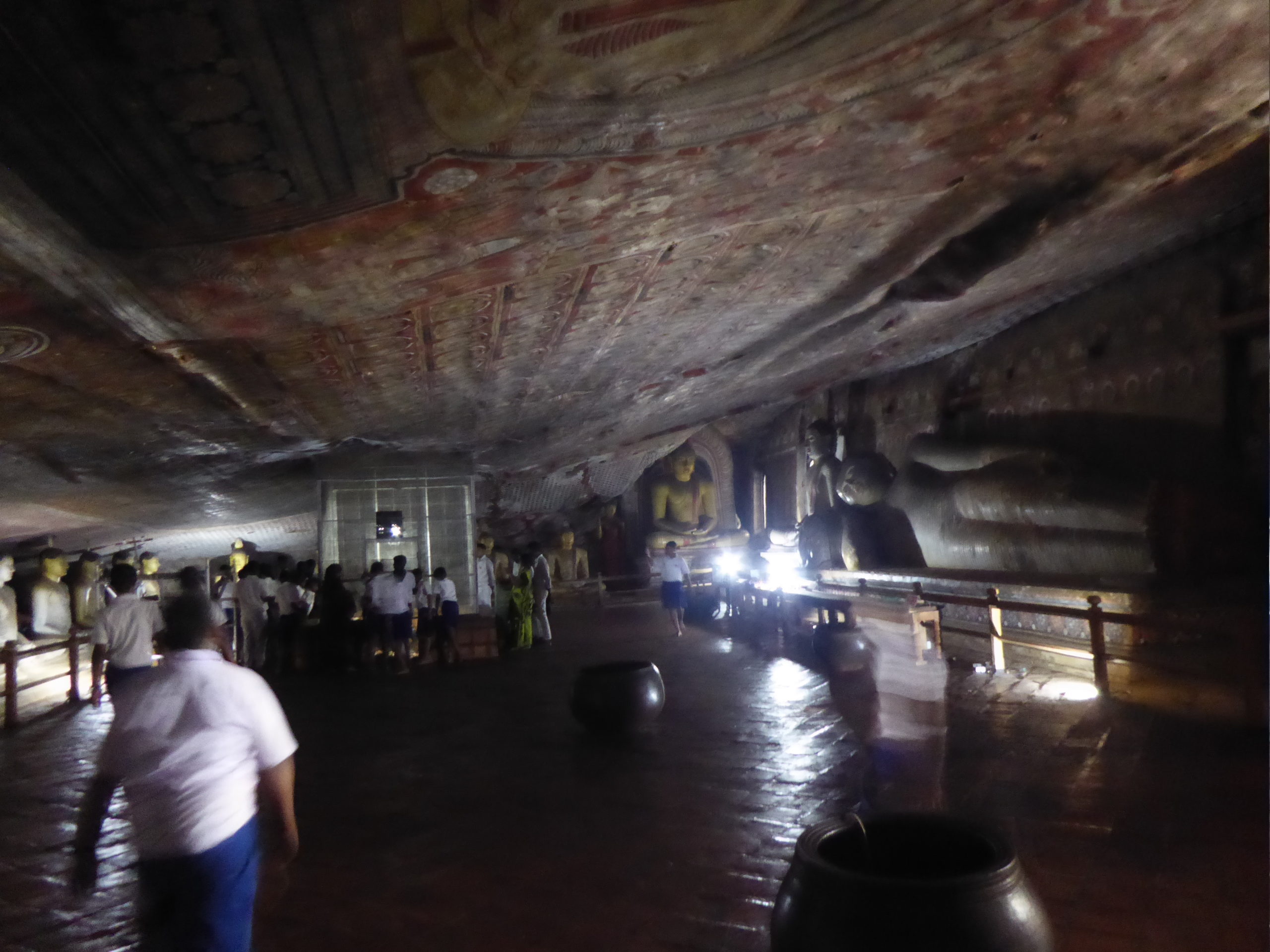
Inside one cave
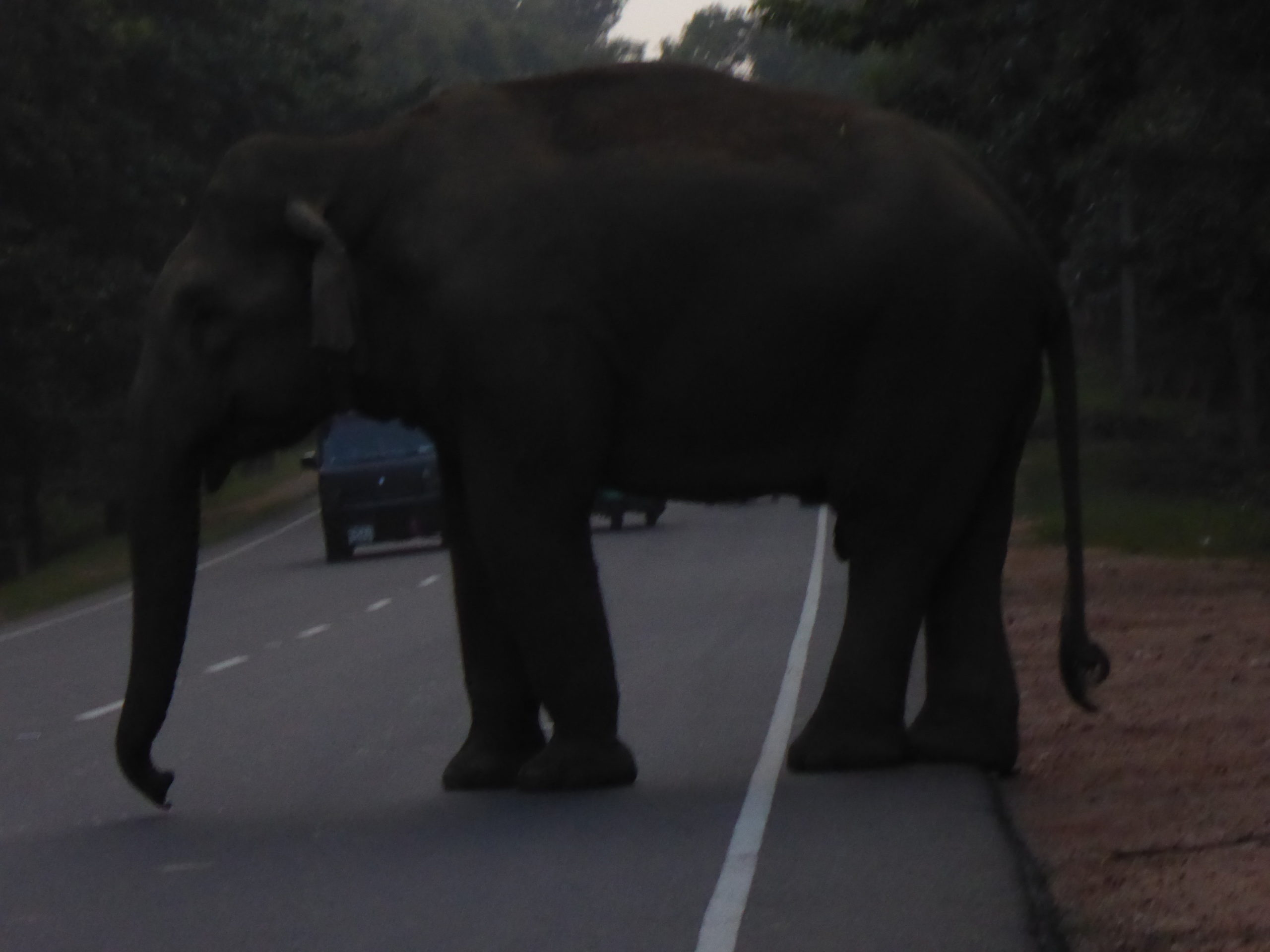
Elephant in the road at dusk
Saturday turned out to be wet and cloudy – and damaging. Our route took us to Kandy and a climb our the hills and into the cloud – sadly the organiser’s offering of a “drive on one of the most scenic drives” did not materialise. The police had been evident at various junctions but sadly mis-directed us way off route so from being the lead car we were last at the coffee stop. After coffee we ascended, only to 1300metres but on a rough lumpy road and the suspension got hammered and passing busses on the narrow wet road was fraught. Others got more lost on the way to lunch so we got there “mid-pack”. More tuk-tuks took us to the Temple of the Sacred Tooth relic. Apparently, a monk pulled just one tooth from the Buddha’s mouth as he burned on his funeral pyre and first Indian then Ceylonese Kings, then the British Raj and now Sri Lanka had the duty to safeguard this relic. It is paraded round Kandy in its casket in a 100 elephant convoy in August but normally resides in this temple

Flower offerings at the Temple
An examination of the car at the hotel (in the rain) showed that one side rollbar fixing had snapped and the exhaust pipe was tight against the sump guard. We jacked up the suspension with help of the rally mechanics and drove very carefully next day! A mention of the Jetwings hotel in Kandy – the meat at supper was tougher than any other meat I eaten anywhere but they did put on a dramatic display of traditional and fire dancing.
Sunday was a short drive to The Heritance Tea Factory (hotel) in Nuwara Eliya – the Little England of Sri Lanka.

Some of 18 hairpins
The drive included an 18 hairpin descent and lunch at a very welcoming and contrasting restaurant with the hustle of the street one side of the building and the peace of a lake and hills behind.

lunch stop
We finished early to get to the hotel and were more than happy to find a workshop next to the car park, complete with a vice where I could shape the sump guard supports! Job done, car happy, well nearly as the roll bar is still strapped up and hopefully out of harm’s way.
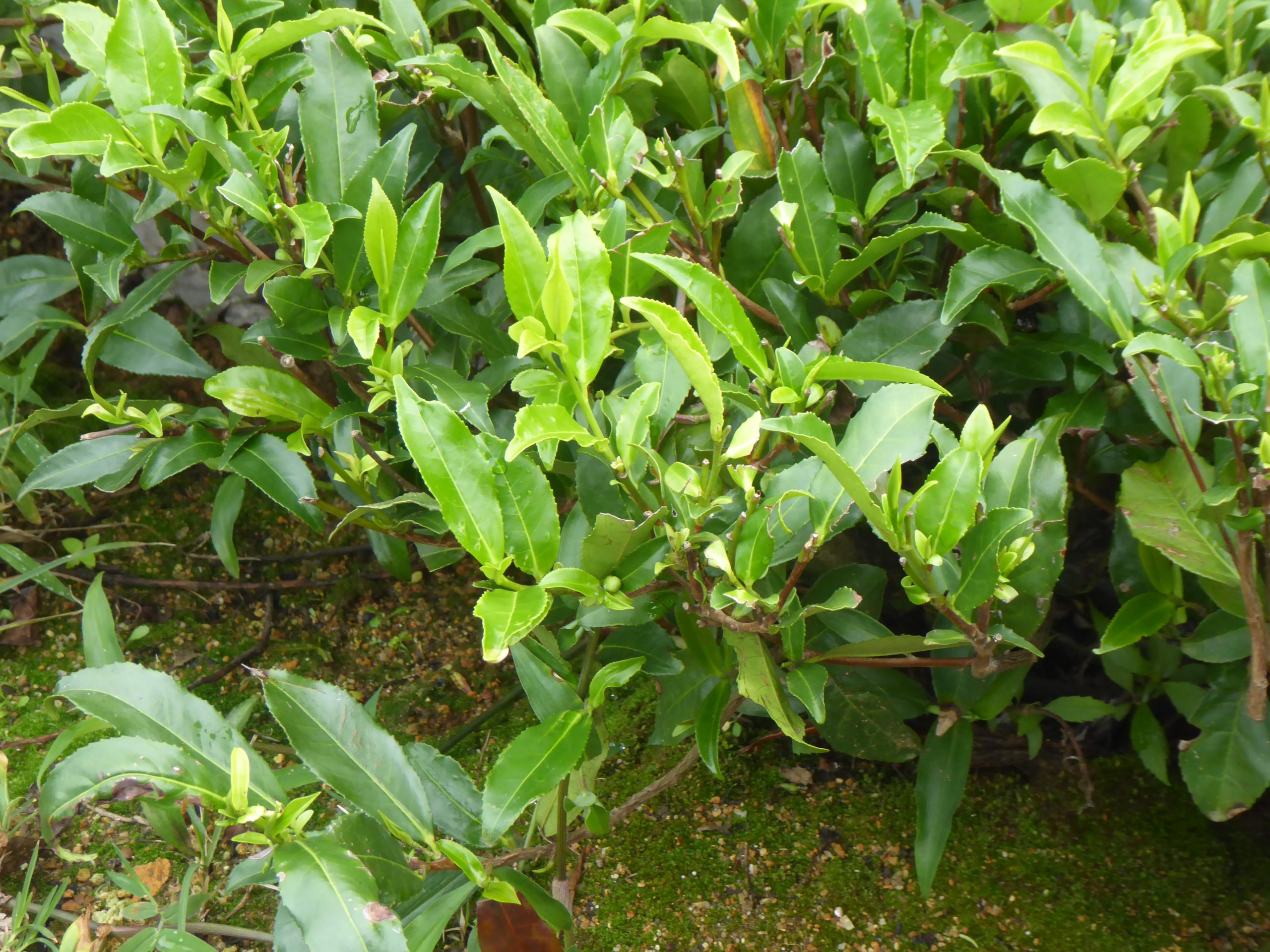
tea plant

A view of the tea plantation area
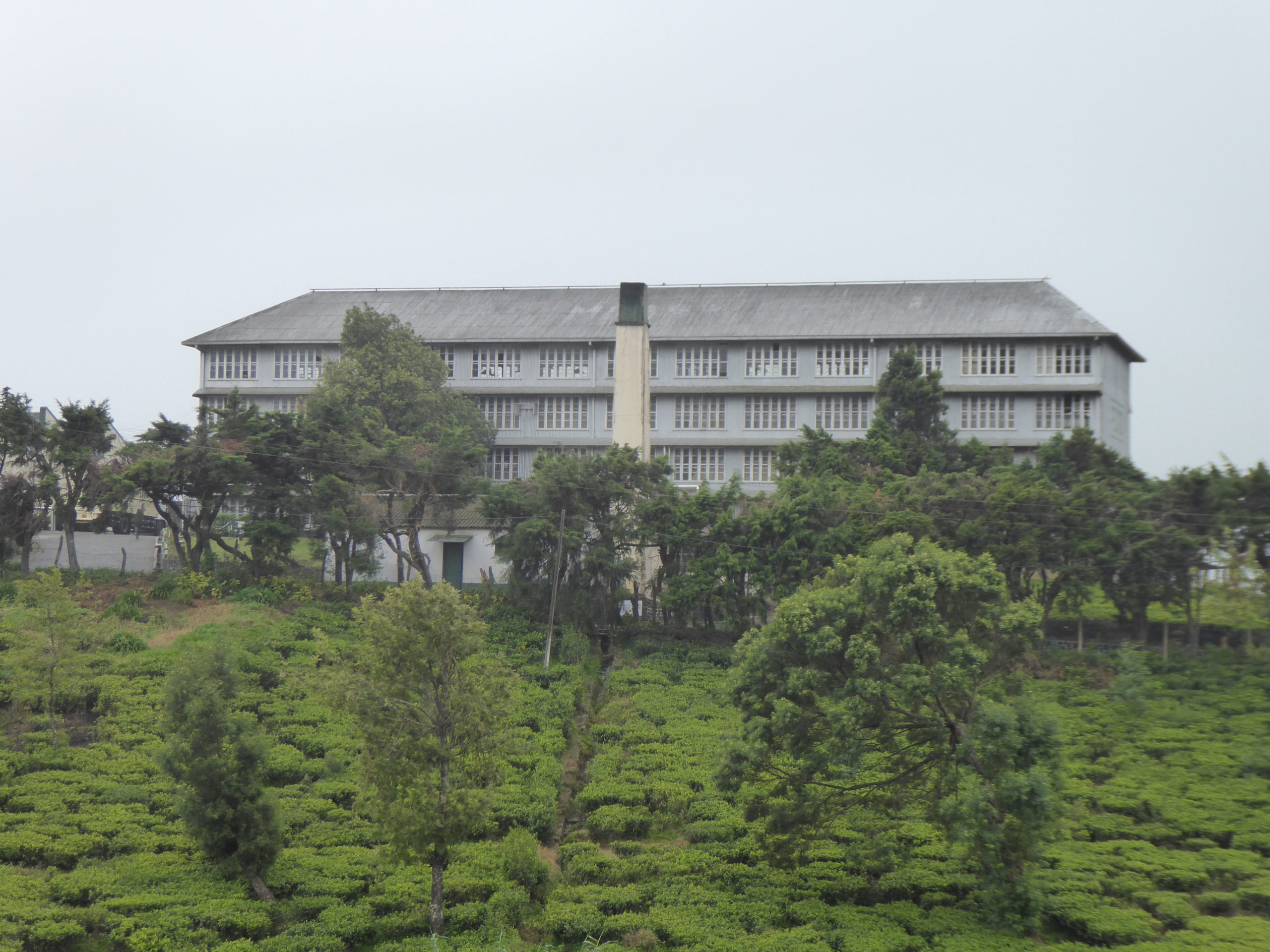
Not the Heritance Tea Factory but similar
The Factory/Hotel hade been refurbished in 1932 and abandoned in 1973. It was founded by Edward Flowerdue of Hethersett (Norfolk in the 1860’s. The conversion into a hotel some 25 years later had retained a number of pieces of machinery which generated a great atmosphere.
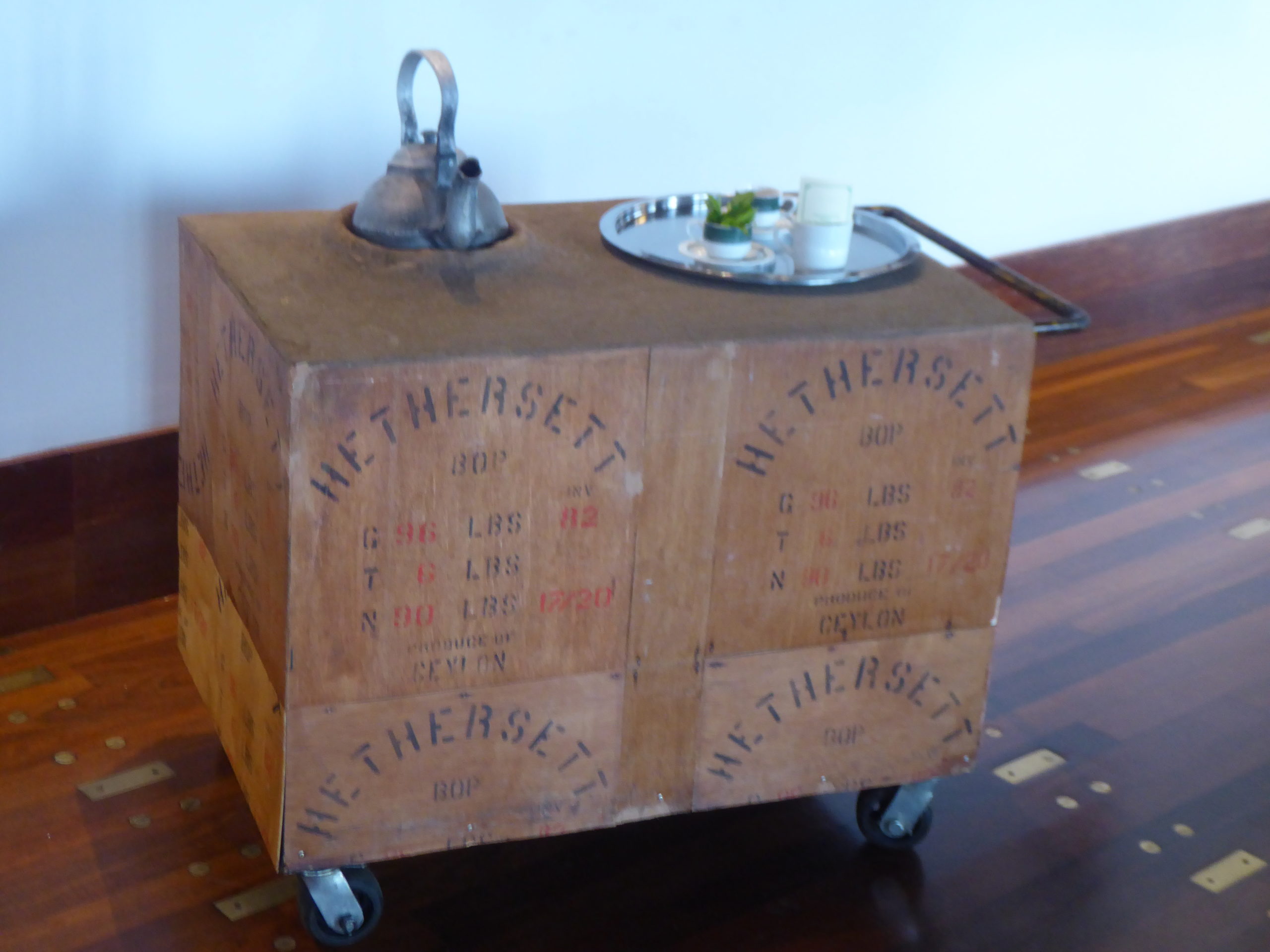
Tea Trolley

Hotel Stairwell
The evening was coolish and we wore pullovers all of the next day. This started wet and cloudy and our first activity was a visit to a tea museum with participatory tea leaf picking. Clearly if this was my job, I’d starve! Slow to identify the leaves to be picked and incapable of dropping the leaves in the basket – my arms aren’t flexible enough.
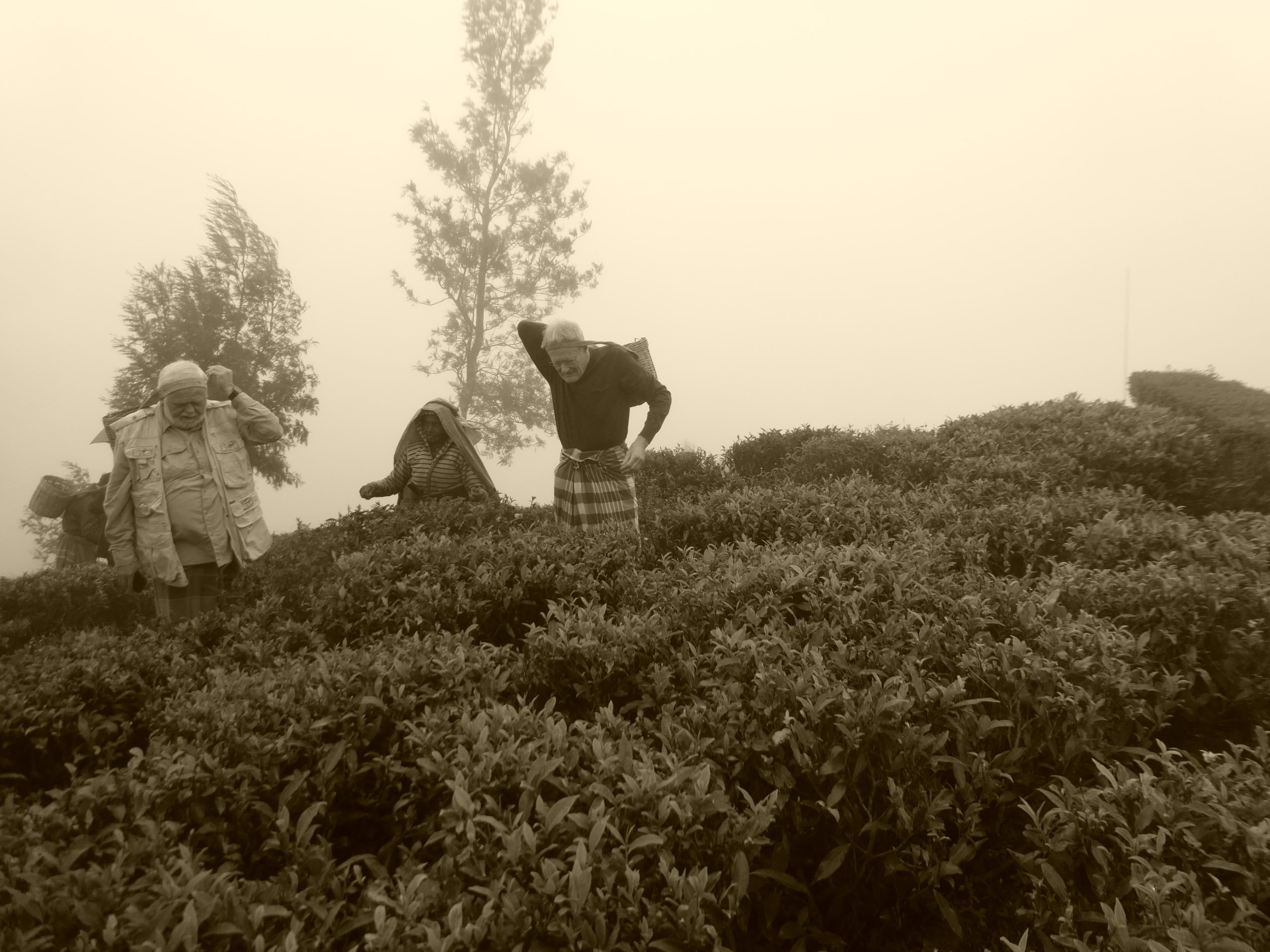
Amateur tea picker in costume
The drive today was choice of scenic (cloudy and wet) or direct to Nuara Eliya. There we had more history hunting to do so we selected “direct” and were later told it was bright and sunny on the scenic…. Our clues were photographs – a town entry sign, a hotel, a building, a roundabout with monument and a pagoda in a park. We found a similar town entry sign as the design hasn’t changed much in 80 years

Today’s town sign – the original showed 6191 ft

Grosvenor Hotel today – abandoned
The hotel lead us a merry dance as what was the Grosvenor in 1942 is now the abandoned
Seabank Hotel and the current Grosvenor was the Grosvenor Hotel Bungalow – which is where we started. The building was the Golf Clubhouse which we found, it still exists and we had tea and a tour round

Clubhouse – unchanged but many more trees.
. We thought we had two more successes – A Church shrine and a Buddhist stupa – but both were close but not what we were looking for.
Tuesday – a short day which started with concern over the headlight vacuum system but that eased during the day. We drove in the drizzle and cloud to Horton Plains National Park, passing Pattipola Railway Station – possibly Sri Lanka’s highest altitude station at about 1900metres – and we saw a train!!
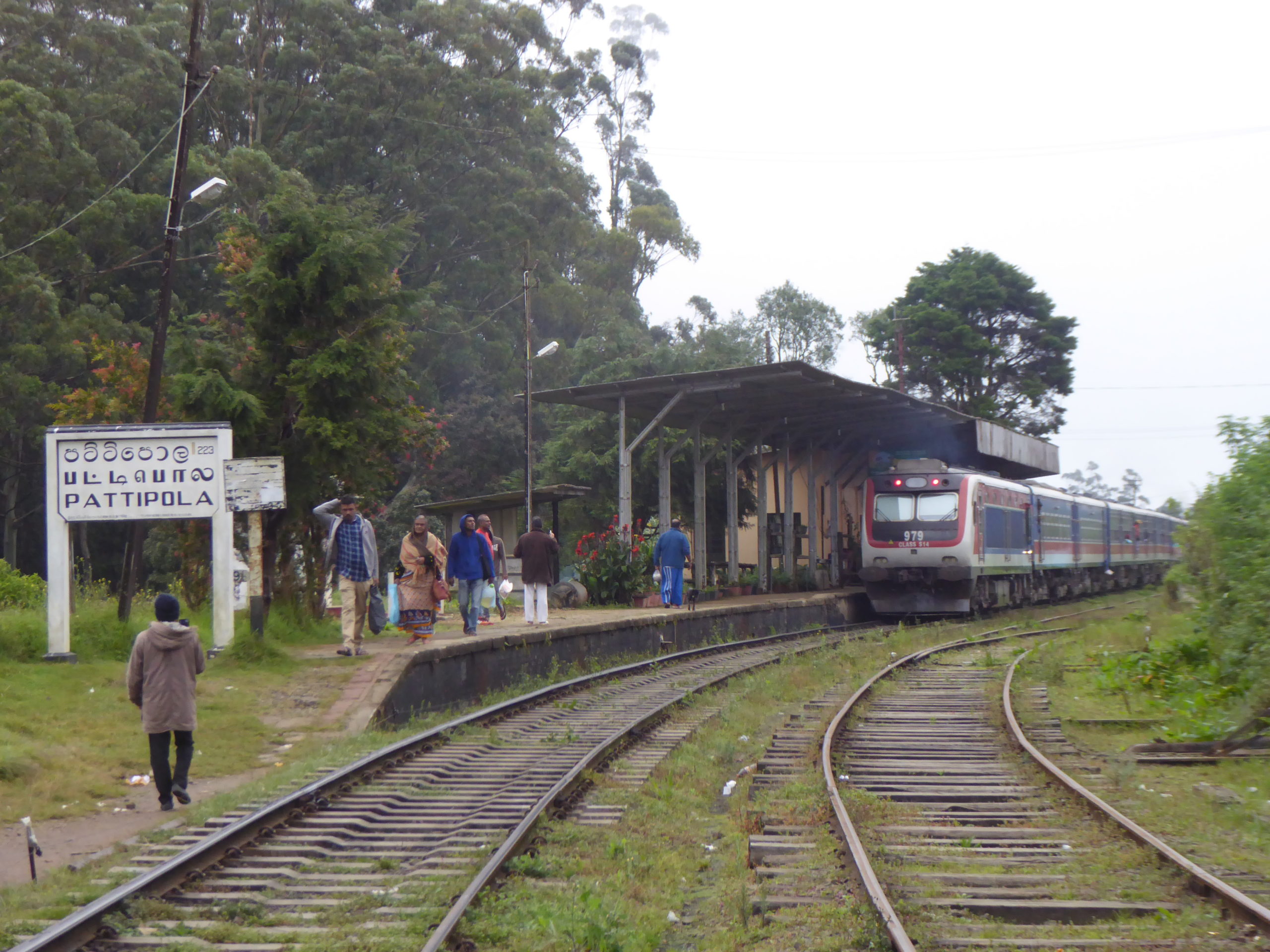
The train just going
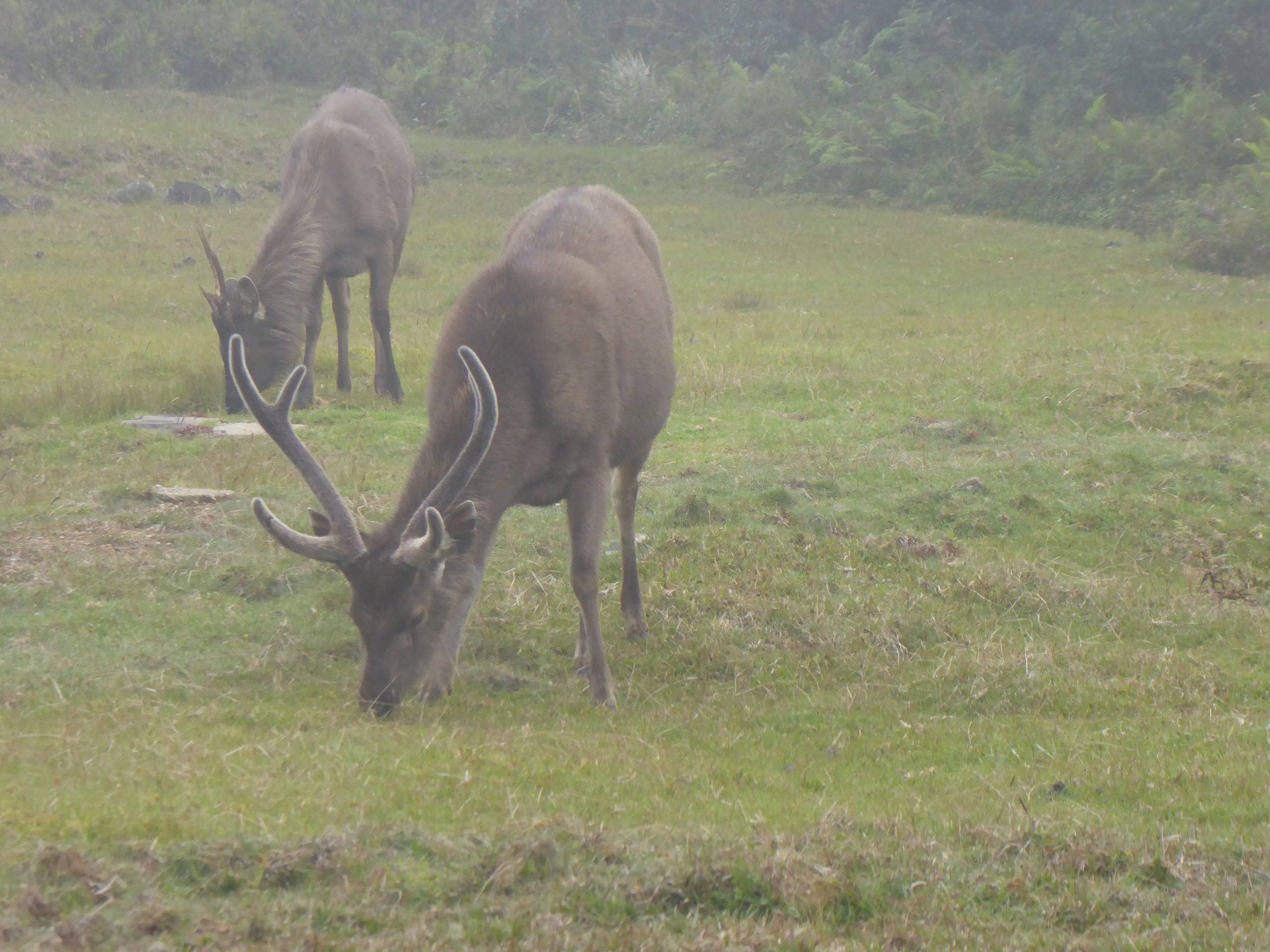 The ticket office clerk at the Park was still having breakfast when we arrived – in the mist which remained on/off or most of the day. We saw some deer and a stuffed leopard (in the museum) and I’ve not met anyone who did better, then a peaceful drive through the hills to coffee stop, which we left before anyone else arrived, and on to a leisurely lunch with the usual vast quantities of food – I feel quite embarrassed at the amounts we don’t eat. The afternoon’s excitement was a waterfall, Sri Lanka’s second highest, but not much volume. Despite the rain we’ve met in the hills we were assured that now is the dry season.

Diyaluma Falls
. At the hotel, the inspired chef created our rally logo – entirely from rice 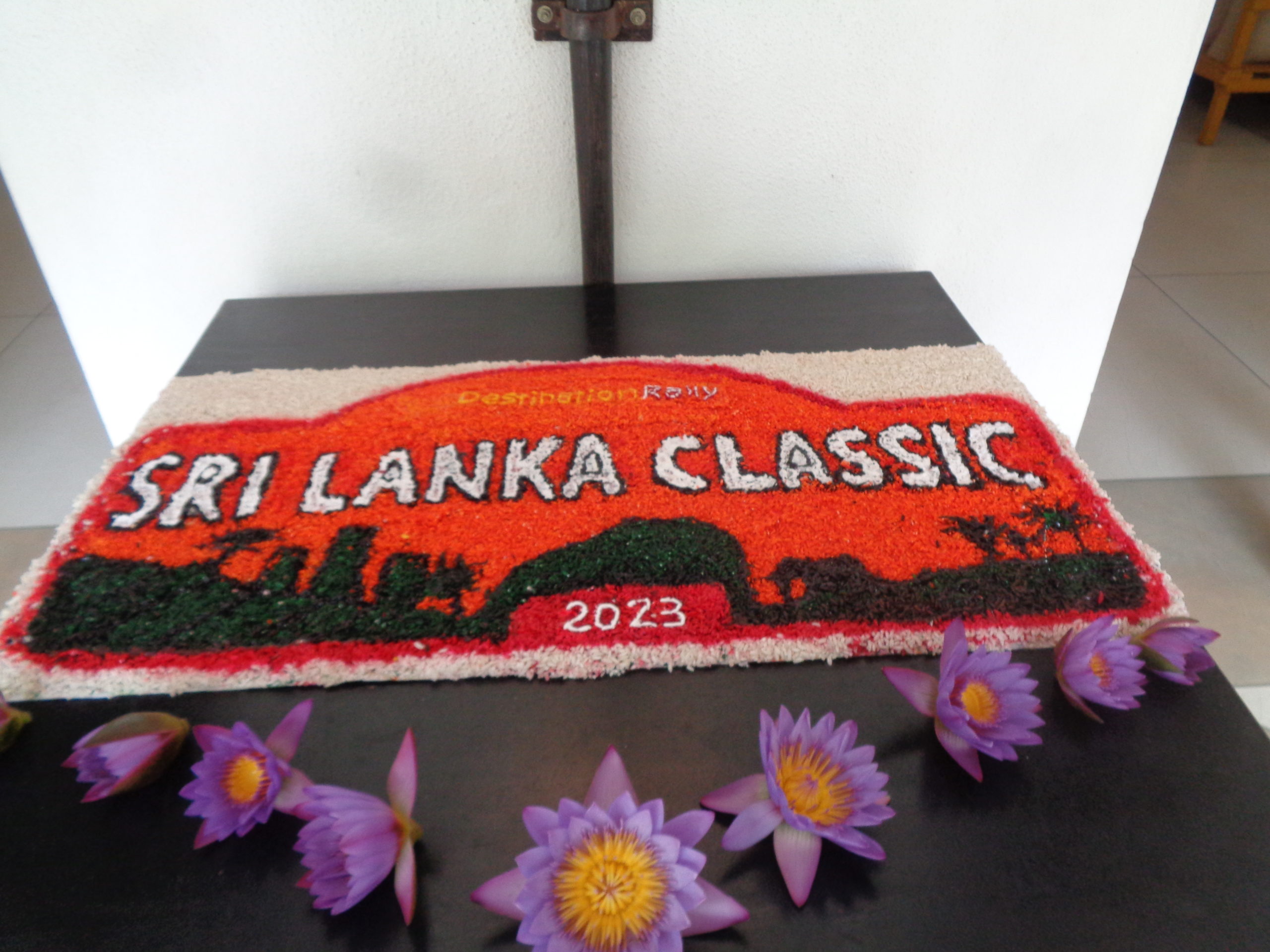
Wednesday turned into wildlife day after a radiator repair. I had added a lot of water the evening before and overnight realised that maybe there was a leak somewhere! Quick check revealed that the frame holding te electric fans had chaffed against the radiator and created a small hole. Our Rally mechanics had the rad out in no time and with a combination of liquid metal, araldite and radweld – problem solved. We drove broadly south to a “tented” camp on the coast and on the way we encountered two elephants, one was peaceful at the roadside whilst the other came marching towards us swinging his trunk as we sped off – see video below. The tented camp did not contain, as I had imagined, a set of luxury tents but some very solid fabric covered structures with extraordinary plumbing constructions

Tent with plumbing
Our afternoon excitement was a 3 hour jeep safari into the neighbouring wildlife park; there were no barriers between our “tents” and the park so we were under instruction (ignored) not to walk around without a hotel guide after 6pm. The safari objective was Elephant, Leopard and Bear – we broadly managed two!

Camera shy leopard

happiness

done it all

Land Monitor Lizard

no ordinary pig
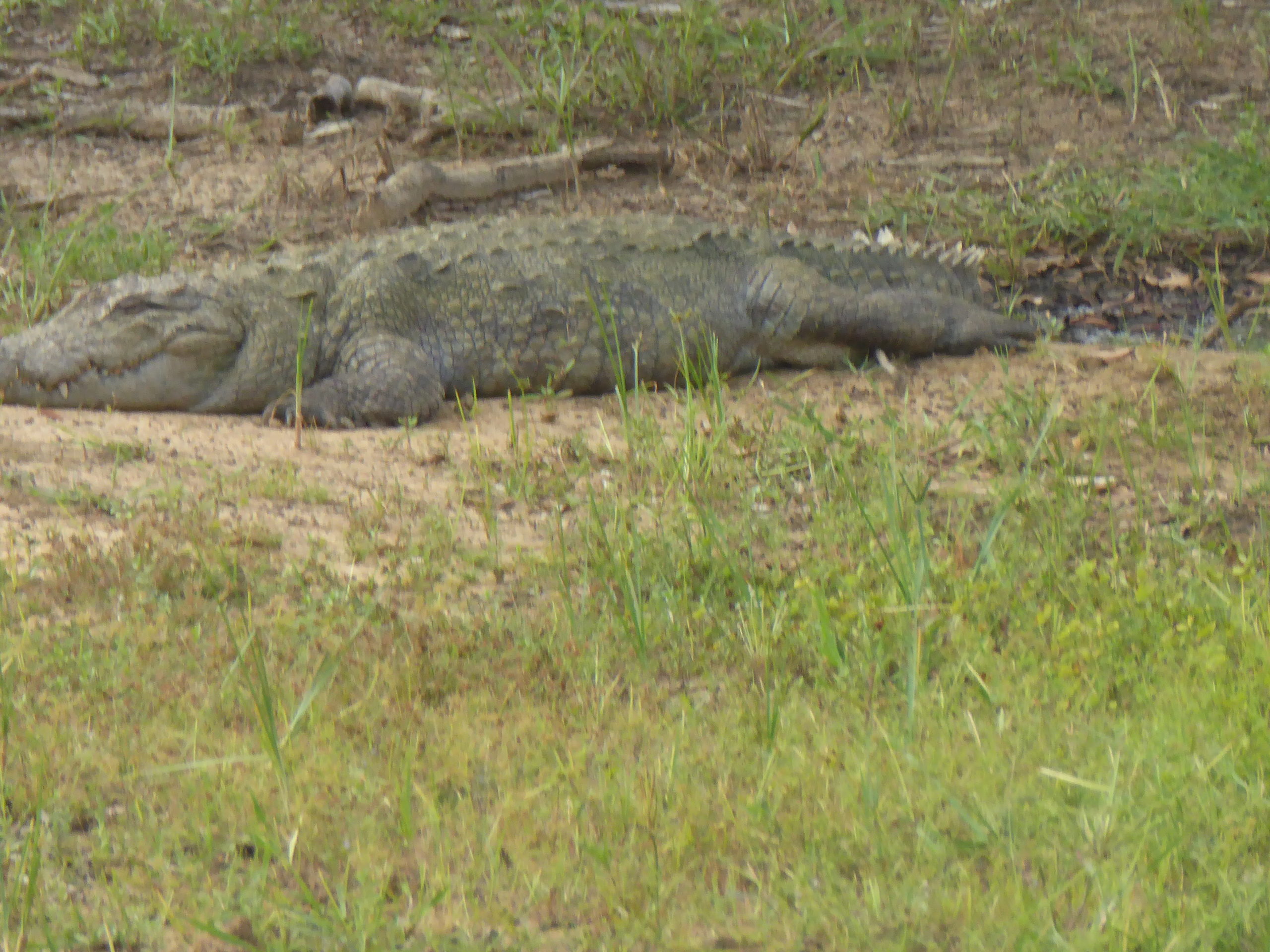
no ordinary log
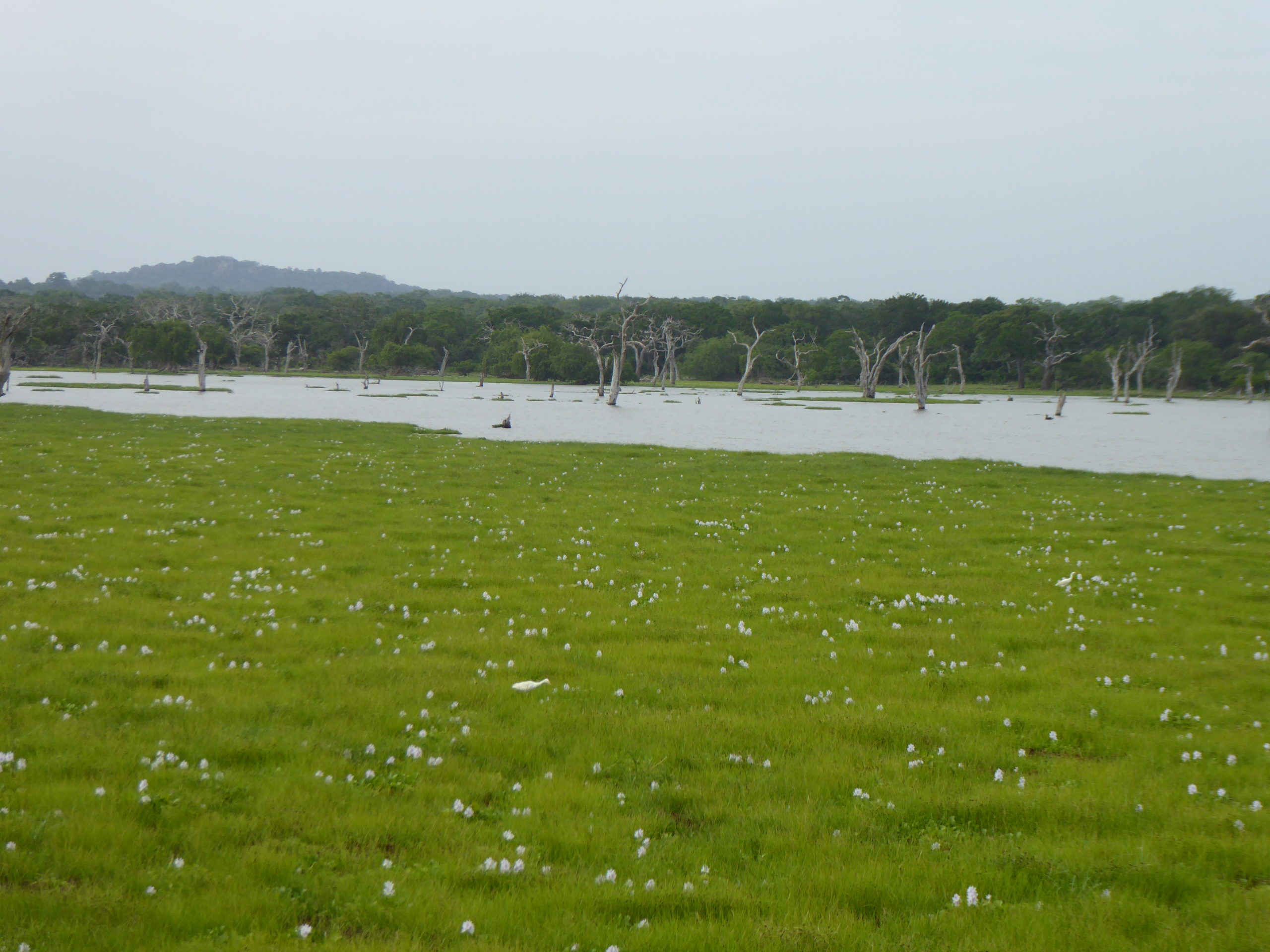
parkscape

too busy to talk

two bee eaters

Egret eating frog, with buffalo friend
The day was rounded of with cocktails by candlelight on the beach and (another) large meal (and an escort back to our tent).
Thursday we moved to an even grander hotel in the same chain further west at Weligama Cape. We travelled via a school which the rally was supporting with a gift of a couple of computers and a printer – and T-shirts
for pupils. We were first to arrive and were greeted by assembled parents and children along with the flower bouquet – also obligatory at each hotel.

welcome party

Irving with Head Teacher and bouquet party
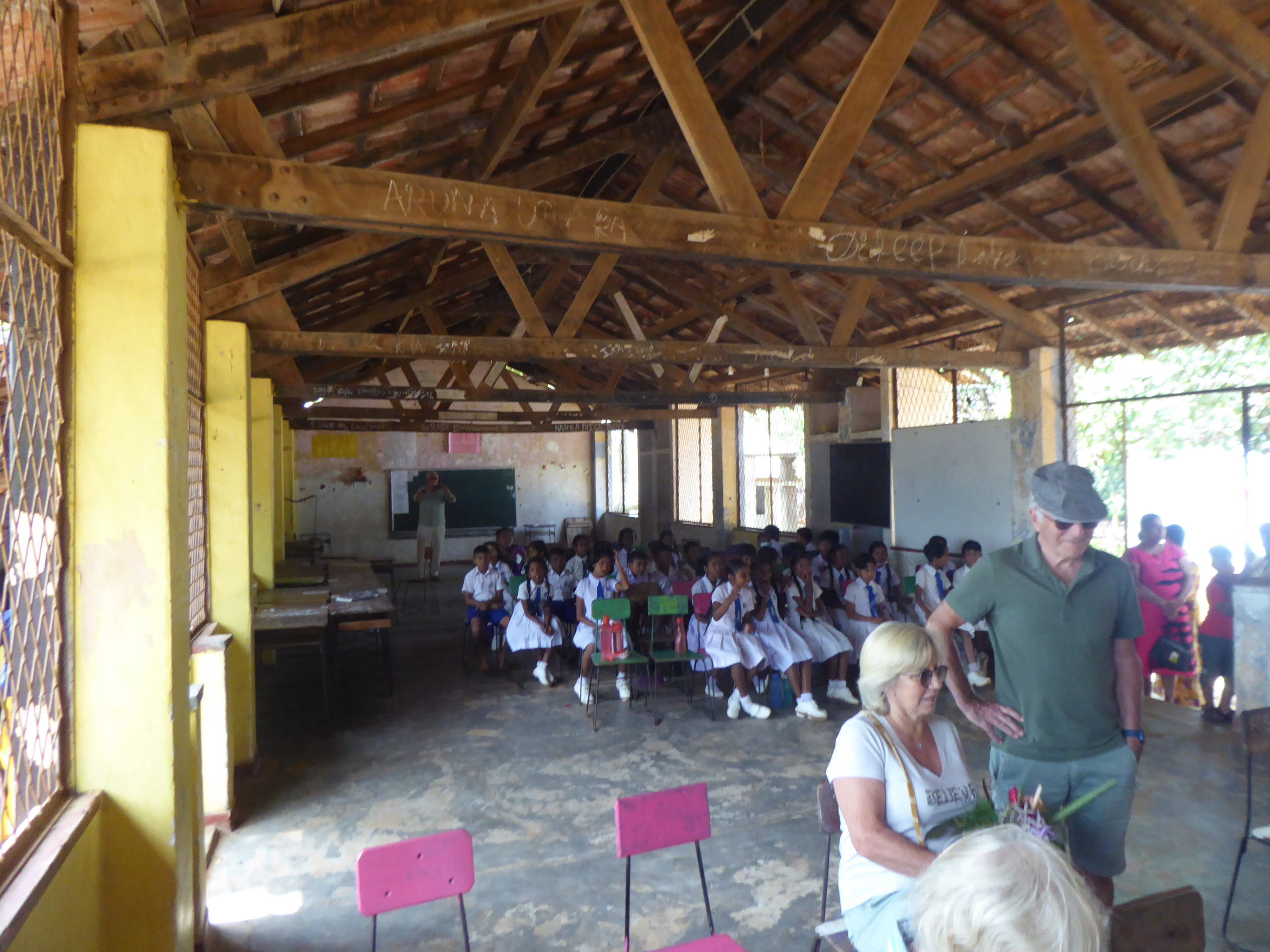
Assembly Hall
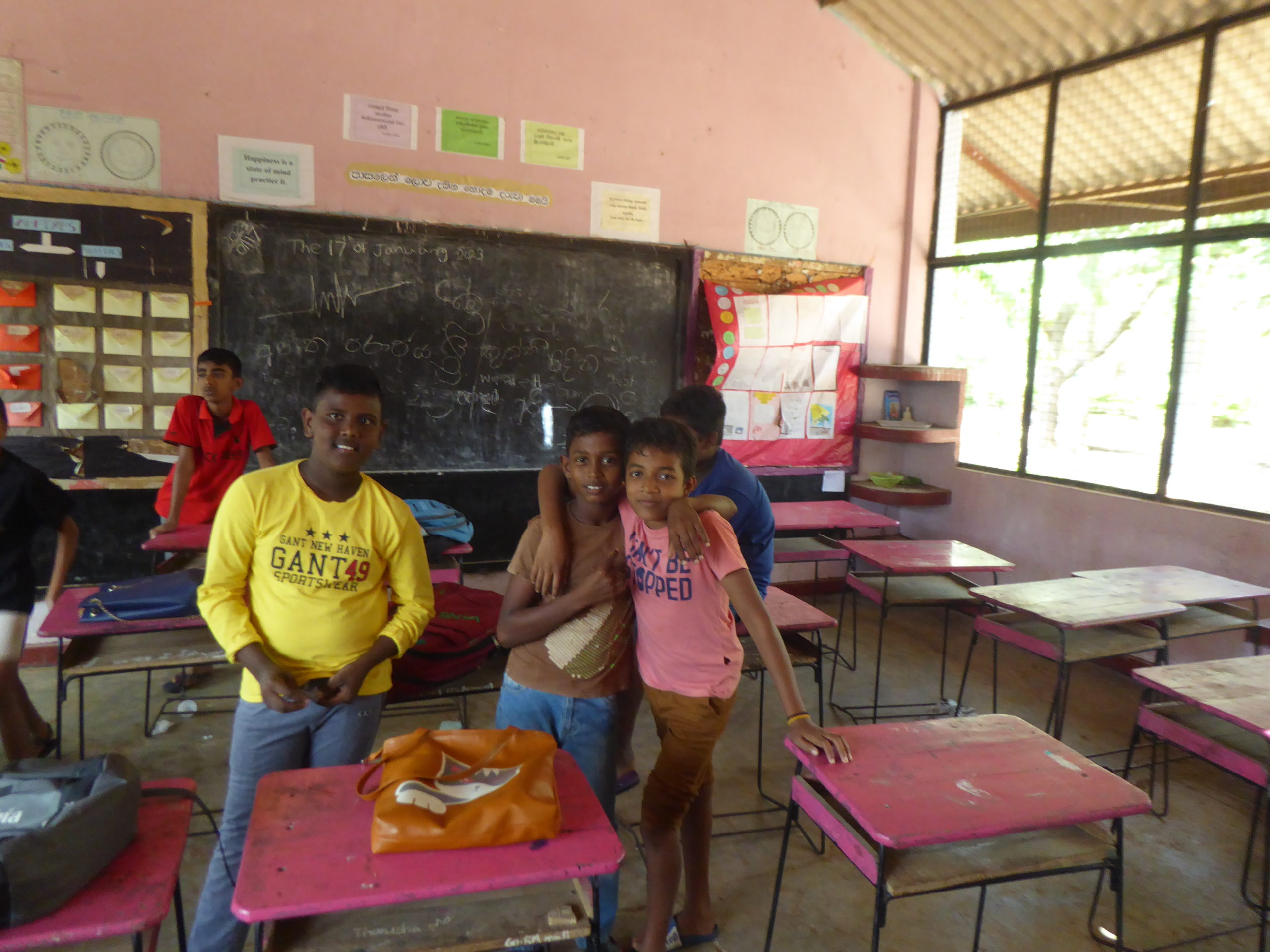
Classroom; these kids had a day off
After another large lunch we passed on the opportunity for a two hour wait to see orphaned elephants being fed and headed for the hotel, passing a beach with fishing boats, back home after a morning at sea. These boats have a single main hull and a separate additional float, all held together with tree trunks; the fishermen checking their nets under a canopy

Fishing boat with attached float
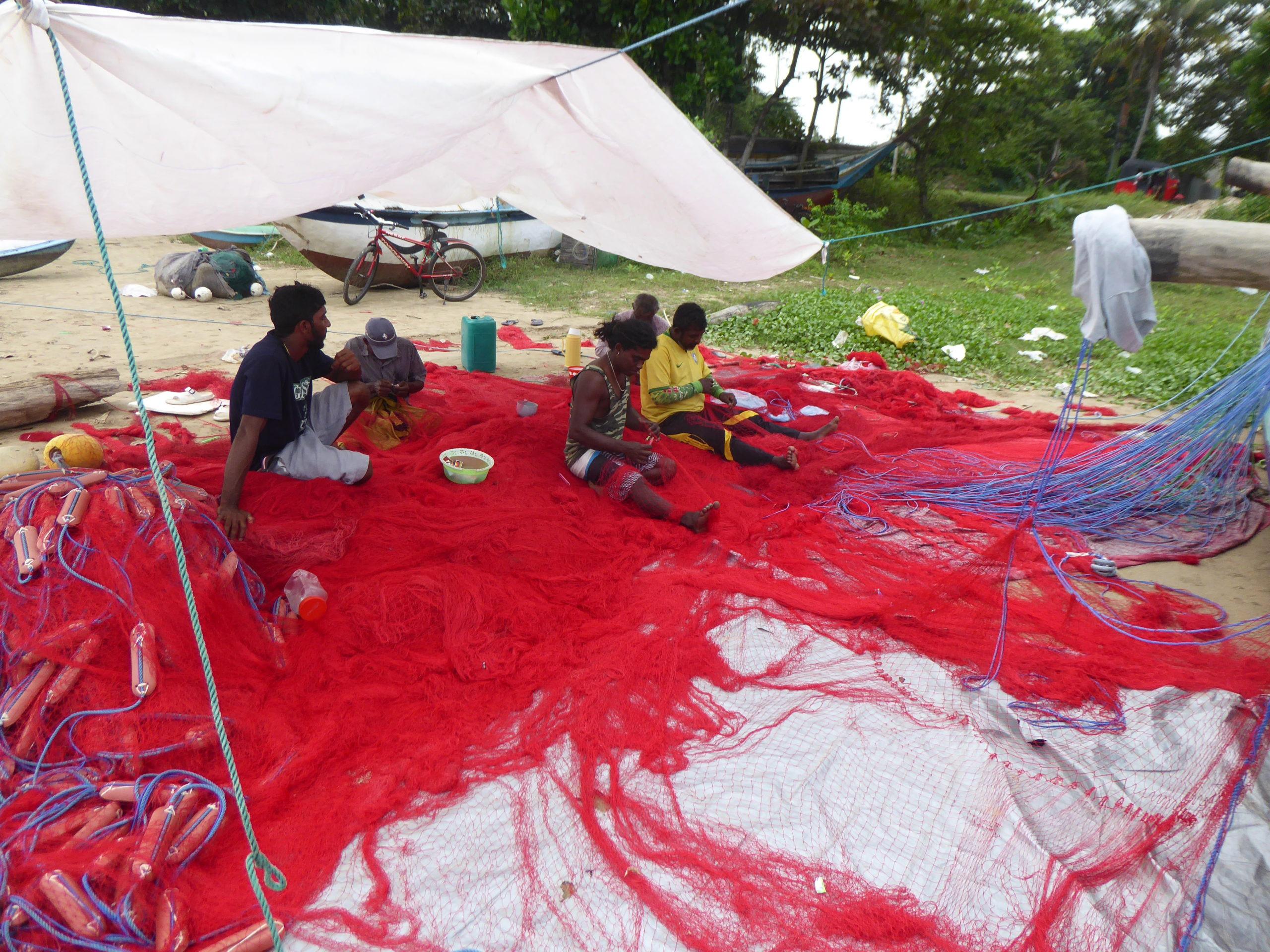
net check
At the hotel, we reported a problem with the shower and three guys came to look at it (a valve was broken and it produced only (very) hot water. We left them to it when we went for supper and a minute after we returned at about 10.00,the manager came to tell us it needed a part and would we mind being upgraded…. So at 10.30 we relocated to an even grander room. It is linear, a bathroom, entry hall and bedroom/sitting room and measures some 9*21 metres.
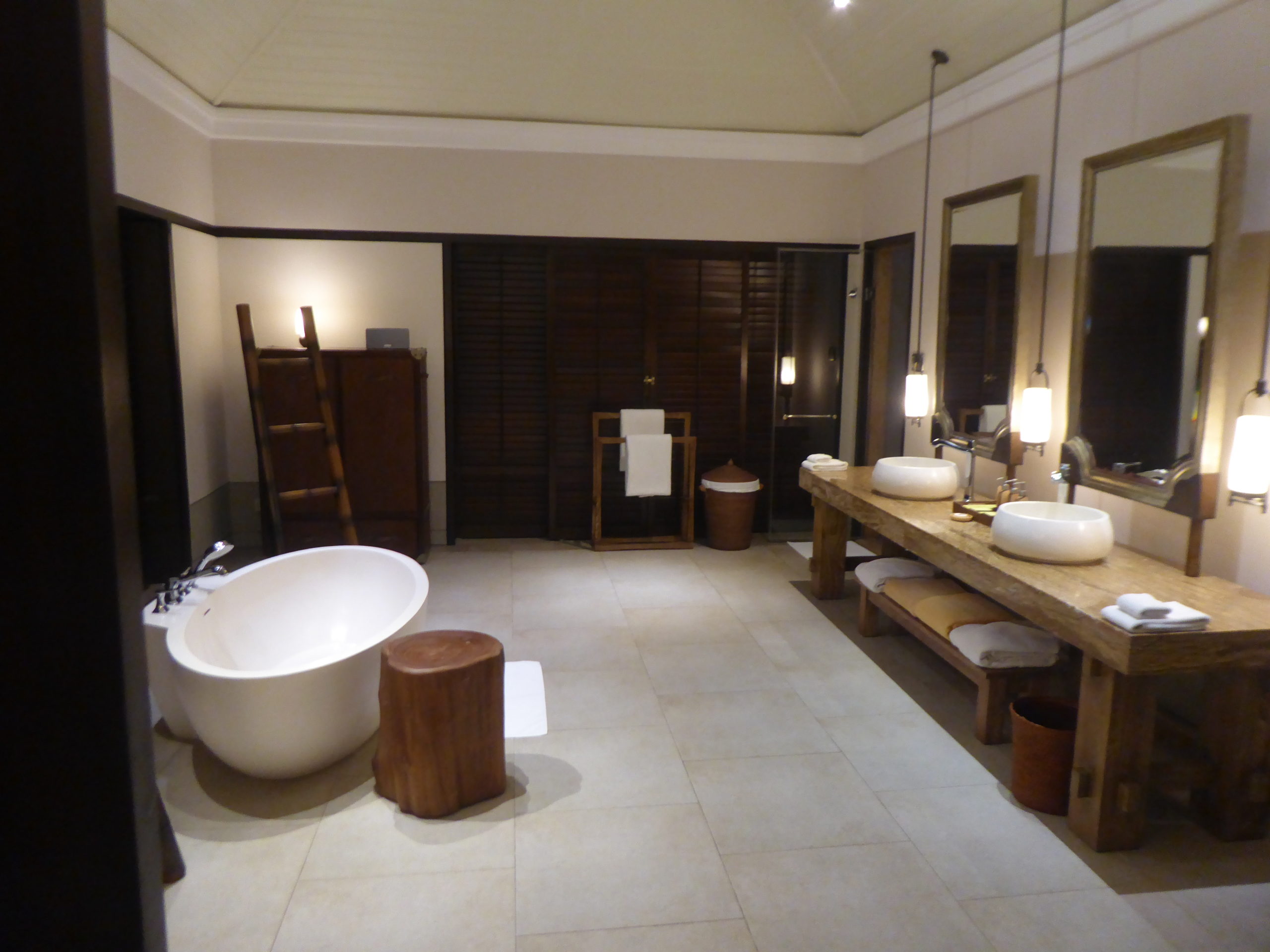
bathroom with shower, loo and dressing room off
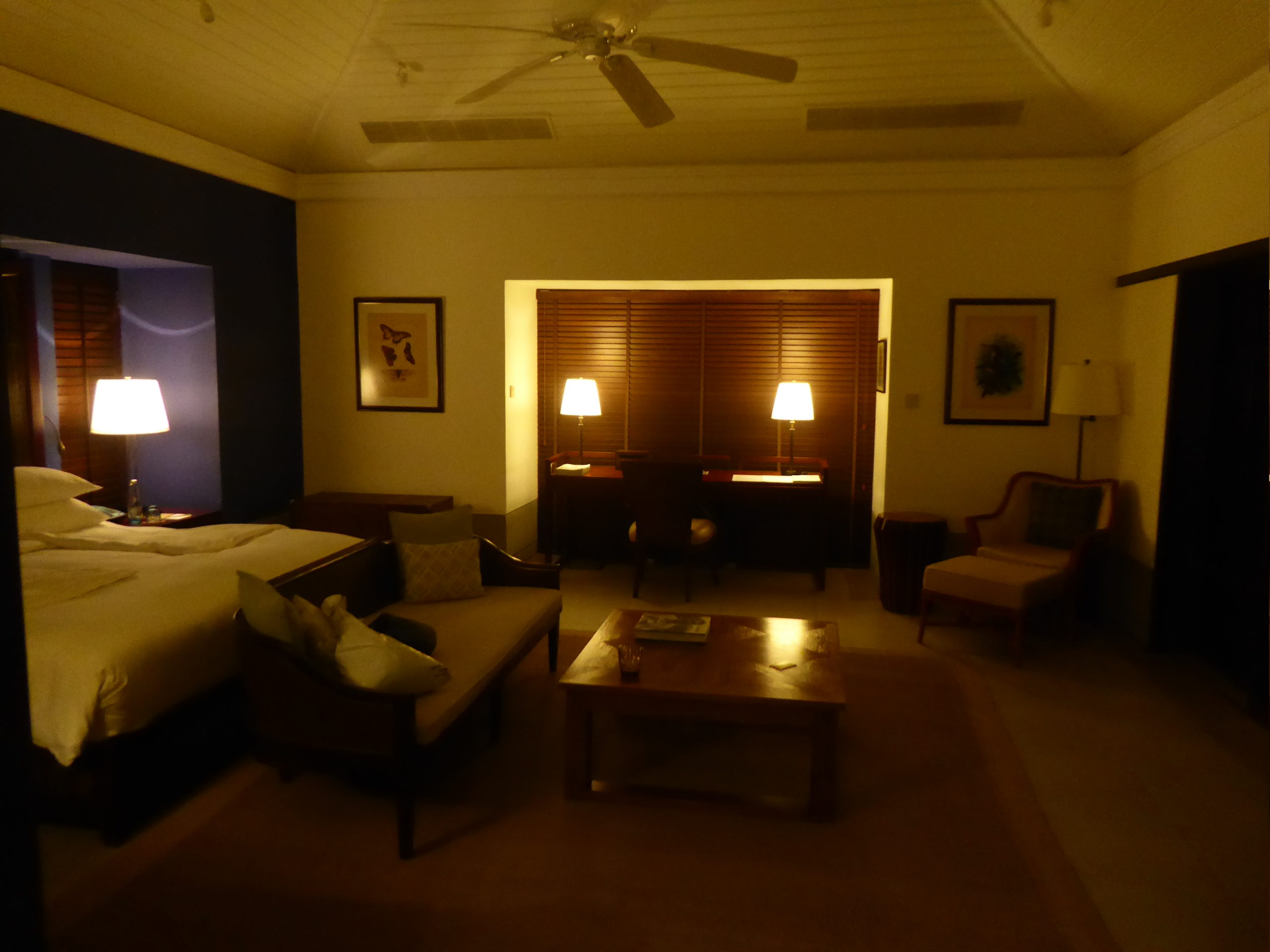
bedroom

outside
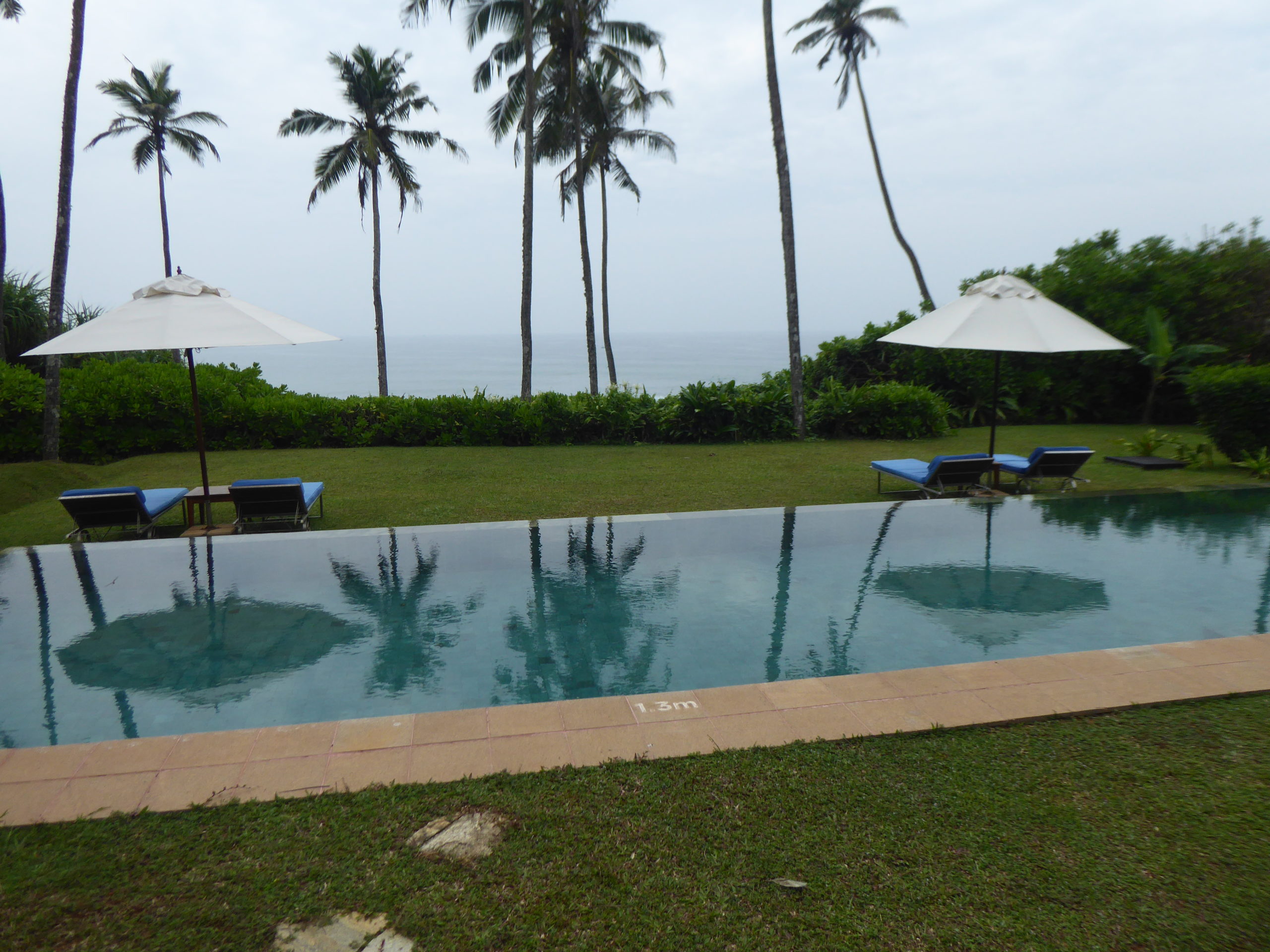
Private pool with the Indian Ocean beyond

ok, shared with peahen and chick
Friday was a rest day so we passed on the option of a 5.30 departure to go whale watching, opting for a morning swim in the pool (shared between 3 rooms and a peahen), a late breakfast and another unpack of the boot to dry it out after a downpour last night. We later found out that it was a nice boat – but no whales. In the afternoon we visited a boat building/sail making business, run by a friend of a rally participant, which started as a training enterprise but then expanded to employ the people who had been trained; then to cocktails at the owner’s house – an austere all-concrete block construction on a promontory designed by the Japanese architect Tadao Ando.

Sail making
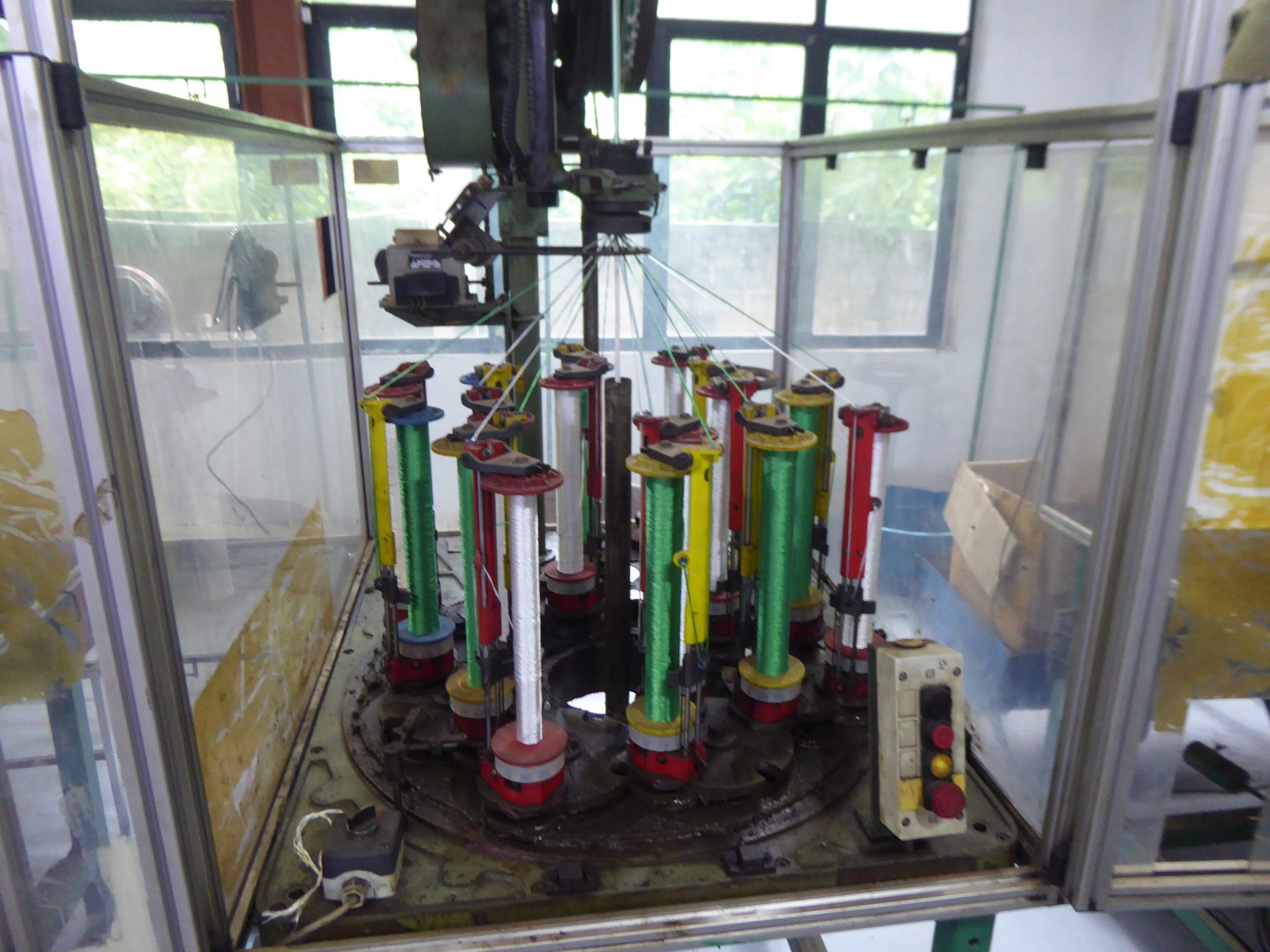
Rope making

austere concrete
Saturday we had all of 40kms to drive to Galle via a White Tea plantation, White tea is high in anti-oxidants and the story runs that in ancient China the leaves picked by virgins wearing gloves and using gold scissors to avoid contamination; even now it commands much higher per kg prices than other teas.
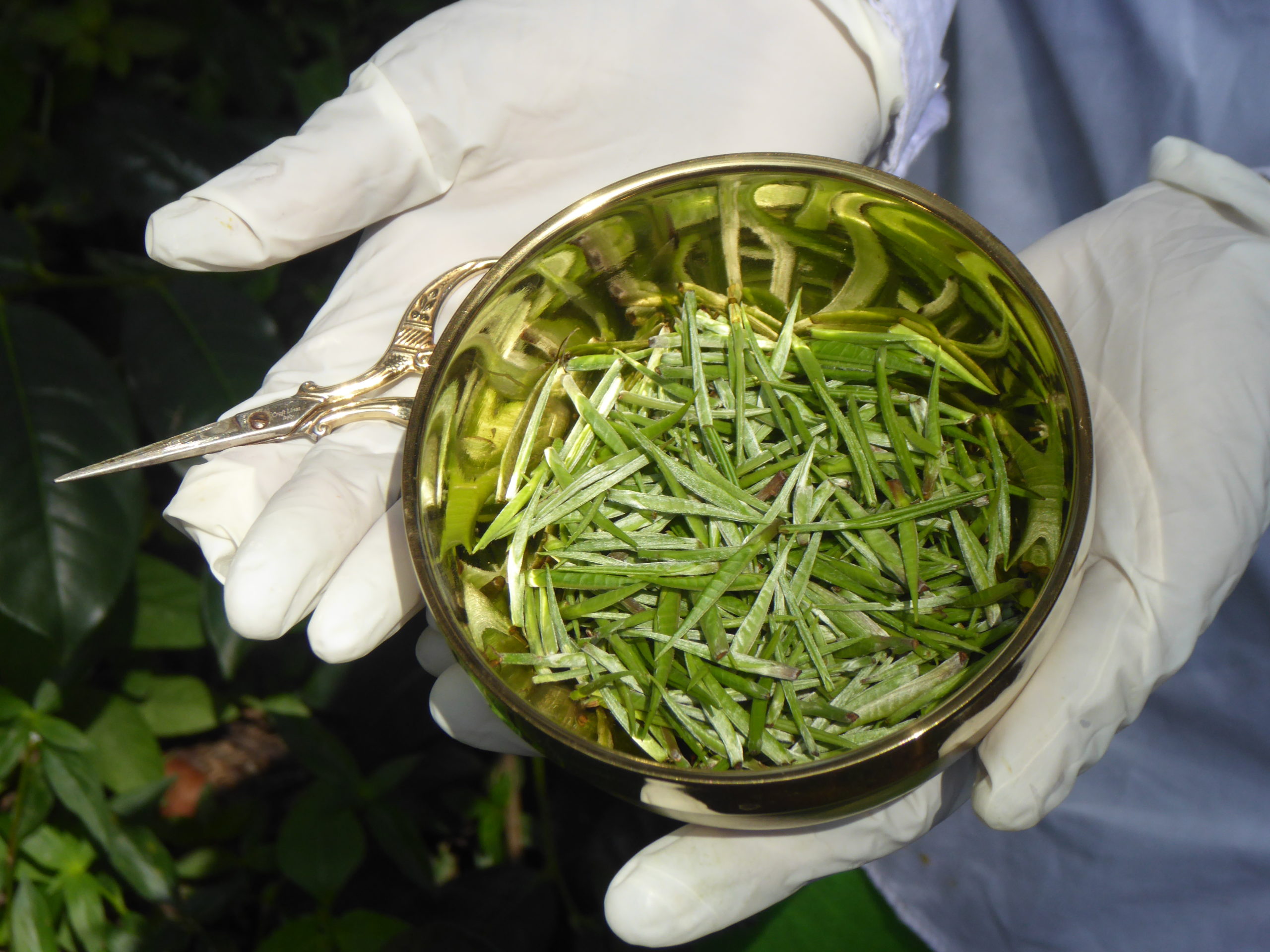
White tea – but no virgins

Tea Talk

Tea Picking
Then on to Galle and a tour round the Portuguese/Dutch/British bastions 
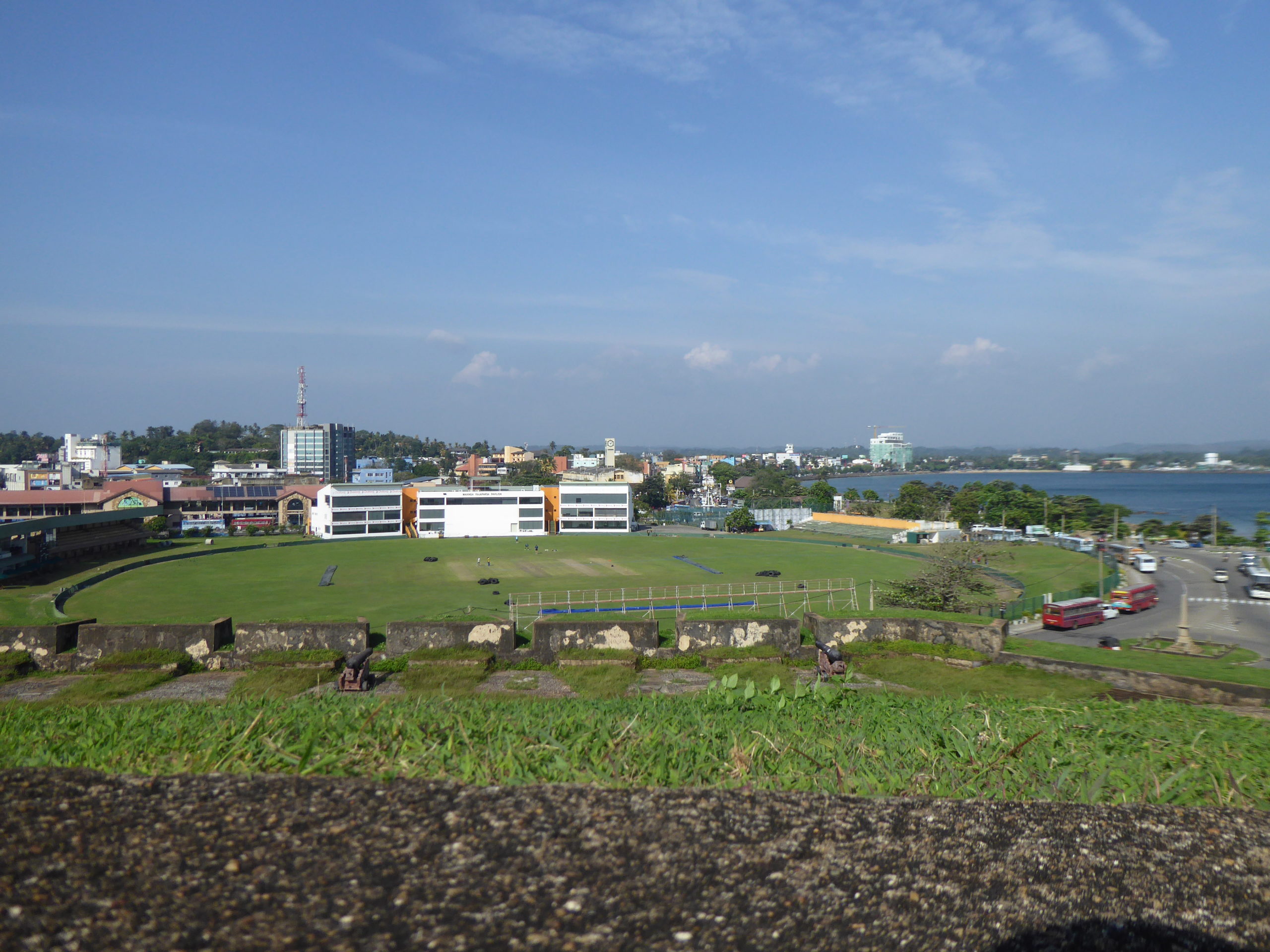
Galle Cricket Ground

Old Town Rooftops

A view along the walls

Looking towards the Lighthouse
From Galle we had a twisting route to our lunch stop with the Classic Car Club of Sri Lanka at the home of Mr Akbar – and he has a Lotus Esprit Turbo in his collection (but tucked away in a gallery of red cars at the end against a wall) – I didn’t count the number of cars in his collection but there were lots of them and all are on-the-road. The setting was fantastic with a wide spread of lawn flanked by collectible cars and the ocean behind. Te meal was excellent and far exceeding our ability to consume it!

Amongst the palm trees

Popular beach?

Car Club Members cars

Lunch Stop
After lunch a police escorted convoy took us to our Colombo hotel, where we parked up and the car’s journey was at an end. For us there was a little bit of war-time research to follow up. Our route had lead us to an area on a wartime map and Information for Visiting Troops, issued by the Troops Entertainment Committee. It marked hotels, shops, information centres and the Canteen. Some street names have changed but Lotus Road is still there

No other roads required
. We wandered the near deserted roads by the old port area, dereliction being the main feature, even though it was quite close to the Presidential Palace – the scene of mass protests just a few months earlier.
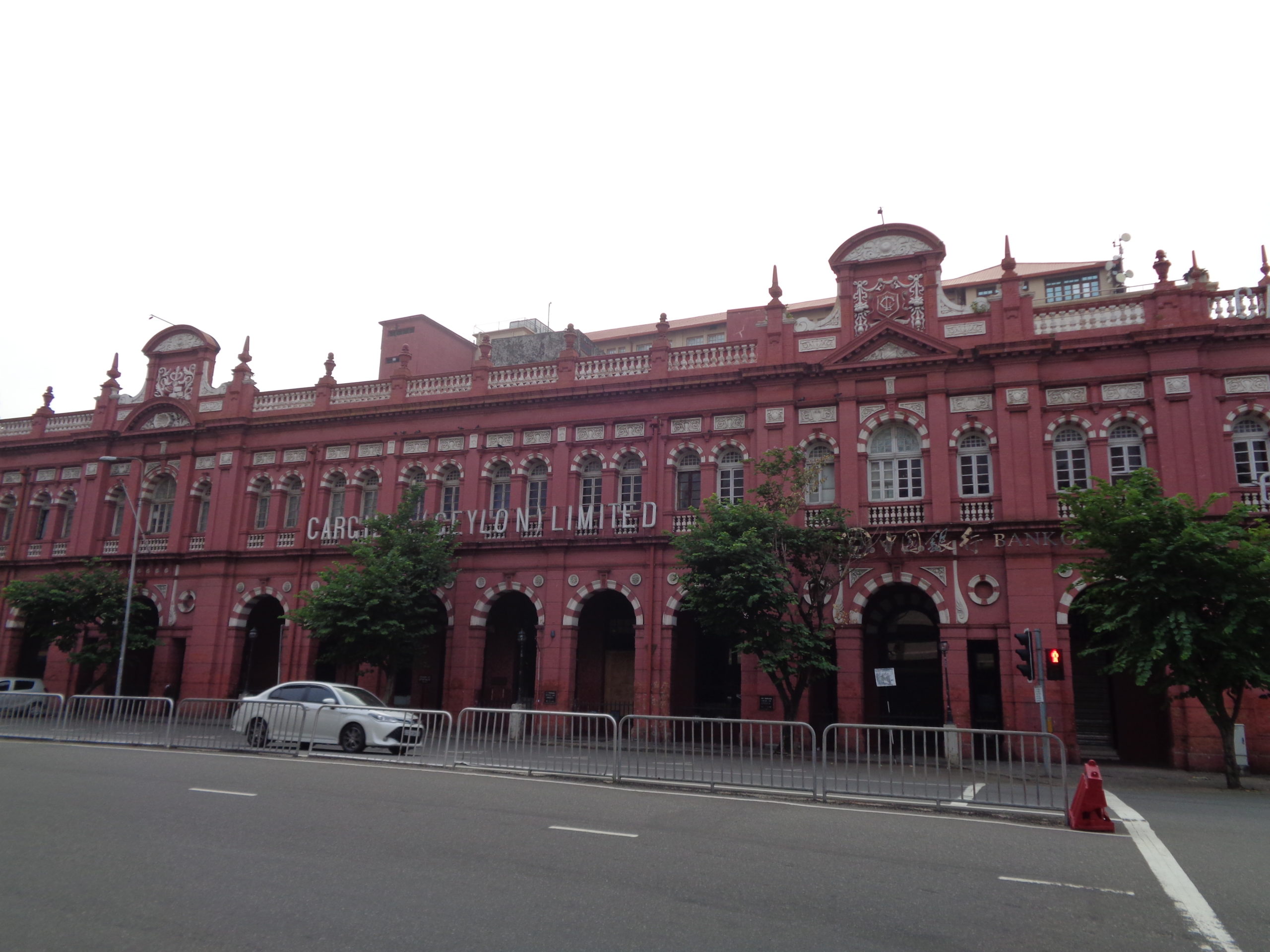
Magnificent Cargills Store

GOH – Grand Oriental Hotel
. Ending at the GOH, we found the Tap Room in the basement and drank a toast to Allison’s father – did he drink here 80 years ago? In all probability yes. Then a tuk-tuk back to our hotel on the Promenade where next week will host Independence Day celebrations and even now people were congregating. All that remained was to remember that the car radiator was full of water only after its repair and to add some anti-freeze just in case it got cold on the journey home.
Kazakhstan, Uzbekistan, Tajikistan and Kyrgyzstan
Another week and we will arrive in Almaty and hopefully find the red Elan waiting at our hotel. After a long period of idleness, the first day is some 600 kms so hope its feeling good! Start day -4 Just heard from the rally organiser that the Elan has got stuck in reverse gear – what have they been doing out there? Off to see Graham Bolton tomorrow and hope he can give me some ideas; there’s not much he doesn’t know about these gearboxes.
Start day -2 and the rally organiser sends a what’sapp video of him driving the elan round the container park – forwards! Never a problem, just the guys unloading the container didn’t know how to change gear!!
Sunday 7th and we have arrived in Tashkent, capital of Uzbekistan.

the evening sun softens the stark communist era concreterie in the main square
We landed in Almaty (ex capital of Kazakhstan) in the early hours of Friday 5th when our first task was to visit Customs to register our arrival as part of the process to clear the cars. That was achieved later in the day and we got back to the hotel in the late afternoon. Even then it was apparent that it was seriously hot – in the thirties. On Saturday we set off for Shymkent in the west of the country – a long hard drive on variable roads of 8 hours without the stops. We had sun, rain accidents, crooked police but fortunately no breakdowns. I was stopped for so-say doing 64 in a 20 limit at some road works and my USD40 went straight into his glove box! What did happen was that the oil degraded and oil pressure dropped alarmingly. For my peace of mind we changed it once we got to Taskkent. On Sunday it was the Uzbek border crossing. Our organiser was adamant that we get to the border by 11.00 am and prepare ourselves for a 4 hour wait in the sun as the Uzbeks plodded through their procedures to ensure there was a queue. In the event the process was quite smooth and two hours was enough to get out of Kazakhstan and into Uzbekistan. We had also been told to get the cars full of fuel as Uzbek quality is awful. We didn’t quite manage that and hope that a couple of gallons of Uzbek 91 Ron will mix with the Kazakh 96 to enable the car to run.

Statue of Tamerlane
Tomorrow is a rest day as we’ve done about 15% of the distance (but not the hours already). The car needs a rest as its been so hot and the guage is hovering between 90 and 100.

Tashkent Imam Hazrati Complex

Tashkent Sheikhantur
mausoleum

Over-the-hill route to Samarkand

Gur Amir – Mausoleum of Tamurlane

Bibi Khanum
The Registan

July 11 we drive to Dushanbe in Tajikistan after a day looking at the sights of Samarkand. Another border crossing which the organiser thought would take about an hour but was probably twice as long. The first car through was unloaded but they gave up on that by the time it was our turn. lunch stop at a small museum in Panjakent beside a muddy pool with over-ripe apricots falling around us. Then a long climb to about 2700 metres and the Iranian built Tunnel of Death- a 5km barely lit and unventillated tunnel; we followed the mechanics as they had lights that showed them where to go! We stopped on the way up before we overheated.

To avoid overheating

View on the descent
July 12 a rest day in Dushanbe. The heat is the killer! When we got out of the car last night, the ignition key was almost too hot to hold. At breakfast we listened to the rally organiser outline the route ahead for the next few days as we head into the wilderness of the Pamirs. Everything will be in short supply except for heat and dust! Should we take the by-pass route to the campsite in 3 days time, with the offer of easy tarmac, a shorter day but without the most scenic part of the drive along the Afghan border? Its posted as a 7 3/4+ hour day but bound to be longer for us. Bad news for the sweep as we will be the slowest car and he will have to stay with us. We’ll go for it but first we have to get to Khulaikhum and Khorog!
July 13 another long day as we head away from the capital and into the provinces. Dushanbe has wide tarmac roads and magnificent buildings – not so in the rest of the country! The first hurdle was another 5 km tunnel and we managed to find a passing local to lead us through.

Cyclists memorial
We passed a memorial to 4 cyclists killed in a terror attack a year earlier and then the halfway point of Kulob. Here we visited the mausoleum of the Iranian writer Hamadani where we were greeted like royalty – though as ever the car stole everyone’s attention. Our next stop was unintentional as the ascent to the pass proved too much for our cooling system so we stopped before we boiled over. That happened twice so that evening we removed the thermostat which we hope will let more water through the radiator. Police checkpoints were forecast to be a feature of this section of the rally as we are now in the semi autonomous area of Badakhshan. Visas and lifting the car headlights are what they want -every time!

First view of Afghanistan

Bridge to Afghanistan but not for us!
From here we are travelling the Afghan border – just across the river – and you know it looks just the same as where we are! We followed on and off tarmac to the overnight stop at khuilaikhum where the hotel was on the main road and the sight of 6 oddball classic cars was a magnet for every (annoying) kid for the whole town! We have a couple of niggly faults- the gear stick gaiter comes off which allows quantities of heat, noise and dust into the car, the passenger door jams and cannot be opened from inside and the headlight vacuum system (which lifts the lights) has a broken junction piece (and the new one broke as well!) so we’ve had to bodge an old damaged one.
July 14th an 8 hour drive at an average of 30 kph along off-road roads. This was the Pamir highway, the main trucking route from China with huge lorries plus trailers.

Give way – he’s bigger!

no kidding – that’s the way to go
The start of the day was unusually cool – thankfully – as we followed the river and the Afghan border all the way to Khorog.

Afghanistan over the river
July 15 a rest day in Khorog when not much got done! Our hotel was on the bank of the river separating us from Afghanistan and breakfast in the gardens gave us views to the other side.

Breakfast was as close as we got

Afghanistan
July 16 a potentially long and rough day along the “Wakhan corridor” beside the river to a wilderness campsite. We opted for a more gentle route with more recognised roads. Our local guide accompanied us in his 4×4 and it was ironic that it was his 4×4 which broke down! we helped him repair his cv joint and shared a very sweet melon with a passing truck driver who stopped to look. 

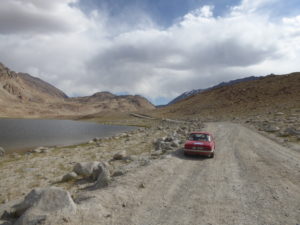 After the lake the track was very rough and corrugated which meant that we were in first gear for much of the next 30 miles. At one incline, the track was so steep and rough that the car could not get up. We had to clear rocks, roll back,charge up and hope to limit the damage to the underside. On this section we sustained a lot of damage both to the sump guard which was smashed and dented and to the rear exhaust where the fixing under the boot was ripped out; the exhaust is now held in place by its safety chains. We got to the campsite and decided to leave the damage where it was but to raise the suspension to give us more ground clearance.

July 17 – the Sweep did most of the work to raise the suspension – the fine threads on the adjustable spring platforms had been filled with dust, which combined with a bit of damp meant the result was near concrete and needed a lot of extra leverage from his tools to turn the adjusters. We retraced our route along those 30 miles but more easily. Twice we stopped to remove stones which were rubbing between the dirt shield and the brake disc and once the car just stopped – and restarted a few moments rest. A couple of cars were suffering with variable fuel – cutting out or frothing out of the tanks.
 After this work we were at the end of the rally with the sweep behind us. The plan had been to go to another wildcamp – we got there to find lots of mosquitoes but nothing else – change of plan but the organiser failed to tell us – he misjudged how far we had got but fortunately Phil and Kieron came to see the campsite and told us of the revised plans.
July 18 – another border crossing, now from Tajikistan to Kyrgyzstan. There had been a border dispute so the two posts are 20 km apart on the top of a mountain and that 20 km of no mans land has no-one to maintain the rocky, baked soil track which passes for a “road”. Fortunately we were going down hill but going up after rain would have required a 4WD. On the way we met various groups of cyclists. Question – who is more deranged, someone cycling in these conditions or someone in a Lotus Elan?

Golden marmot

with one of many cyclists

and they are cycling to over 4600 metres!

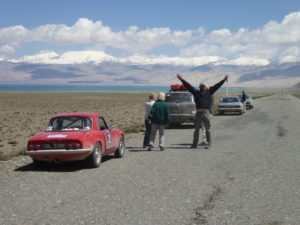
by Lake Karakol

Between the border posts
July 19 a rest day in Osh, Kyrgyzstan’s second city. Both we and the car were dustbowls – it was everywhere! We tinkered with the car before taking it to a very thorough (and long winded) carwash at the garage next door  Then a stroll up to Solomon Mountain and down to the river walks where an old aircraft sits in a clearing, its wings providing shade for a cafe.
July 20th from Osh we set out on our longest scheduled day to a yurt camp in a old caravanserai 500 kms and 9+ hours away.

Mountain pass-the camera suffered from the dust as well!
We together with Paul and Mary in the Jag XK decided that would be too long a day as most was on gravel and there was another yurt camp the following night. So we took most of the route before taking the tarmac to a hotel in Naryn. Even our route took 10 hours, not helped by having to return to the hotel to tighten up the fan belt which had been ok yesterday! And three halts on the inclines as we stopped to cool down before boiling over 


July 21 no rush today as we had only a couple of hours drive to an upmarket yurt camp on the shores of Song Kul lake.

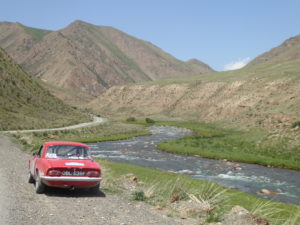
Beside a babbling brook….
To get there we had to climb the 33 Parrots Pass; we haven’t found out how it got that name though 33 seems to refer to the number of hairpins. These had to be taken at speed as we didn’t have enough spare engine power to pick our way gently round the rocks and gulleys – a bit of a wing and a prayer perhaps?

Count them if you can

Our Yurt, wood fire and 4 beds

Group breakfast

Action outside
Everywhere we looked here there were scattered yurt camps and herds of sheep, goats and horses – all looking very fit and well fed on the plentiful grass.

grazing herds/flocks
July 22 we left the lakeside wilderness for Bishkek, the capital of Kyrgyzstan, sooner overtaken by the organiser in his 4WD who enveloped us in clouds of dust. Then it rained, the temperature dropped and we stopped to put on some warm clothes! The windscreen wiper rubber became detached from the holder so we stopped again to re-attach it – wearing waterproofs – but the rain did keep the dust down! Approaching Kochkor, we fortunately took the wrong road. This meant that we were going much slower as we came upon a police control! They stopped us but as we were not speeding and had our lights on, there was not much they could do apart from ask for documents and let us go on our way! Others were not so lucky and were done for “no headlights”. Allison decided the car was too empty so we had to stop (a number of times) until we found a women’s co-operative who made the felt rugs. Leaving town we picked up our “Sweep escort” – they had been making coffee waiting for us – all cars have trackers and the sweep is meant to follow the last car on the rally route; chose a different route and you lose the comfort of the Sweep. We stopped at Burana Tower where we found the Aston Martin

Burana Tower – dust affecting the camera shutter

View from the top on a hazy day
.
Then off to Bishkek mainly on tarmac side roads, following the Aston until his superior power on the hills left us behind.
July 23/24 two rest days in Bishkek, doing the sights, checking on the car (the sweep, Pablo had planned to attack the sump guard with a large hammer but problems with the Mercedes wheel bearings distracted him so we remain with a mis-shaped guard!). I made an attempt to hold the rear of the exhaust on a mounting bracket as opposed to the safety chains so time will tell how long that lasts!

Bishkek Ala Too Square

More Ala Too Square

In the bazaar

Swimming in Ala Too Square
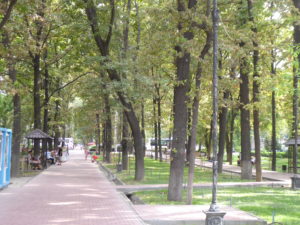
Tree lined boulevard near the hotel

Austere WW2 Memorial
Tomorrow – we leave Bishkek (and the heat?) for Issy Kul lake and Karakol, will the Lotus exhaust and the Merceds rear wheel bearing hold up?
July 25 a drive along tarmac roads from Bishkek to Karakol, much of it alongside the 100+ mile long Issy Kul Lake. We were stopped twice by the police; the first was purely a “what is this?”, all very pleasant and we carried on. The second was on a dual carriageway when we were singled out in a line a free flowing traffic and asked for a USD 100 fine, this went gradually down to USD 40, then USD 25 then they gave up and I walked away clearly being a time waster! We tried to find a “salt lake” but that was a small fenced off pool so we tried the Skazka Valley Fairytale Canyon.

Skazka Valley

Skazka Valley
/ Then down to the lake for a sandwich lunch and very brief paddle;there was zero activity on the water and we were told there was plenty on the more developed northern shore but none here on the southern. We were now at 1600 metres compared to 700 at Bishkek but the effect on temperature was enormous. It was hot in the sun but otherwise cool – bearable!

By Issy Kul Lake
. After this, things got a bit confusing but not for us. The Sweep was tracking us as we took a wrong turn towards Barskoon Waterfall. As he lost network coverage, he assumed we had gone on to the waterfall so he followed along and found us not there! In fact we had taken the wrong turn into the village as Allison wanted to revisit a felt factory she had visited 12 years ago. She found it eventually by asking at a shop where someone recognised a person in the photos she had. So we found the factory, had koumiss with owner, talked about changes to the factory and were given some hand made mats for car seats representing a traditional pattern. When the sweep regained coverage he saw a spiders web of tracks as we wandered round the village. We were last into the hotel and spent a happy hour repairing the door lock which was threatening to fall off and did just that as soon as we showed it the toolbox. We had bypassed a fine art museum but in doing so missed an abandoned Soviet era uranium mining village, which was much more interesting!
July 26 a rest day in Karakol, Allison went to the market with our Kyrgy guide whilst I attempted the never ending tasks of dusting the inside of the car with a damp cloth and adjusting the handbrake. En route to tge picnic arranged by the organiser (60 kms away) we visited the Russian Orthodox Church (rebuilt 1860 following an earthquake) and the Chinese Mosque, built without nails

Karakol Orthodox Church

Dungan Mosque
We were late to the picnic site after being stopped by some would-be police who had a barrier across the road and demanded documents so I asked them for proof they were police; they showed something but it could have been swimming club membership for all I knew! We got through but decided that Allison could drive back in the afternoon.

Picnic Valley
Tomorrow we are camping and then its our last driving day arriving in Almaty on Sunday afternoon.
July 27 – our drive to the Kazakh border was obstructed by the closure of the highway (which we took to avoid 25 kms of rough road) but as it happens we got rough roads when the highway ended!

Last road in Kyrgyzstan
The road was mainly tarmac in Kazakhstan but undulating and we had to slow to avoid smashing the exhaust as rear bounced up and down. The exhaust survived but we broke the catch chain, which I heard dragging on the road. The sight of the day was Charyn Canyon, it must have been formed by a river but the floor now is a dry and dusty trail leading to a holiday village

The smooth, bleak road to the Canyon

Above the canyon

The Canyon Floor

A walk along the valley flopr
Heading for the Campsite we were stopped by the organiser to be told that the site was very windy with sand blowing everywhere in the gusts; did we want to camp or continue to Almaty, as the first three cars had done? We chose Almaty. At a cafe in the next village we met up with the crew and, later, the last three cars – all of whom chose to camp! We took the Highway and an uneventful 2 hour run to the hotel. The alternative was the “rally route” which the organiser later told us was rougher than expected.
July 28 – our first call was Violet’s car wash, where we sat with Richard and Heather and a civilised tea whilst an almost all-female team cleaned the cars. Then sightseeing, the Orthodox Cathedral,

Cathedral of the holy Ascension
the Arasan Baths “exuberant 1980’s Soviet architecture” and the pedestrianised Zhibek Zholy Street after which we took a tube and walking route back to the hotel and the end of the rally. The car had not done the entire rally route but had survived some very rough tracks with no major problems and not even a puncture;plenty of minor niggles, mainly caused by things rattling loose. Next trip – Moscow in the yellow Elan,lets hope its more successful than its abortive trip to New Zealand!

Leaving the Almaty hotel for the container port
Classic Persia
October 21st – tourist day! We took the bus again and really the only times we got off were to change busses or to go on boat trips – and both boats we only made by the skin of our teeth, one had already cast off but as there were only 8 other passengers it was no problem. Today’s photos try to show the old (dhows) and the new (the infrastructure and skyline).
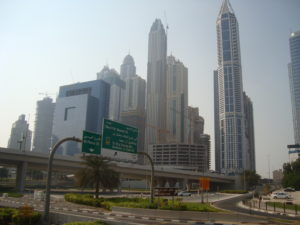

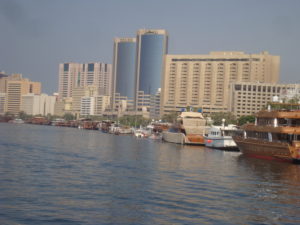
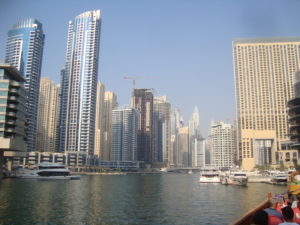
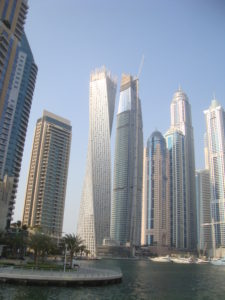
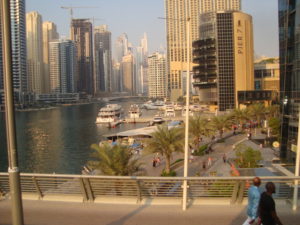
October 20th – Its a different world in Dubai! We got to our hotel after the flight from
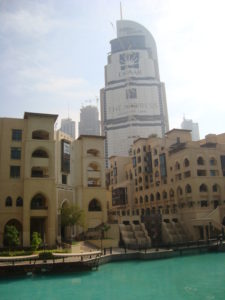
View from the hotel room
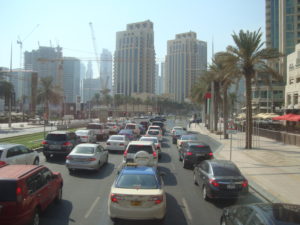
Dubai scene
Bandar Abbas at around 11.15 and by the time we got to bed it was past midnight. Our hotel is unashamed luxury, the staff are embarrassingly deferential, everything is available (at a price), ladies wear what they want from full burkas with just the eyes – showing at one extreme to (nearly) everything showing! The building work and skyline is amazing, there are excellent roads everywhere, driving is disciplined, all the cars are modern and clean – and the flight time was just 35 minutes. We bought a bus ticket and spent the day hopping off the bus and into tourist sites. This evening is our rally dinner – but the organisers have not yet got the cars to the containers; they had planned to do this without us being involved. The cars are in the UAE but the next part is

Compare this with….
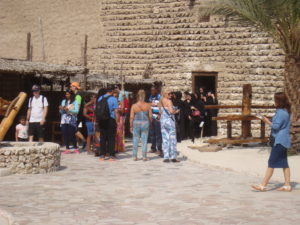
….this – at the same site
unfinished and this evening we might find out what is happening and whether we may need to be involved tomorrow.
October 19th – up early (5.30) as I could not sleep – so checked the car’s points instead! The
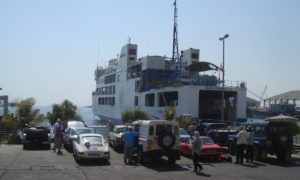
Portside in Bandar Abbas
gap had closed up. reset it and the car started ok so maybe that was it. We then convoyed to the port and spent about 3 hours being processed, getting back to the hotel at around 12.30. We are not expecting to see the car until Southampton.
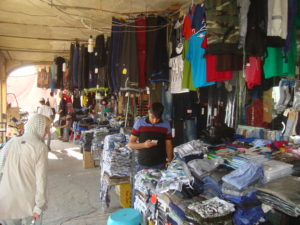
Allison (not) shopping in Bandar Abbas
October 18th – this was to have been a 9 hour day but after questions were asked, the route was shifted to become 7 hours. We had a navigational “moment” on leaving the hotel so had an unguided tour of Shiraz. The Garmin didn’t help as it repeatedly took us back to the same square and gave impossible directions. Eventually we got out and drove south into the heat of the desert – 39 according to Kieran. The car was not entirely happy and the water temperature was around 90 for most of the day. We had several spluttering sessions but outside of these the car ran well. Paul’s Mercedes suffered similarly; he changed points, condenser and plugs and the problem continued. Our problem may be points but the car starts ok which it doesn’t normally when points are dying. Anyway we now have just 10 km to go to the port and the next journey will be in England. Bandar Abbas is hotter and more humid than anywhere we have been before and we were dripping when we reached the hotel and its welcome air conditioning. Tomorrow is scheduled to be a day at the port, getting the car exported from Iran (then we can redeem our Carnet de Passage). First stop is the ferry to UAE then a transporter to the container port in Dubai.
October 17th – a day in Shiraz – somehow much more tiring than a day of driving and certainly
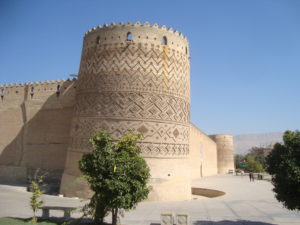
Arg-e-Karim Khan Zand

Vakil Mosque
more expensive! A taxi into town brought us to the citadel, built 250 years ago, more like a palace but it has been a prison. Inside the gardens contained orange trees (every garden has orange trees, green skinned) but we didn’t try picking them! Then a bit of a ramble through various bazars to the Vakil Mosque, where we came upon our tour guide who was most concerned as he had lost one couple and was trying to find them. Then to the money changers and a teahouse before visiting the Shah Cheragh Mausoleum. This was a huge complex
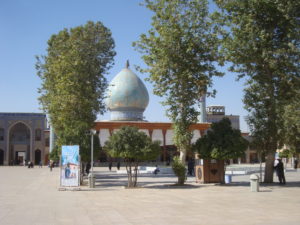
Shah Cheragh
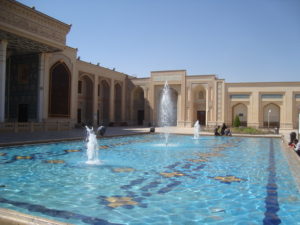
Shah Cheragh
and seems to have absorbed what is marked o the map as a large intersection. It contains the graves of two brothers of the eighth Imam. Allison had to wear a Chador and we were accompanied by an official guide. Here we met two more sets of participants -there must be a statistic to calculate the odds but I guess they are low. Lunch was at a local restaurant up a side street – all Iranians apart from us. Another Mosque and a
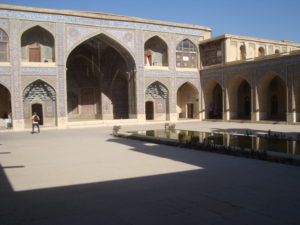
Nasir al-Molk Mosque
150 year old house
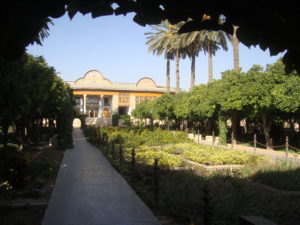
Narenjestan
more gardens – and we were finished!
October 16th – the rally were organising a tour of Shiraz today and a trip (by car) to the ancient sites tomorrow. We preferred to reverse the programme so that if anything happened carwise en route, there would be a day in hand to sort it out. So we went to Persepolis and then to Pasegard.
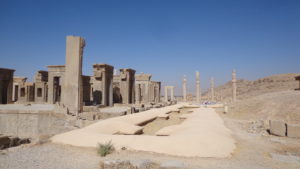
Persepolis
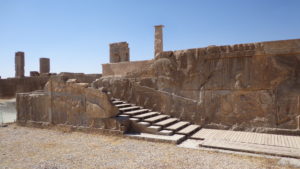 Persepolis had changed since our last visit nearly 40 years ago. There was a visitor centre, stalls and car parking. The site had been protected against excess human traffic by way of screens and fenced off areas. None of which takes away from the spectacle. Then on to Pasegard, a disappointment but maybe I was thinking of another site at Naqsh-e-Rostam when I remembered what we saw before.
Wherever we went the Elan was the most photographed object in town. 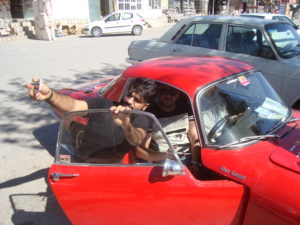
October 15th – we took advantage of the 6am breakfast and were on the road by 7.00,heading for Shiraz.
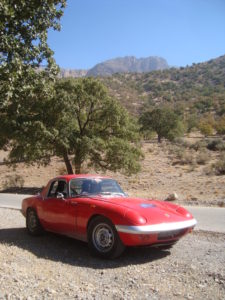
On a quiet mountain road
The direct route was 4 1/2 hours, ours was slightly longer but we avoided the roughest section and were in Shiraz shortly after 3pm. En route we had our first motoring incident, peacefully bumbling along the motorway, a local drove into the passengers door – a glancing blow, I guess he was so busy looking that he didn’t see where he was.
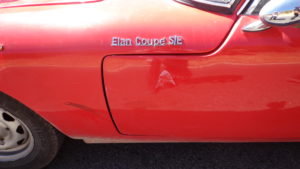
No real damage
I jumped out and shouted at him – after hooting furiously at him. He didn’t try to protest any innocence and indicated that the marks could be polished off. There was no physical damage, just we ended up with some of his rubber strip and white paint and he had some of our red! He was a bit alarmed that I was dripping blood – caught my thumb on something whilst jumping out. However he kissed me on both cheeks, we shook hands and that was it. Allison says the door closed better afterwards.
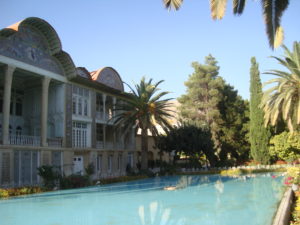
Palace at Barg-e-Eram
We went on past the hotel to the Barg-e-Eram, the most important of the numerous gardens in Shiraz, a peaceful and quiet contrast to the noise and bustle of city driving in Iran! Our room is on the corner of the 16th floor with views onto the mountains ringing the city one way and the car park the other – to see a little red car way down below!
October 14th – second rest day. I tightened the fan belt before breakfast and found we had lost one of the bolts securing the alternator. Timothy had spent yesterday in the car park working on the Lagonda and reported a steady stream of visitors – the Lotus bonnet would be full of fingerprints! Everybody was asking him what was happening so he really needed an assistant just to speak with people! Half the rally went on a
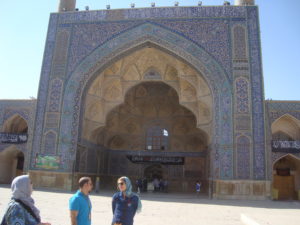
Courtyard Friday Mosque
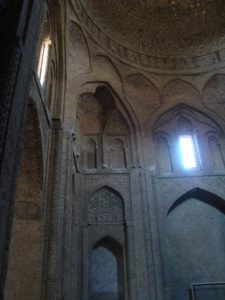
Inside Friday Mosque
tour of contrasts in the morning, first to the exceptionally plain Friday Mosque, tiled in the courtyard but inside just bricks and a little mud coloured plaster, different styles of brickwork – a huge complex constructed over seven centuries. Part was rebuilt following an airstrike in the Iran-Iraq war. Then to the Armenian St Saviours Cathedral – the interior covered in
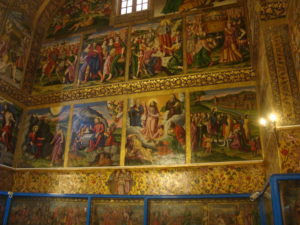
Inside St Saviours
paintings, some depicting the gruesome tortures of saints. An unusual Cathedral in that it had a Mosque-like dome to stay in keeping with the surrounding architecture.
We then went to the Khaju Bridge – now an irrelevance as the Zayanden River has been redirected to provide water for Yazd. The riverbed is dry as a bone and surprisingly free of debris. A fleet of
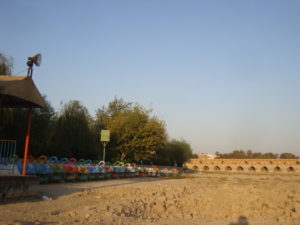
Dried out pedalos
pedalos stand forlornly by the bank. Then to the Palace of Hasht Behesht and the inevitable ice cream at the Abbasi Hotel for Allison.
October 13th – the first of 2 rest days in Isfahan. Brief check of car before breakfast – need to tighten up fan belt otherwise all seems ok. A tour was arranged to the four main sites in Isfahan
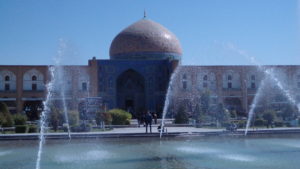
Shah Mosque
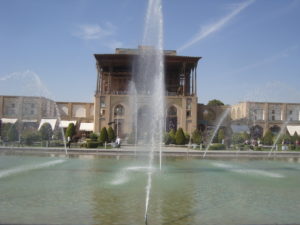
Ali Qapu Palace
– the two Mosques on the main square, Maidan-e-Imam (it had different names in the past), Ali Qapu Palace and Chehel Sotun. This was followed by a trip to a carpet shop and lunch. Allison thought but not for long about a carpet. The others were more serious and were going to go back later. Then a meander round the bazar, after which Allison realised she had lost her camera. We retraced our steps – souvenir shop, pistaccio shop, exchange booth and found it on top of a pile of nougat in the sweet shop – untouched. We ended at the Abbassi Hotel for afternoon tea; Allison had come here with her mother 40 years ago and it was the highlight of mother’s trip to Iran. Returning to our hotel after supper, I was crossing a 4 lane dual carriageway when a policeman came out, shook m
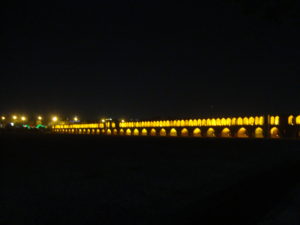
Se-o-se Pol bridge at night
y hand and stopped the traffic for me!
October 12th – a long drive to Isfahan so the interest had to come from the road. Today was part

Procession
of Ashura and the roads were empty – of cars. In the towns there were processions – drums. flags, people with “mud” on their hair, face and clothes and the rituals of self-flagellation.
On the road we came across the stationary Mercedes of Paul & Sandra – this time a broken fan belt. After problems with the gears and ongoing unhappiness with the ignition timing, Paul’s comment was – I should have brought a Lotus!
Altogether three rally cars came to Paul’s aid as well as numerous Iranians, some to take photos –
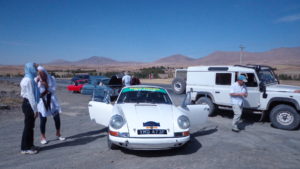
Four of the remaining five rally cars
mainly of the Lotus, but there was also the Mercedes and the Porsche to choose from. One kind man
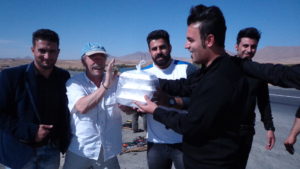
lunch boxes for Bernard
went back to the nearest town and returned with lunch boxes for each rally car. The friendliness of the Iranians cannot be overstated, they ask where we are from and say “welcome to our country” – the only exception being when you are lost at a road junction, unable to read the Farsi signs and not knowing where the places are anyway – then impatience and hooting are the order of the day.
October 11th – the direct route to Kermanshah is 130km and takes just over 2 hours.

The scenery – Lotus
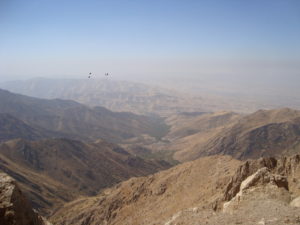 Our route was up into the hills of Kurdistan, overlooking Iraq and was nearer 350km and 7 hours. We came across a broken down Mercedes early on –they were stuck in 5th gear, fortunately they were able to hammer the external gear linkage which was jammed and were able to continue. Then we had a lengthy stop at a military control point, together with the Mercedes of Phil & Kieron – but not the Landrover of Dina & Bernard which sailed on through as the soldiers were looking the other way; frantic military hand-waving went unnoticed! We spent a good 20 minutes whilst our passports were checked and phone calls made. We were told not to take photos but of course every passing car had mobile phones out taking photos of the Elan! One can understand their suspicion, after all why would any sensible person take a 350 km trip to another town when 130 was on offer?
The route split after a while; we opted for the shorter and quicker route – probably just as well because the other route was extremely rough. We stopped at an empty layby to look out over Iraq. The layby soon filled up and the cameras were out in force; people were in the car, on the car and around the car. Two teenage girls came up from another layby and had a long conversation with Allison, also translating questions from the others and our answers about the car. The upshot was that we were invited to lunch at Grandma’s but first we had tea with them in their layby – cue more Lotus viewing and photos! After lunch we set off on a route which crossed between the road we wanted to be on and the main route of the day, joining just after the end of their rough section. Concerned over the gearbox – a new noise and very hot. The gear lever rubber sleeve had come off – so that may explain some of the noise – and checked the oil so we’ll see how tomorrow fares.
At the hotel, Phil and Kieron told how they were nearly blown up – rock blasting was taking place on the main rally route (the rough part) but the only warning was a man in dusty clothes, running around and waving his arms. They took him for a village idiot but stopped when the car behind them stopped and flashed – the road ahead was soon covered in rockfall……
October 10th – today we planned to go completely off route by visiting the remains at Tahkt-e-Soleyman
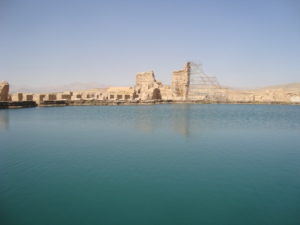
The Lake in the crater
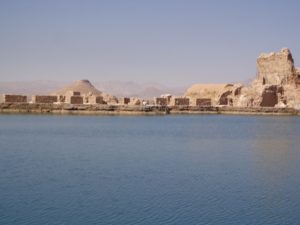
The Lake
en-route to Sanandaj. The rally had encouraged us to use a navigational app called Gallileo – we had the app but not got round to loading the tracks or using it. Today we wanted it to make sure that we knew where we were as I was not sure if I could program the Garmin sat nav. In the event we used both though relying mainly on the Garmin. I missed the first turning and then we were confused when the Garmin tried to make us drive across a dual carriageway and through the Armco in the central barrier! Eventually we got on the right road and navigation was ok thereafter; we rejoined the rally route about 80 km before Sanandaj.
The site was built around a crater and enclosed in 200AD. It contained a Zoroastrian Fire Temple where the Kings used to come to complete their accession. We had the site virtually to ourselves, most of the other visitors being Iranian.
Leaving Tahkt-e-Soleyman we had our first puncture of the trip and 10km later found a town where it was repaired. The sight of the Elan drew the crowds and as usual I found it very difficult to answer one of the most common questions – how much does it cost? How would you value a collector’s car in a country where there are no spares and often unsuitable roads? The mobile phone cameras are out in force everywhere the Elan appears and its difficult to tell if men or women are the greatest fans! Two cars are now “out” of the rally -the Lagonda, being trucked to Isfahan when new parts from UK should be fitted, and the Bentley, now on a truck to Bandar Abbas with steering failure.
Our evening meal was in town and, as we left, the streets in the centre were eerily quiet as the police had closed the roads – probably anticipating tomorrow’s Ashura processions and marches.
October 9th – we could have done the scenic route to Zanjan which involves gravel and slow roads and an average speed of 42kph over 2 hours – but we didn’t! So it was a gentle day’s travel and we arrived in our hotel at 2pm.
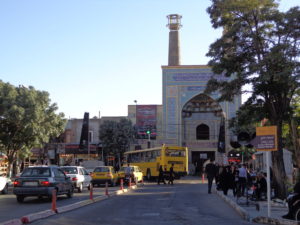
Zanjan Friday Mosque

The road ahead near Khalkhal
We spoke with Timothy, the rally mechanic, who diagnosed the dripping oil as a failed seal on the cable drive – which is what I thought but still not sure just where it is. 40km out from the hotel we came upon a broken down Bentley, spewing steering fluid onto the road. They had set out early to do the full route in daylight (for the first time) so not the best start to their day. We could not help apart from moral support and they contacted Timothy who should be along in about an hour. That was the only rally car we saw all day.
Our route was along the Caspian – but not close enough to see – and then climbed to 2300m and a completely different landscape. This was back to dusty desert and hillside dwellings, far away from the bustle of the coast. We took a taxi into town and wandered through the bazaar and past the outside of some mosques.
Every town has black flags fluttering as it is early in the month of Moharram; women should wear more sombre clothes in the days leading up to the religious festival of Ashura which is next Tuesday. Certainly in the streets, the vast majority of women wore black chadors.
October 8th – surprisingly all the rally cleared the border and got to Tabriz though some of them did not arrive till past midnight. The Lagonda needs garage repairs and plans to join later when we have rest days. We fixed the horn but failed with the window – one pulley has come adrift and needs refixing so the window is held up with the universal repair tool – cable ties.
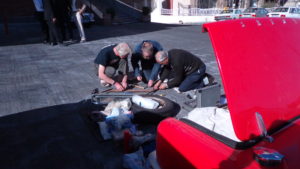
car park repairs
We motored gently to Astara via Ardebil, hoping to visit a Sufi World Heritage site on the way – but lost the signposts so failed on that as well! Astara is on the Azerbijan border and it is odd to see the border fence, topped with razor wire alongside the road as it drops down from the dry desert plateau to the damp greenery of the Caspian. In the evening we took a taxi into town and after a tour round the sites had a meal, whilst the taxi driver went to change some money for us. Where else would you give a taxi driver USD 200 and expect to get it back again? The driver didn’t speak much English so the communication was via his sister on his mobile phone!
October 7th – this was always going to be a long day – and it was. In theory we could do just 500km and a border crossing (which was known to be a long slow and inefficient process). We set out at 7am and made good progress until we were stopped by Paul & Sandra’s Mercedes – the road ahead had been closed by the military. We turned round and soon came across the Bentley who followed behind. In the first village we found Paul & Sandra who were getting instruction from a local on a rough track which bypassed the closure. He said we would never make it over the rough terrain and as we did not have the mapping equipment which the others had we continued to retrace our route. The Bentley stopped to have a puncture fixed and we soon came upon the other Mercedes (Phil & Keron). Together we decided not to risk the rough track but to complete 3 sides of the square and add over 300km to our day by travelling north to join the main truck route.
At the border there was a 13km queue of lorries, two abreast waiting to cross – what an extraordinary waste of time, money and people’s lives!
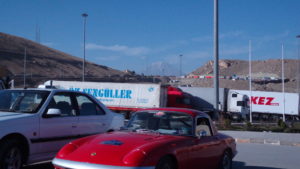
Border Crossing with Mt Ararat
It took us about 3 hours to complete all the formalities – including all our fingerprints, twice, on a sheet of A4. Then on to Tabriz, only stopped once by the police, which we reached just after 8pm, well into darkness. Not my idea of fun as night driving was definitely on my “don’t want” list. The Elan is attracting interest from everyone all the time; every second car overtakes us, lets us overtake, hoots, waves, flashes or calls out to us. If we charged per photo we’d be rich! A very tiring day but there are no more border crossings so hopefully it will be the worst day. The car is doing amazingly well, the only things I know I have to look at are the horn, passenger’s window and the recurrence of the gearbox oil being pushed up the speedo cable and dripping onto my legs.
October 6th – we got covered in “stuff”! Overnight
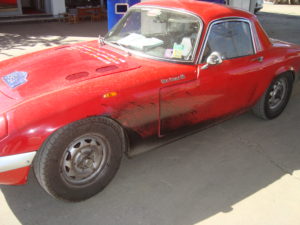
Tar!
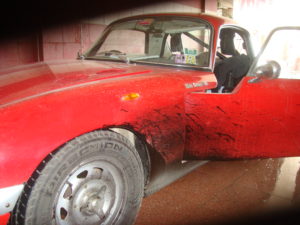
Still tar
we were parked under a tree and the red elan was unmissable target practice. My first task was therefore to clean the car so our early start was a little delayed. We sorted out a route thanks to TomTom which took us as we thought onto a ferry (TomTom picture of a boat was a hint) but the ferry had turned a splendid and empty bridge. After the bridge the road looked and smelt like liquid tarmac – and if something smells like a pig and looks like a pig it probably is a pig! It seems they had spread the liquid tar but not got round to the chippings. I figured that if I went slowly I would get stuck – so I carried on at normal speed for a good surface. When we got to the next town the brakes made a horrible noise so we stopped at a friendly fuel station to check them out. The tyres, which I had worried about, were clean but the sides of the car were covered with black tar and puddles of tar were forming on the ground, where it was dripping off the underside and suspension …… What a mess! The garage brought us glasses of tea and the men sat round as we emptied the boot to find the jack handle to check the brake pads – which were fine. I made gestures of cleaning and after a reply in Turkish I was handed a smart phone with the translated message – “purge with diesel”. Penny dropped – after a road incident involving diesel, the road is resurfaced – diesel kills tar.
We continued our 8½ hour drive to Van, where the black car had become brown as dirt and dust adhered to the wet tar and baked in the heat of the day! The first fuel station with a washing function couldn’t help but the second could and the chief mechanic knew exactly what to do – and an hour later we had a sparkling clean car – though the underside and suspension will have to wait till we get back home. How long we have to love the smell of diesel remains to be seen.
October 5th – the longest day so far at 9 hours plus stops. Some of the group left at 5am for balloon rides over the valleys and at breakfast we saw about 20 of them gliding over the valley and as we set out we saw them again, deflating on the ground. Driving at night was not what we wanted so we pushed on as fast as we could and our only sight seeing was the burial mound and statutes to King Antiochus and his family on top of Mount Nemrut.

Early evening view from Mt Nemrut
We reached our hotel just after dark at about 6.30; Allison said the engine felt lumpy after she drove the last leg but a quick fluid level check was all that we had the energy for!
October 4th – a short day scheduled for 6 hours which we reduced to 4½ by using the main roads more. Our first stop was Church of St Jean at Gulsheir – carved out of the inside of a lump of rock
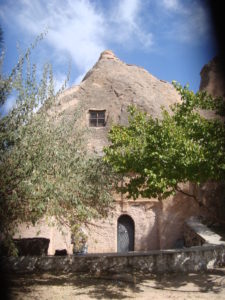
Church of St Jean
and contains some unusual frescos. This is the appeal of Cappadoccia where rocks take on strange shapes and are frequently hollowed out as houses and, in the case of our next visit to Tatlarin, underground cities. Then to the Castle at Orchisar, a mix of carved rock and construction, right in the centre of a town largely devoid of tourists. Our last stop was Sword Valley,

Sword Valley
not many tourists but there was a film crew filming a TV episode. Getting to our hotel from the wrong direction was a challenge as the GPS was in the right place but too high up as the hotel occupied several layers of building on the side of a cliff face.
October 3rd – photographs and general milling around delayed our departure
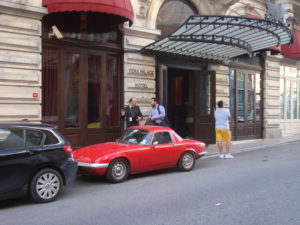
Pera Palace Hotel Istanbul
but eventually we left into more Istanbul traffic – and the car following us, following the car in front all got lost as the Garmin (supplied by the rally) lost signal in the underpass. An illicit U turn corrected that error but more were to follow as the day wore on. So much so that Allison for whom our recently acquired TomTom was a thing to be distrusted, was soon calling out for me to chuck out the Garmin and bring back the TomTom – but the Garmin has our route programmed into it so not an easy option.
The route book said that we had an 8 hour day ahead of us; we decided that after a late start and a few wrong turns, we would follow the main road, forsaking the scenic route – but we did arrive with daylight to spare whilst most of those who followed the route were driving in the dark. We checked the car over, planned our route – using TomTom – for tomorrow with hopefully sightseeing time in the strange world of Cappadocia. Our hotel is a series of caves – and I’m not sure whether caveman has internet…..
October 2nd – this was planned as a short day – just 4 hours plus a border crossing and unsurprisingly it didn’t quite turn out that way! We reached the border ok but when it came to buying our third party insurance, the website had crashed so we spent over an hour waiting to buy this legally required but totally irrelevant document. Our wait was small compared to a guy who was taking his bike to a biking event in Anatolya. He had to insure both his bike and his van – the complication being that one person was bring in two road legal vehicles – he had arrived at 3am and it was now midday….
We stopped in Edirne to see the Selimiye Mosque – a World Heritage site – and the Lotus was much
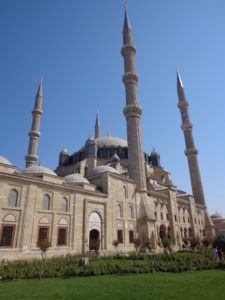
Selimiye Mosque Edirne
admired in a town that is usually bypassed by folk hurrying away from the border. Then to Istanbul.

Istanbul from hotel balcony
TomTom’s assessment of journey time was way out as we entered an 20 km traffic jam. Thanks to the powerful fans supplied by Cliveyboy.com the temperature never rose above about 90 degrees and overheating was not a concern (it was 30 degrees outside). TomTom didn’t recognise our hotel but I had set a neighbouring one as our destination so we arrived in time for the evening fally briefing – with pole position right outside the front doors.
October 1st – after a non breakfast we headed further south east. The car is using a little oil and this morning the radiator needed a top up. It was warm and hazy as we passed Belgrade and pushed our way past various road works. Sight seeing was in short supply on this trip as we hurry to catch up the day we lost but we did manage a visit to a 14th century monastery set up in the hills. 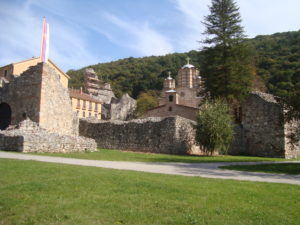
The border to Bulgaria was empty and the crossing quick. The main road was dual carriageway in the main and avoided most towns – except Sofia where TomTom reckoned that straight through the centre was better than the ring road. There is no way of knowing if that was the right choice as there is no control to compare against – you have to believe it or not! The route out of Serbia was slow as the road is still being built but Bulgaria (apart from Sofia) seems to be all dual carriageway and much of it very new.
Tonight we stopped in Haskovo (as planned) and in theory tomorrow needs only 350kms and one border crossing to our hotel in Istanbul ….and the minor matter of navigating through that huge and busy city!
September 30 – our hotel was everything you might expect of a southern German hotel, a jovial host in lederhosen, wood everywhere, large portions and an excellent breakfast. The Elan was parked in the beer garden overnight – hope it had a good time!
We were on the road at eight and planned to get south of Zagreb for the night so as to be somewhere near our original plan – and it worked; we spent the night just north of Belgrade having travelled through five countries to get there – Germany, Austria, Slovenia, Croatia and Serbia.
The car hummed, the only problem being at the border crossings where the clutch wouldn’t disengage – annoying as the slave cylinder was new the week before we left, the master cylinder refurbished a few months ago and fluid levels fine.
We were navigating on the TomTom and after Zagreb its instructions were simple – 375km straight on. Night fell as we crossed into Serbia and I was uncertain as to the quality of the road, it was dual carriageway, the slow lane was bumpy from all the trucks and the outside occupied by folk travelling much faster than us – at 70 we were constantly overtaken but much faster and the car felt unstable – I will have to chat with Spyder again when the car gets back home.
We were fortunate to be travelling east and south – our border queues were relatively short but the other way, towards western Europe they were long and slow.
Neither Croatia nor Serbia are in the Euro and we had no local currency – but thanks to plastic this was not a problem – fuel, tolls, motorway vignette, restaurant and hotel – all gobbled up by a piece of plastic! After leaving the motorway we stopped at a petrol station and asked about hotels (the language being a cross between German and sign language). The instructions included “rotunda” (roundabout) and semaphore (traffic lights) but when we arrived a local policeman said it was closed! Cue more instructions but incomprehensible – so our friendly cop jumped into his car and lead us back to the motorway we had just left, down a track and back towards town – was this an exercise in obfuscation? No, the road was closed. The hotel was a massive construction and hosting an 18th birthday party for 150 people so the restaurant was closed. More sign language/German established that they had a room but no meals and cost all of 28 Euros so where could we eat? More half German/sign language confused the message whilst the athletics club, the beton on the road, the police and the lefts and rights morphed into each other so the porter got into his car and we followed him! The beton on the road and the police merged to become a sleeping policeman and some lefts became right but we got there! He then arranged our meal and we gorged on meat, meat and more meat with a little beer to wash it down. Our first impression of the Serbs was very pleasant – last time we were in the area it had been Yugoslavia and the main road a ribbon of tarmac with dirt tracks off each side.
September 29th, we have reached the small historic town of Altdorf near Nurnberg – but it wasn’t meant to be like this – we had planned to be in Zagreb. We started as planned on the ferry to Hook of Holland but then worried too much about the car’s poor starting! The car had been fine before going to the workshop for a change of engine gaskets; when it came back the starter was grinding rather than spinning rapidly. It did not improve much after the evening trip (with lights) to Harwich but stalled on the boat and only just started. Thinking about it rather than sleeping I decided I was worried about starting a rally with a non-starting car. Was it the electrical connections (via the chassis), the battery or the starter? Not the first as I had cleaned them recently but there again both the battery and the starter were also new! I reckoned I could pick up a battery anywhere – but a starter? I had one at home so to cut a long story short we took a circuitous journey back home from Hook of Holland, picked up the starter and set off again but 24 hours late and this time via Dover/Calais as the Harwich ferry was fully booked. By now battery and starter were fine!!
Thus after a (very) early morning ferry we had a long drive to Nurnberg, held up by numerous roadworks and are still not as close to Istanbul as we should have been yesterday! We have two more long hard drives ahead of us if we are to make the rally start!
We set out tomorrow for our third long distance rally in thirteen months – that represents over 16,000 miles, not bad for a car that becomes 50 next year!
A number of things went wrong in Norway so some have been resolved –
– points so we have a Boyer Bransden for negative earth (the old positive earth version is now on the yellow Elan),
– we replaced the rear wishbones,
– the engine had been very noisy so the cam cover came off and the cam lobes were found to be disintegrating! That meant new cams and new cam cups – as well as flushing the engine to remove any loose swarf.
– still overheating so we have a pair of Revotec “pull” fans mounted between the engine and the radiator – kindly supplied by cliveyboy.com
– the engine continues to run after the ignition is switched off – not sorted yet; I’m sure its connected to the fans and cliveyboy has sent me a new fan controller (but I’ve not fitted it yet). The problem is electrical and could be a result of changing the ignition switch – get to that in due course!
– fully refurbed steering rack ( so hopefully the car will go where its pointed and not jump around the road!)
So where to this time? The title says it all – first stop Istanbul where the rally starts then through Turkey and Iran to the Persian Gulf; we take the quick route home (fly) whilst the Lotus has another container trip. I’ll try to update the story and photos as we go along.
Himalayan Elan
Our 2007 trip was to the roof of the world or as near as we could manage.  Our trip was to India, Nepal and Bhutan, the car may not have actually seen Everest – but we did from a chartered sightseeing jet from Kathmandu airport!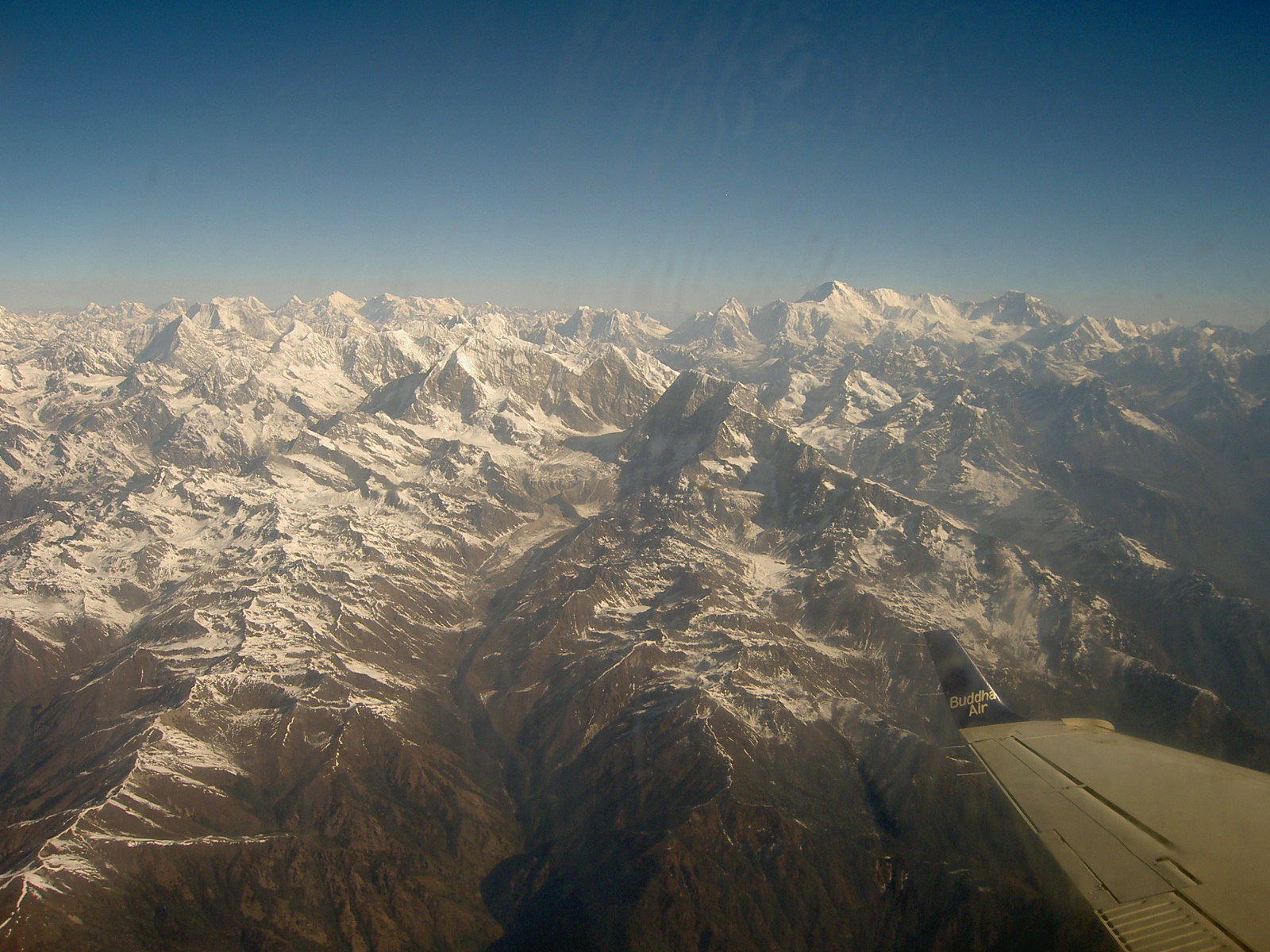
The trip was planned well in advance and the cars were due to be shipped two months before we flew to Udaipur in western India. So plenty of time to prepare, no last minute gremlins – wrong! The drive to the docks had to be abandoned due to fuel starvation – the engine which had been fine pottering round home just died when we were ambling along the motorway at (shall we say?) just about the speed limit. The float chamber had no fuel but the tank was half full – probably the braided fuel line delaminating so we changed that and the (mechanical) fuel pump and all was sweetness and light.
We next saw the car along with its fellows in the Motor museum owned by the Maharana of Udaipur. A Maharana is like a Maharaja only the Maharana is more important. The other cars in this tour (not a competitive rally) were 6 Mercedes SLKs, two 1950/60 Bentleys, two Volvos, two pre-war Bentleys, a 1935 Rolls Royce and two Sunbeams. The reports from the crew who unloaded the cars from the containers were that the car was “pretty sporty”. This time we had the S/E engine and yes we were concerned that the local fuel or the effect of altitude could spell disaster and we took two spare cylinder head gaskets just in case. In fact apart from asking for a change of points and condenser, the engine behaved perfectly and was completely unfazed by the 87 octane fuel (87 on a good day). How did it ask? Well it poured out black smoke, refused to idle, lost power and had a good sulk!
 In Udaipur we stayed at the Lake Palace hotel – anyone who has seen Octopussy will recognise the hotel in the middle of a lake –
 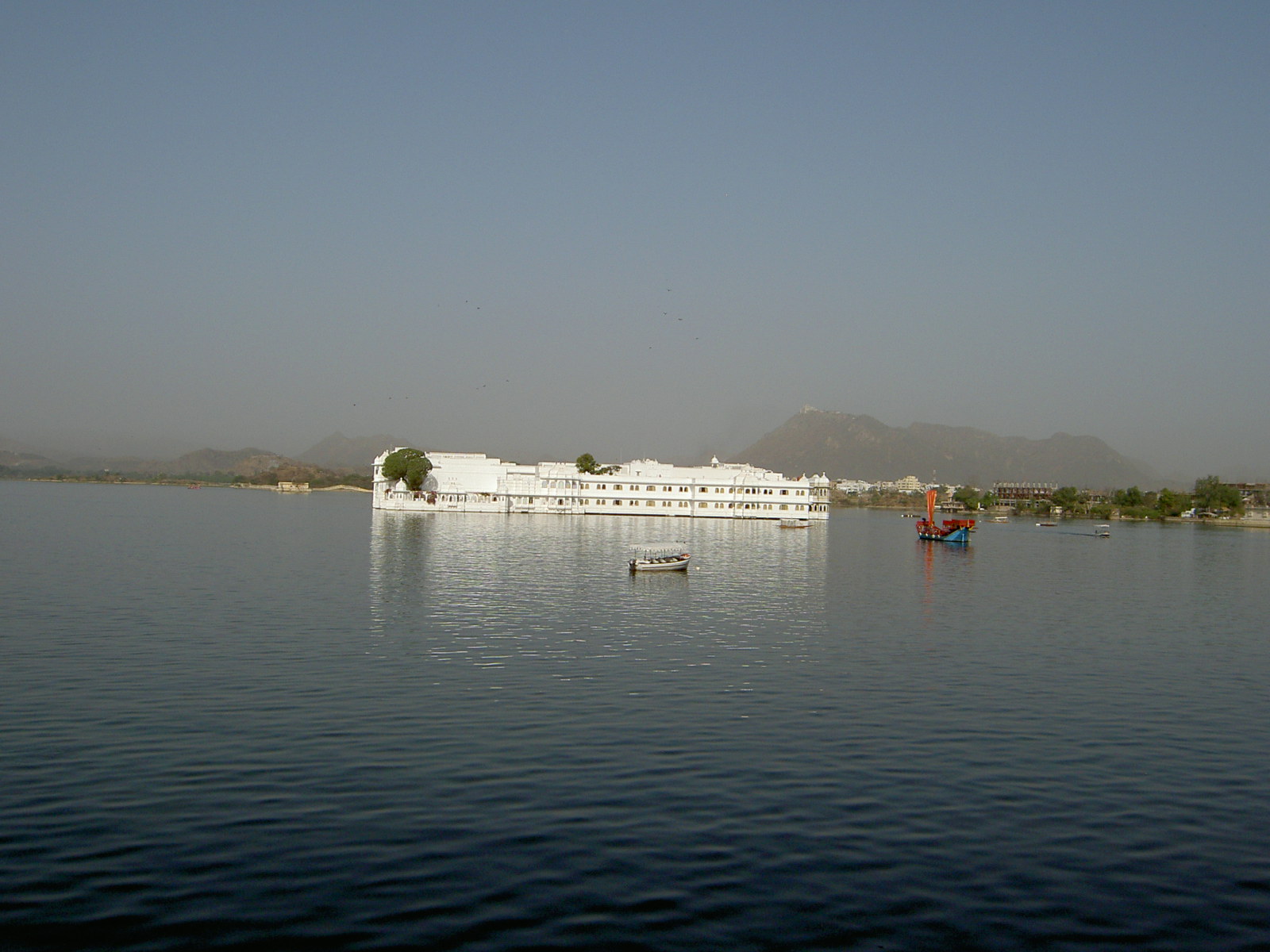 Bond and the villains used a replica crocodile to get over the water, we just used the hotel boat!
The Maharana flagged us off on the first leg to Jodhpur and already the Elan was attracting attention. For the Indians a two seater car was of little practical use and its size and particularly the headlights were a magnet; other competitors complained that the Lotus was the centre of interest. It featured in all the photos printed in the local papers – though its description as a 1965 Volvo was a little off the mark!
The feature of Indian roads is that they’re busy. There are some cars, there are lots of lorries and busses, there are a few elephants, there are carts pulled by tractors, camels, horses, water buffalo, humans there are pedal powered carts there are tricycle carts, there  are three wheeled rickshaws and pedal rickshaws, there are sheep, goats, people, bicycles (lots and lots), motorbikes and yes, there are cows. The cows do just as they please – well so do the people but the people do at least respond to liberal use of the horn whilst the cows just look at you – and carry on doing just whatever it was they were doing before.
Another feature is that they’re noisy. We had a very big horn in a small car and when the horn decided it was being overworked – well you were insignificant, nothing. You had no way of doing anything. The horn is essential if you want to drive forwards, backwards, sideways – or if you are a bus – even to stop! If you want to overtake with no horn – it just does not happen, you cannot do it unless you want to get pushed sideways off the road.
The third feature of the roads is variability. You do not know what comes next. It could be an excellent surface where you’re happy to go at 80. Its just as likely that 25 yards ahead of you will be a sleeping policeman (favoured spots in villages, at railway crossings and both ends of bridges). Or you might find potholes (favoured spots on hairpin bends and in the shadows of trees but also found in otherwise perfect pistes of tarmac). You are most likely to come across broken tarmac, where one patch is about an inch below the next patch, a trench across the road or no tarmac at all, where you’re driving over – well anything from mud to riverbeds to landslides. Now its fine if you know what’s coming next and its consistent but consistency is a guaranteed no-no.
Jodhpur is home to the magnificent Blue Fort,  which we enjoyed wandering round before setting off towards the relatively quiet and well surfaced Rajasthan desert. Our route saw us struggle out of town – until you’ve driven there its difficult to comprehend the sheer chaos of an Indian road.
There are all the other contenders for roadspace, there’s the noise they make – the slower the traffic the greater the noise – there’s also the use of that physical space. In principle they drive on the left – so its easy? Well not exactly! If there’s no-one else around and if your side of the road looks no less attractive than the other side you might well drive on the left. But if there’s anyone else around and particularly if traffic is slow and your horn is in good condition you drive on any piece of road that isn’t occupied by someone else and if your horn is louder you carry on driving on your chosen piece of road and push everyone else out of the way. This does have implications for traffic flow and congestion when the road is closed – as for a level crossing.
The opening of a level crossing in a busy town is an interesting experience. Traffic isn’t moving so the first imperative is to sound your horn. Next you advance as far as you can across the tracks until you encounter the oncoming traffic. Then you stop because all of the road is now occupied! You have moved to the right of all the traffic waiting at the crossing so as to get away quick and make full use of the space available. Equally and logically the oncoming traffic has done just the same; so you all stop and then you start inching and squeezing. Whatever progress you can make is slowed down by the motorbikes who are weaving every which way, the pedestrians who are everywhere and the cyclos, pedal carts and hand pulled/pushed carts which have limited acceleration. And you’re all trying to avoid the sleeping policemen or in our case go diagonally across them so as to minimise the distance travelled on the sump guard. Yes its interesting and it does occupy your day!
The desert was a welcome relief!
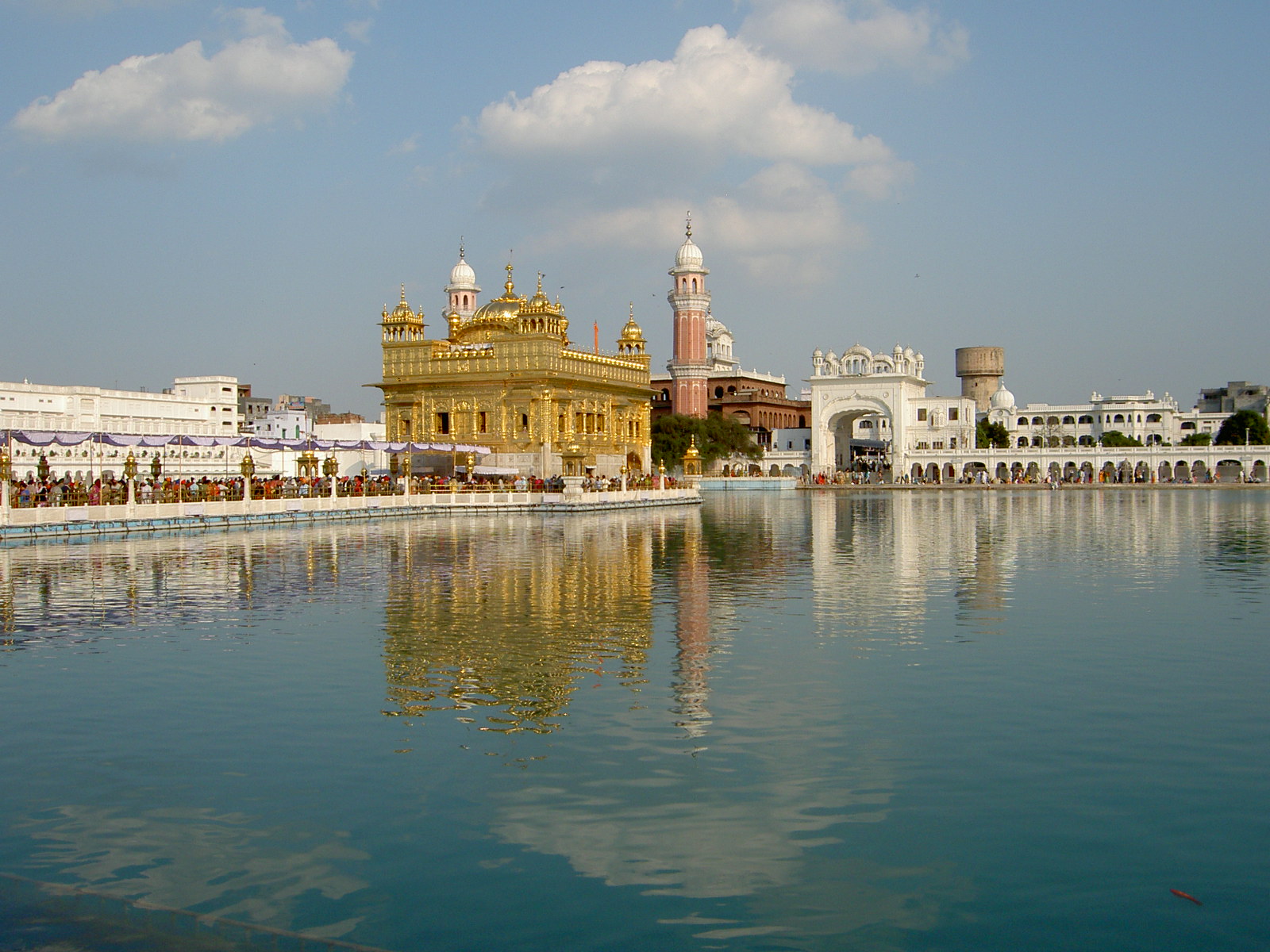 The next day was the longest drive of the rally, 545 kms with a scheduled time of 9¼ hours. That’s an average of 37 mph for a whole day – and it was a good road – on the whole! We spent the night in Amritsar, home of the Golden Temple, which we were able to visit in daylight.
Sunrise was about 6am though it varied slightly as we changed clocks between the three countries and we always started as early as possible so as to benefit from the cool of the morning and the absence of other road users much before 8.30. This was the cause of daily friction in the cockpit – I wanted my breakfast whilst Allison wanted to get away at the crack of dawn. Strange, back home she’s always the one to want to stay in bed!
Next day we travelled to Dharamsala, home to the exiled Dalai Lama.  Now we were in the hills, it was cooler and the engine markedly less happy – it didn’t pull so well and first thing in the morning could hardly move the car until it had warmed up. Maybe the choke would have helped but we don’t do chokes! We had to tighten up a lose compression joint at the fuel pump but otherwise the car was fine and now after 900 miles I had still not had to add any oil to the engine. We had our first sight of the Himalayas during the day – distant, white, exciting!
 On to Simla, summer capital of the British Indian Empire, where I had some family business to attend to. My grandfather had lived there in 1901 and my task was to locate the house and give a full report to my father. It was here that we had our first mechanical problem – one front shock absorber had leaked; useless! Both tasks were resolved fairly easily.
 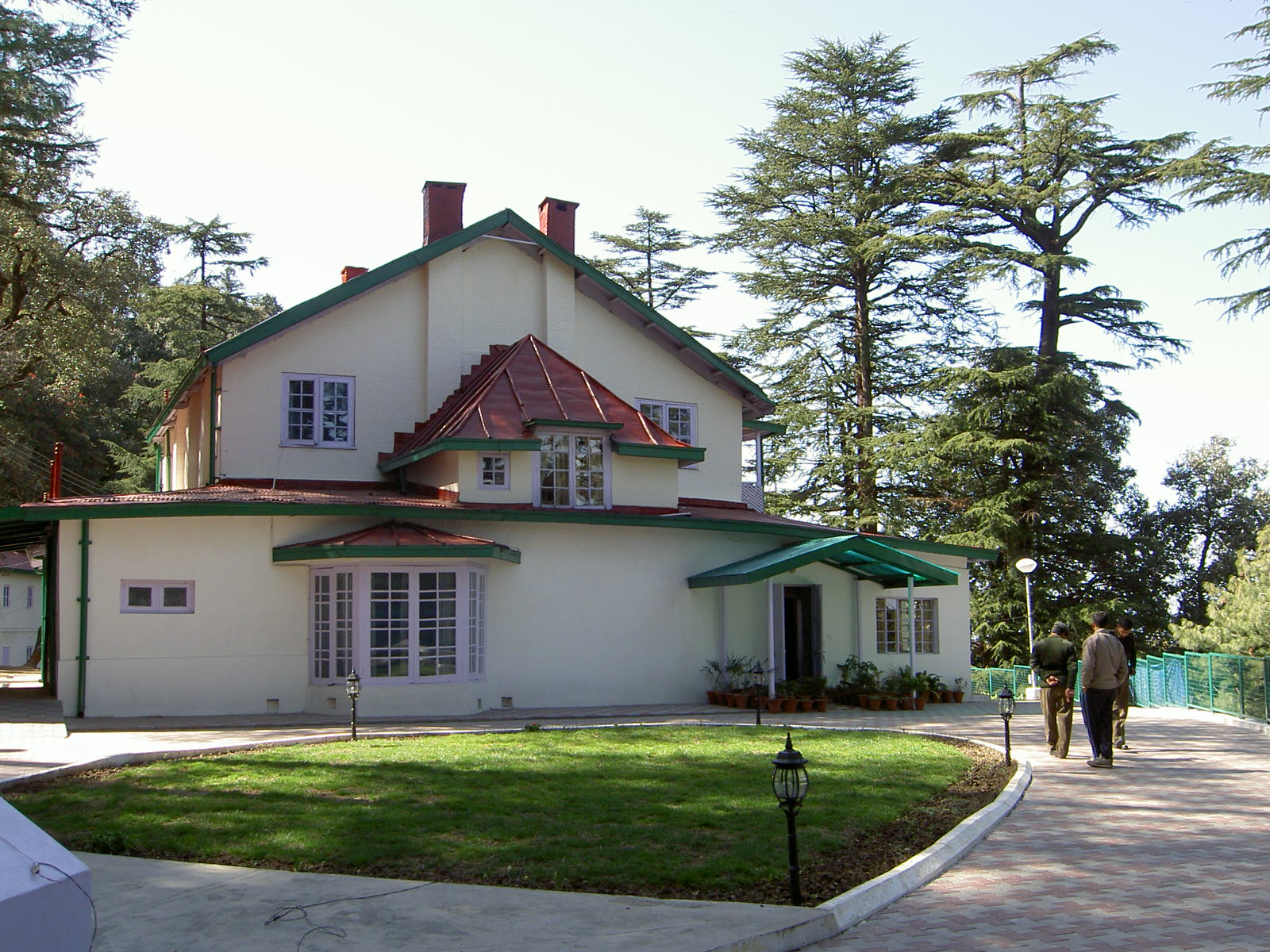 We found the house, now with a full military guard and used as a guesthouse by the Chief of Staff of the Indian Army western command. The shock absorber was rebuilt locally using parts from a similar one for the grand sum of £4.50! The other drivers told us to slow down – what? Drive a Lotus and slow down!
Caution being the better part of valour, we phoned home for a set of front shock absorbers to be sent out to await our arrival in Kathmandu – and don’t tell me that’s not a world first! Susan Miller now describes her business as “Far Flung Parts a Speciality”.
From Simla we tracked east towards Nepal. A rest day at a Tiger 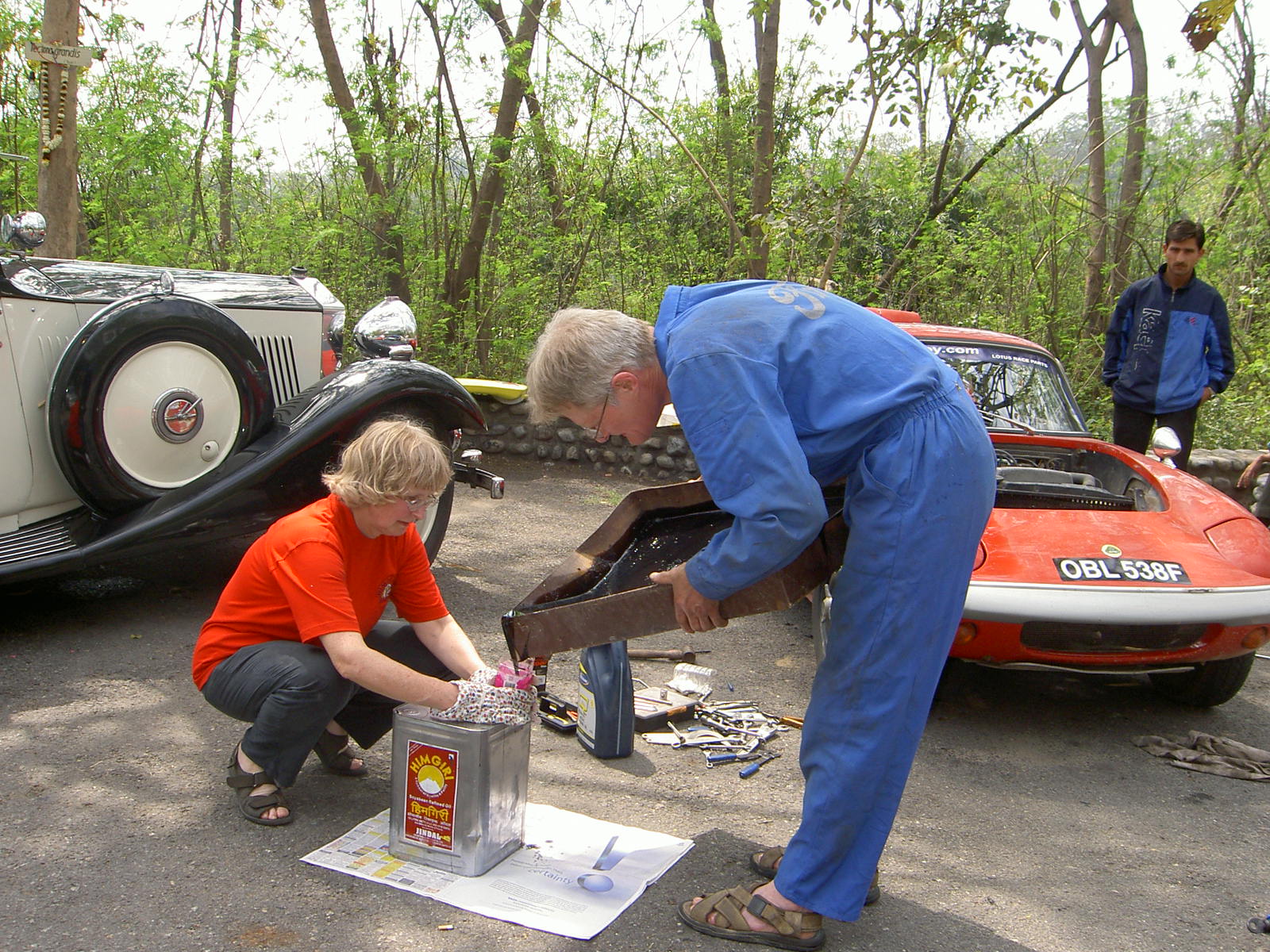 Reserve encouraged Allison to demand an oil change which was fine until the threads on the sump decided they were worn out and it took liberal use of PTFE tape to persuade the sump plug to provide an oil-tight seal. Moral – yes you’ve guessed – if it ain’t broke don’t fix it! No we didn’t see any tigers.
The next day was bad news. The road book said 150kms with a  time of 3½ hours. Well not exactly! The distance was wrong, the roads were bad, the directions inaccurate so we took a huge detour and the brake servo packed up. It didn’t just stop working; it began by pushing the pedal back against our feet then it locked the brakes solid. As we were trying to go uphill, down dale and round hairpin mountain passes this was not very helpful! One of the Indian mechanics was helping us as the day turned to dusk and then to pitch black. The simple idea was to bypass the servo and join the in and out pipes together – one nut seized on the pipe which snapped as he undid it. Plan B was radiator out and join the master cylinder direct to the brake junction (located under the coil on the inside of the chassis). That took a little longer, the torch went flat, it started to rain (heavy rain) it was cold and miserable, Allison fell down a gully in the dark, the room was damp, the sheets fusty…..not a good day.
We set out late next day after completing our repairs in daylight. The Nepal border crossing was straightforward and our delay meant that we avoided the fate of one crew who were “invited” by Maoist demonstrators to join their protests. Our problems were still to come! The last 10 miles were along an “unmade road”. This included a dried-up riverbed where a following car got lost in the dark trying to follow the tracks and went a couple of miles downstream. We continued through a village in dusk, with small boys shouting “one rupee, one rupee”, dodging the rocks, bumps and potholes until the headlight relay packed up. This was not the place for delicate electrical investigations or emptying the boot to locate the electrical kit and reroute the wires. Fortune smiled and one of the organisers’ jeeps came along. We followed close on his tracks, praying that he had a good idea of our ground clearance and breathing in lungfulls of his dust. The sumpguard saw plenty of action and we made it in one piece. The hotel had good showers!
The convoy of cars leaving next morning provided amusement for the locals as we gingerly retraced our way through their village. We found that we wanted to go faster than lot of other cars despite the terrain and that the riverbed was rather a good overtaking zone!
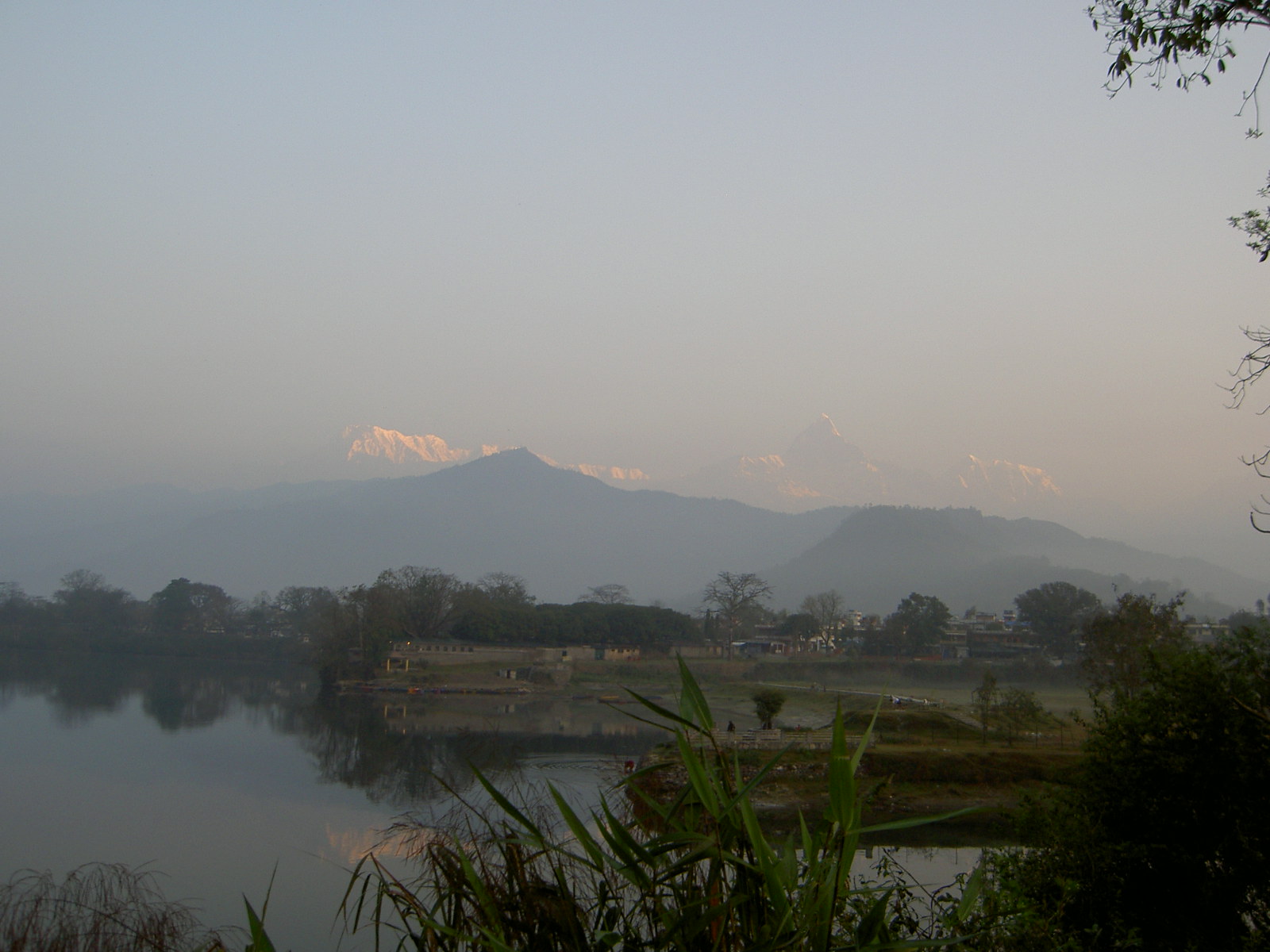 Problems of a different kind emerged the next afternoon. As we approached Pokhara, the second city of Nepal, all the fuel stations were out of petrol. The Maoists had blockaded the one Indian border crossing which was the only route for importing petrol – there was plenty of diesel but we did not want to experiment! Next day was a rest day so we luxuriated in the Fishtail Lodge hotel, waking to a view of the Himalayas from our patio and able to forget the bustle of the town on the far bank of the lake!
We were too confident. After adjusting the rear shock absorbers and spring height, we found that the front wishbone bushes were loose. Instead of the wishbones staying where they were bolted they flopped around at will – the rubber/metal bond had disintegrated and we figured it would not be long before the wishbones themselves would be rattling around and with them the steering and front wheels – not good! Decided there was nothing to do today so moved the car into the shade – no clutch.  Slave cylinder. No problem we had a seal kit. Not quite! The slave cylinder had become firmly attached to its housing and would not be separated. On investigation we also found that the cylinder bore had become rough inside and had chewed up one seal and would do the same to the new one.
The Indian mechanics spent a couple of hours delicately smoothing the rough edges – not easy when lying on your back in the hot sun under such a low slung car. It was well dark by the time we had  bled the system, refitted the sumpguard and the organisers had found enough fuel to get us to Kathmandu. I was shattered – mild sunstroke – and supper in this luxury hotel was wasted, I was too ill to be interested. The next day had to be better!
We left early, the scheduled time was only 5 hours but we wanted to get out of town before anyone started asking where our fuel had come from – we felt uneasy ostentatiously driving thirsty cars during a fuel strike. Leaving town we glanced the rear side of a motorbike; he wobbled but stayed on we went off as fast as we could.
Ours was not the only rally in town – coming towards us a high speed, with lights and flashers, pushing everything out of their way was the South Asian 4WD rally all in modern jeeps – you can easily ride the bumps in them!
Kathmandu was busy, very busy, the last 8 miles took over an hour. Fuel was going down, oil pressure was close to zero and the water temperature reached 108 – we had a 50% antifreeze mix which raises the boiling point – somehow it did not boil – no idea how it managed that! The road was narrow, our windows just at the right height for lorries to fill the car with black, hot smelly clouds of their exhaust. Buses as ever stopped just exactly where they wished, the policeman, all wearing masks, waving them on had no impact whatsoever. It was hot, dusty, noisy and we sat, choking, sweating and hoping those gauges would not tell us that disaster was at hand. It took us nearly 6 hours and we were the fourth car to arrive.
 The afternoon was for a snooze and some sightseeing. Allison recognised the temples in Durbar Square from
 my photos of 25 years earlier. The difference was that then it was peaceful and quiet – not now!
  Next morning we took a dawn flight to see the Himalayas – the roof of the world just the other side of the cabin windows!
We had been told of a midday convoy for fuel. This was abandoned on the grounds that it might just be provocative! We were told to expect 2,500 litres to be delivered to the hotel in the early evening and to get some cans so as to have enough fuel for India – 350 miles away. We estimated we would need 70 litres to be safe and persuaded the mechanics to carry 20 for us – we always carried 10  litres in the boot. Dusk came and the civilised hotel car park was transformed to a mad house as fuel was syphoned out of 45 gallon drums into cans and the stench of petrol filled the air and the surrounding streets. We all overfilled our tanks so petrol was swilling everywhere.
We left Kathmandu before six so as to be out of town before the locals were awake and because today was the longest day with a scheduled driving time of 10½ hours. We knew the last 8 miles was on rough tracks and with the front suspension feeling most unhappy we had to take this section very slowly. We were on minor roads  climbing out of the Kathmandu valley and they were bad! Potholes, broken tarmac and stretches of track and roadworks. Roadworks in this case means rough stones and dirt, with gangs of women chipping the stones to make a hardcore base for tarmac. You don’t go very fast!
For the last 100 miles the engine was coughing and spluttering but not seriously enough to warrant a roadside repair. As we crawled along the track to our overnight campsite (no hotel tonight!) it got worse and at the end it was all we could do to get any life out of it at all. We just made the car park and it died with clouds of black smoke. The popular advice was fuel but we decided that points/condenser were the cause so we changed them – and all was again sweetness and light! I had broken one golden rule during this work – the car was on a weed-covered field and I knew I should put down a ground sheet to catch the bits I was bound to drop if it wasn’t there. So I didn’t and yes I did! I mentally thanked a friend  who had persuaded me to buy one of those flexible mirror stalks with a magnet attachment so I could retrieve the little screw which holds the distributor in place…….!
Next day we left for India and wondered who had left a trail of oil in the dust – no not us! The engine was using next to no oil. I reckon in all the 3,500 miles we used about half a litre (well, plus the oil change). Down the road we came across a sorry Bentley bemoaning the loss of transmission fluid and feeling very despondent thinking he had a cracked transmission casing after a particularly bad bump. In fact it was only a broken hose, located in an inaccessible spot, which the mechanics somehow got into – they are ingenious!
India was welcome security and peace of mind – did I ever expect to hear that? Leaving the border control was slow as, in traditional style, everyone wanting to enter Nepal had spread across the entire road and the verges so we were stuck in the press of lorries, jeeps and cyclos.
We climbed up hairpins to Kalimpong, in tea country and another relic of the British colonial summer exodus to the cooler heights. Today was another “electrical” day as a blown fuse had killed off the wipers, indicators and fuel gauge – but they were all fairly irrelevant here. Next day we descended through the Darjeeling tea 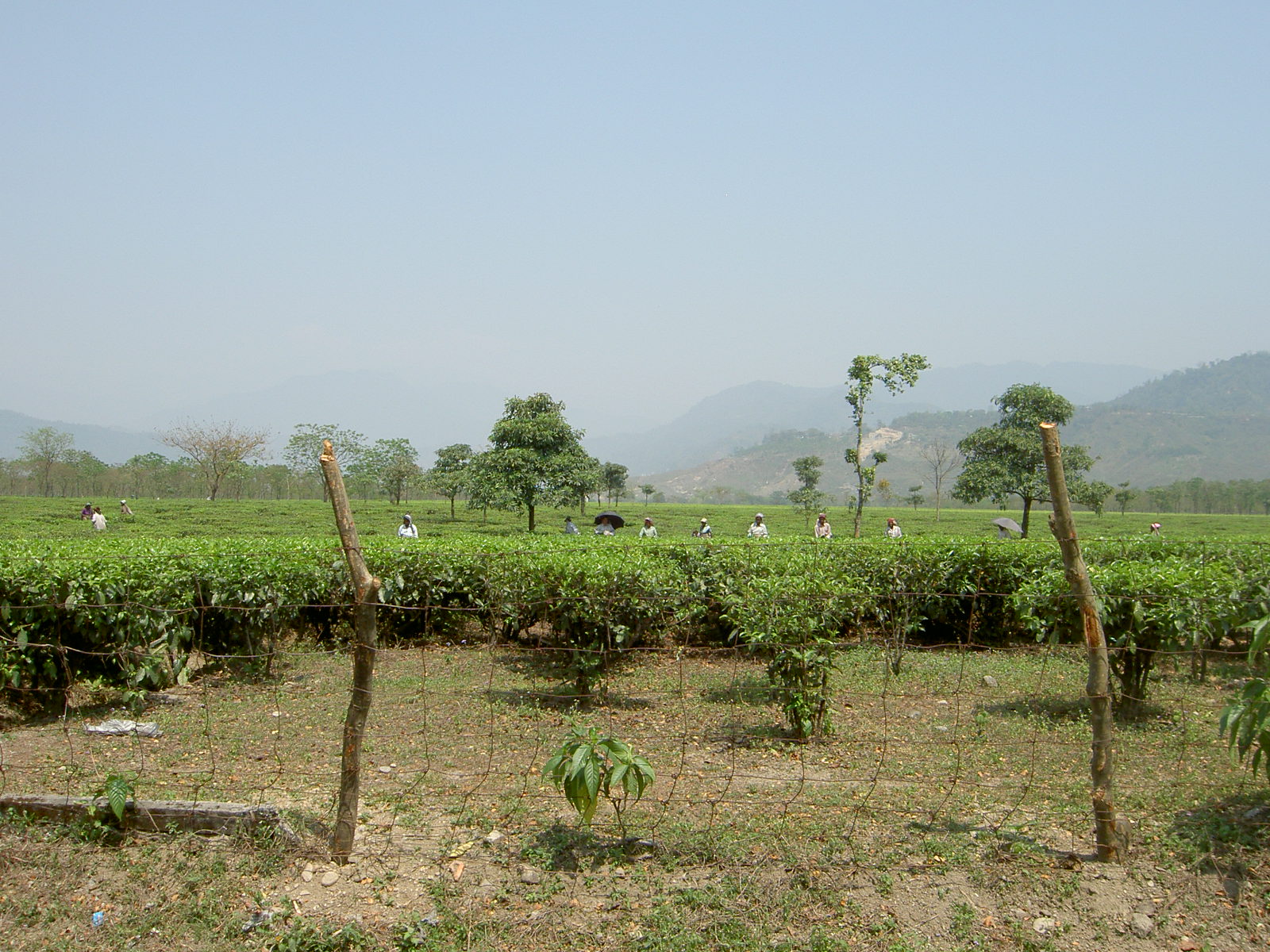 plantations, where people bobbed up and down, their bright clothes contrasting with the single green of the tea leaves. We did not see another rally car all day, which was unusual but it was a short day; our hotel was just inside the hidden kingdom of Bhutan
 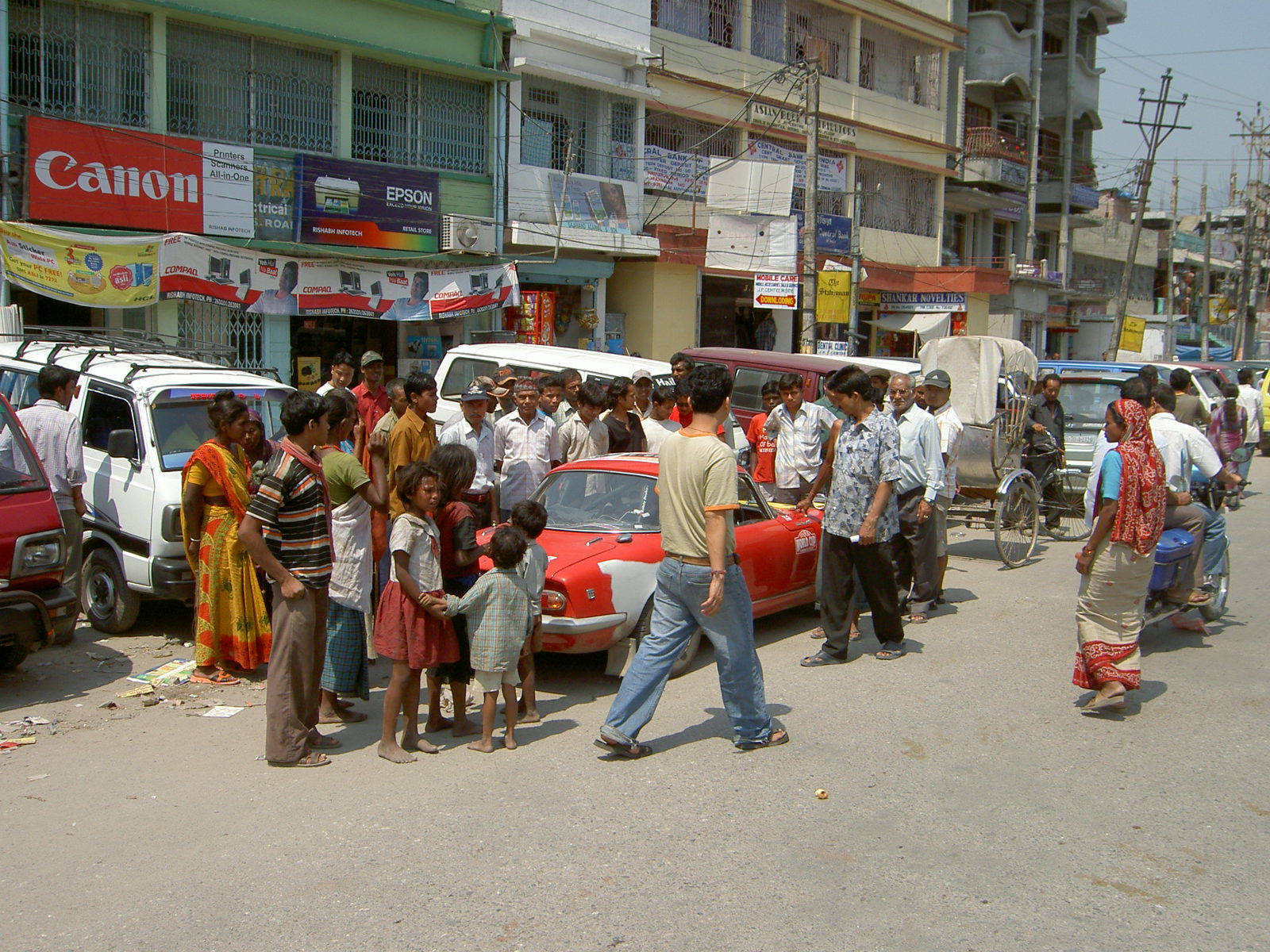 and after finding Indian border control – not easy and we could easily have missed the inconspicuous drab building in the middle of the main street – we arrived in time for lunch.
We parked in the underground car park and decided that, for the first time in a rally, we should replace a donut – better to do it now than as an emergency at the roadside!
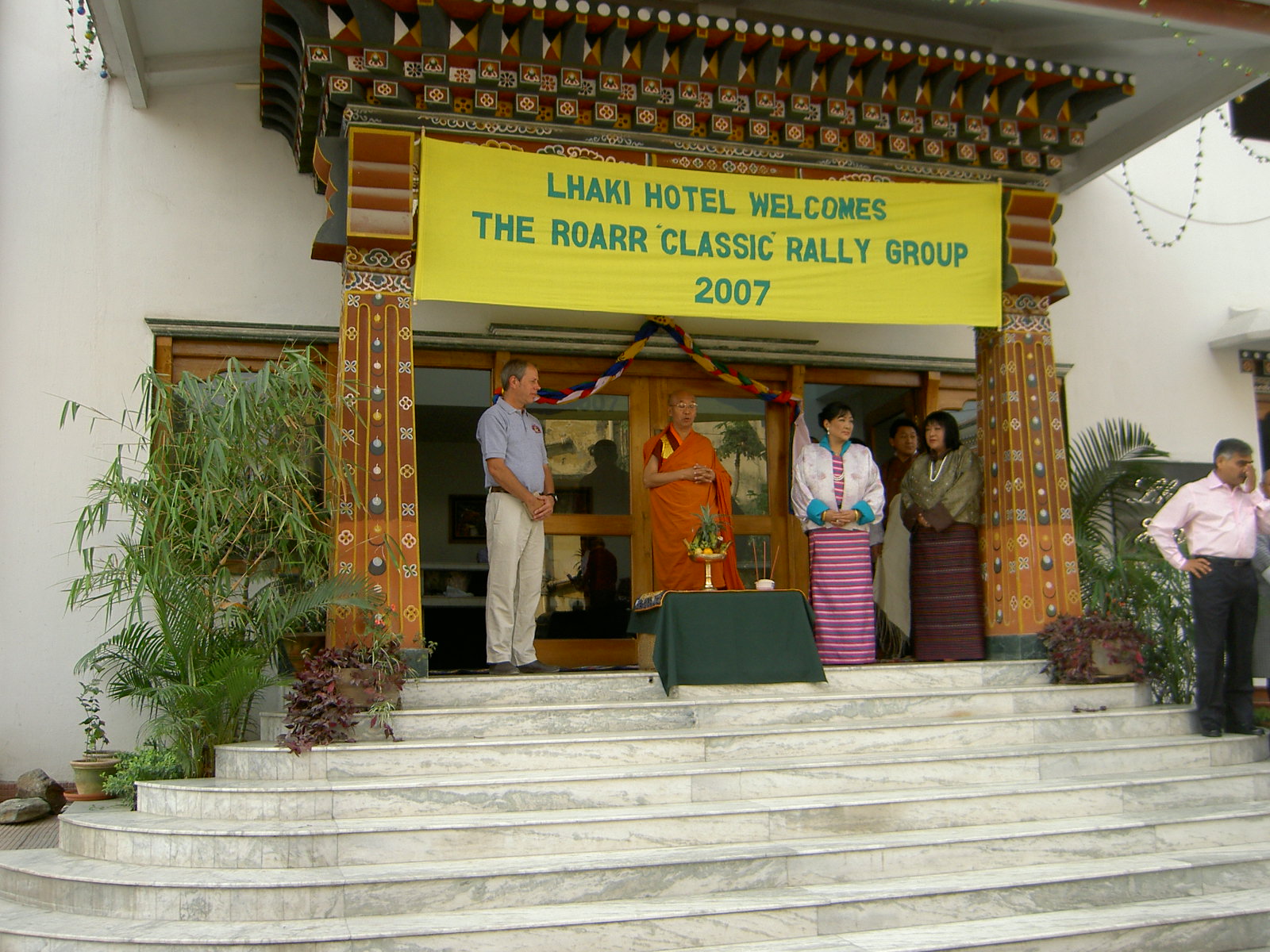 Next day the King’s grandmother came to greet us and send us on our way. Today’s topic were the major roadworks at a place called Confluence where our road met two valleys, one to the second city, Paro and Bhutan’s only airport, and the other to Thimpu, the capital. The new king’s coronation is planned for next year and the roads are being upgraded for the foreign dignitaries travelling from the airport to the capital. The road was closed for two hours at a time as the hillside was blasted away – you can probably imagine the state of it in the open sessions! Most of the largest boulders were cleared away but what remained was not exactly smooth!
Most of the later rally cars came through under police escort but we managed alone – and without our horn, whose fuse had also blown. You’re very vulnerable and lonely without your horn but the drivers must have been warned about our arrival because with the exception of the rally’s baggage van they all pulled over to let us past. At one stage we flew over a smoothly tarmac’d crest to land with a bang in a section of bumpy unmade track. The passenger’s door flew open, the route book and map had to be retrieved and the offside rear suspension banged and clattered for the rest of the day – another “dead” shock absorber but who could blame it?
On inspection the shock absorber problem was that the “collar nut” holding the shock absorber into the bearing housing had come undone. Diagnosis was easy but putting the nut back without removing the spring was very delicate and time consuming. With the assistance of the mechanic’s trolley jack and the Rolls Royce crew we managed it – thankfully!
 Next morning saw the energetic competitors climbing to the Tiger’s Nest monastery, perched high and inaccessibly in the hills, the birthplace of Buddhism in Bhutan. Back for a late breakfast we visited the National Museum and the Paro festival held in the courtyard of the Dzhong – a fort-cum-monastery.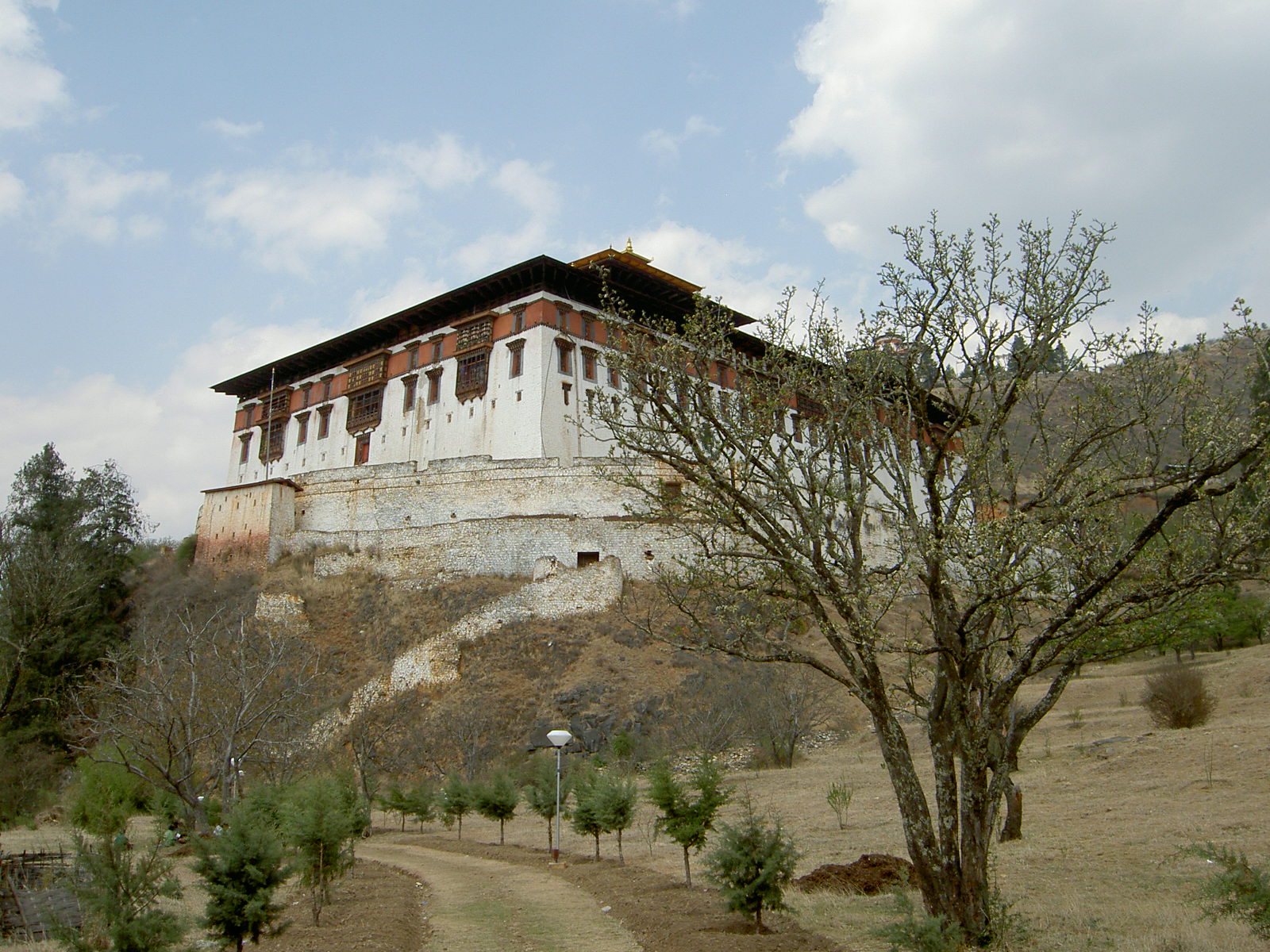
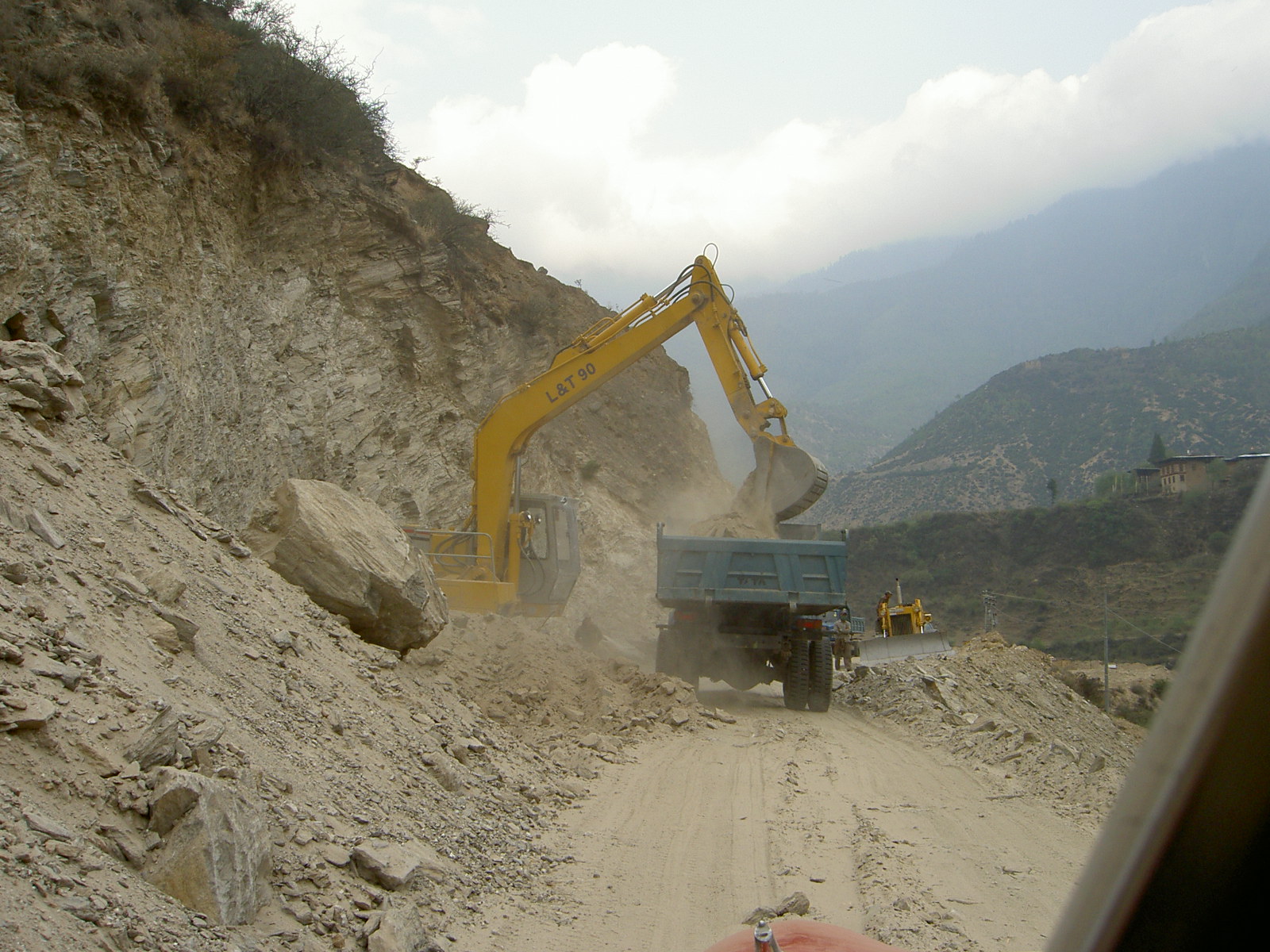 Then a return journey through those roadworks and along the other valley to Thimpu. Fortunately we timed the road closures to perfection and arrived in daylight. Over half the rally got it wrong and endured a slow dark and dusty crawl. Two cars had to be towed – a serious challenge for all concerned.
A rest day to allow us to visit the biggest Dzhong in the country but first an inspection of the car revealed that the front wishbone bushes were “shot”. One o/s top bush was so far gone that the top of the wheel had about an inch of horizontal play. The tourist guides located a garage owner who managed to concoct and fit a replacement within about an hour on Sunday morning – and all for about £7.50!
Next day and another go at those same roadworks as we had to enter and leave Bhutan by the same route. We left early again and avoided most of the heat, dust and traffic. Descending towards the Indian border we were in thick cloud but sadly every vehicle we tried to follow in the murk courteously pulled over to let us go ahead – not what we wanted! Today was a good day for electrics so we had the benefit of both lights and wipers. Arriving at our underground hotel workshop/parking the most serious task was to take the door apart to untangle the knitting otherwise known as the wire and pulleys for the electric window.
Our route ahead was straight to Kolkata over three days. West 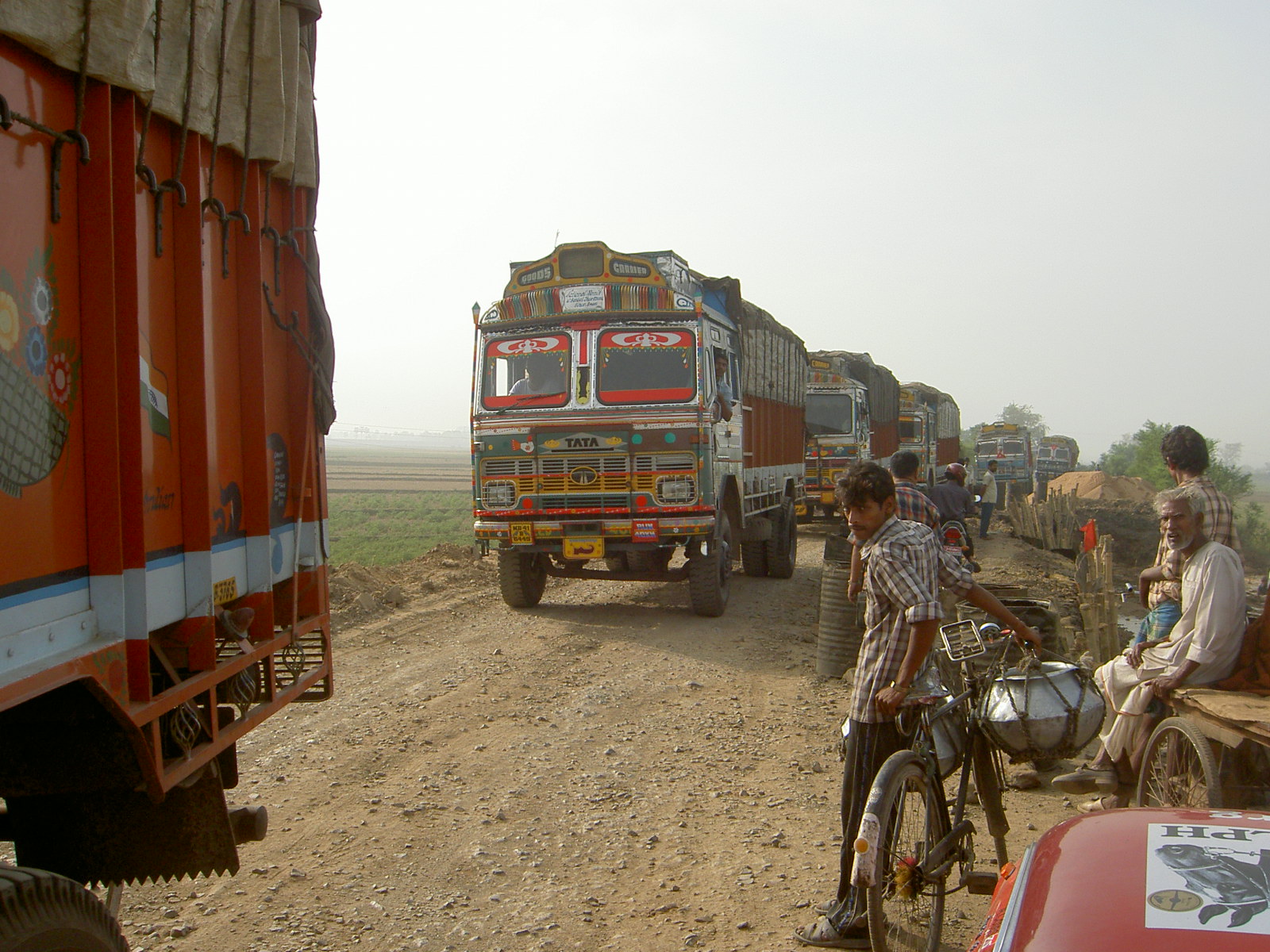 Bengal was mainly flat, always busy, noisy and dusty – and hot and humid. I really feel that if I wanted to go there, which is debatable, I would not chose just now! Having sent an email of our progress to friends and Lotusnet, in praise of our tyres, we had a puncture! But one puncture, repaired at the roadside for 50p, was remarkable in 3,500 miles of these “roads”. To our great astonishment Kolkata’s traffic was not bad and we reached our hotel with no alarms – except for one friendly guy who opened the tinted window of his air conditioned modern luxury to tell us “your right rear wheel bearing is not good; your wheel is wobbling”. He was right but I had figured that, whilst I had a spare, I was not going to replace it now and that it should last the distance – it did!
It just remained to take the cars to the inland container port and hopefully we’ll see it again in Felixstowe in a few weeks time!
What’s next you ask? How about Cambodia, Laos and Vietnam followed by Iceland? Yes, 2008 should be busy!
Tiger Rally 2008
Asian Elan
Before the car had even come back from Calcutta after its Himalayan adventures we had booked onto the 2008 Tiger Rally from Kuala Lumpur to Hanoi; there was however just a little bit of work to do and only six months to do it. The known things were a respray, brake overhaul and rebuild front and rear suspension. Investigation in the garage showed that the chassis was broken in two places – so it was start again time!
I had been aware of one weak spot in the chassis – the flange on the rear turret which holds the Lotocone and the top of the shock absorber.  The punishment it had taken meant that the flange had twisted, the vertical plates had bowed and one had split. The answer seemed to be to have a diagonal strengthening plate running from mid way up the tower to the end of the flange. This called for narrow springs and some specialist chassis work so I had a chat with Andy at Spyder. He devised a solution and for half the price of a new Lotus chassis he refurbished an old chassis with modified rear turrets and thicker engine bay section – the second break was at the rear of the engine bay.
Some months later, the Elan was ready to face the road – in time for an MOT and another trip to Felixstowe to be stuffed into a container.  We next saw it at the end of February at the Sepang circuit in Malaysia sharing a container with a yellow 1936 Lagonda. One tyre was flat and it refused to start until it was in fresh air but apart from that it was raring to go. So how about this circuit – could we have a go on it? Eventually and reluctantly we were allowed to process round behind a pickup truck – lap time just over 6 minutes from pit lane exit to pit lane entrance. Don’t ask what an F1 car does!
Then the 70 kms back to our hotel in the centre of KL.  It would have been easier if we’d turned left for the petrol station instead of right to the city but………..four motorways, two U turns and 80 kms later we were where we should
  have been – in the underground car park of the hotel. These are not places you want to stay in – they are clean enough but they’re hot and humid and an excellent incentive to ensure your car does not break down so you don’t have to work there!
The Malaysians roads were excellent, though on our way north we left the crowded main roads for the emptier motorway – they drive on the left, there is 97 octane petrol and in Georgetown, Penang we even saw a parked yellow Elise. Before that our journey started with a trip up into the Cameron Highlands followed by a long fast descent on wide curvy roads to the island resort of Pankor Laut.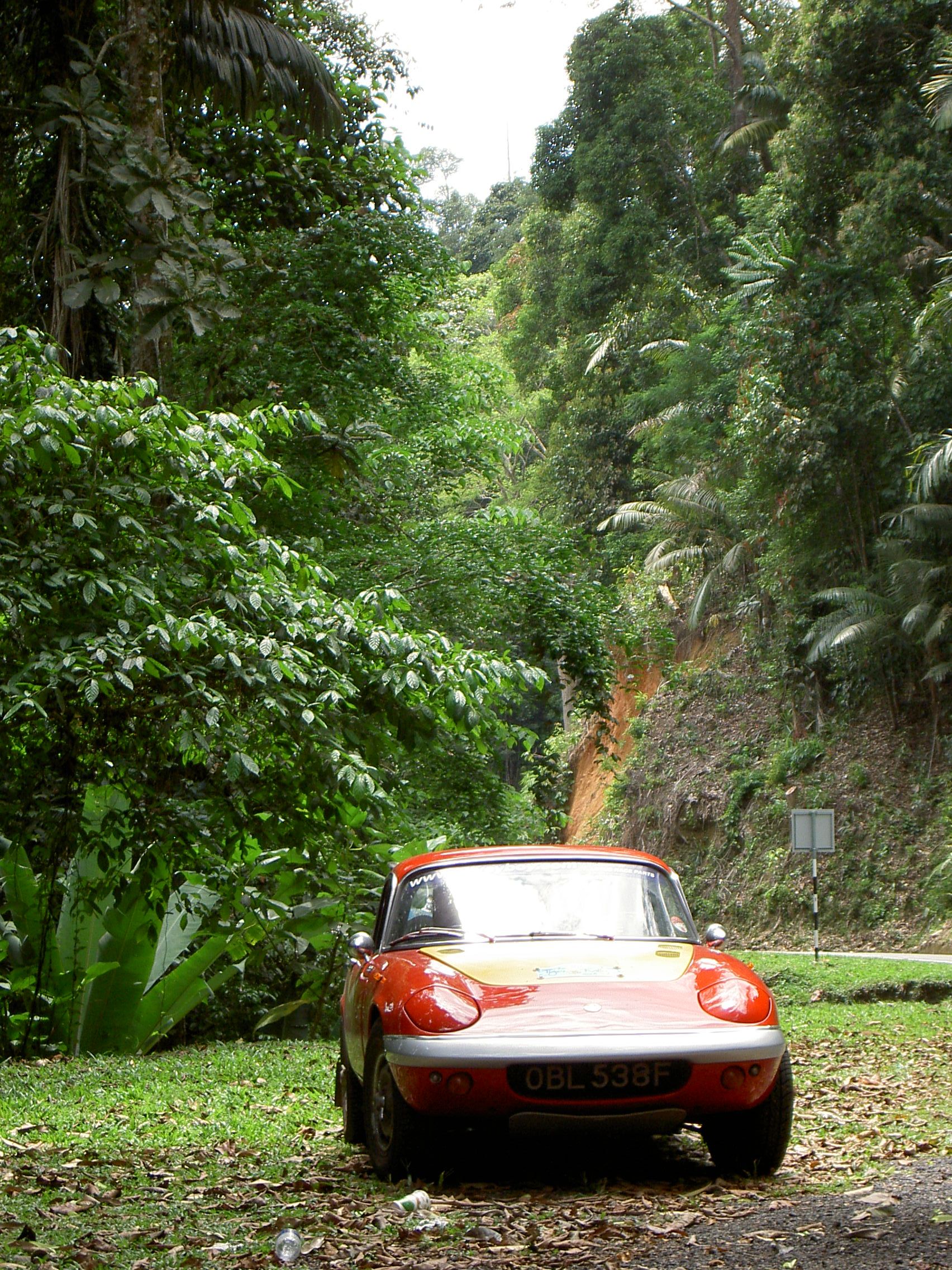 After a few days of driving north we entered Thailand – they also have excellent roads, drive on the left, have 96 octane petrol and someone saw a blue Elise.
  After that it got a bit rougher!
How was the Elan? Very happy! The only problems were the drivers. We are both paranoid about oil pressure and in this temperature we were unable to get more than about 25 psi at 4000rpm. The answer was to call Susan Miller and ask her to send a set of big end shells to Bangkok so that if we did have a problem we would have some chance of a repair. Amazingly within 5 days and thanks to Royal Mail Parcel Force the parts were waiting our arrival.
 In Malaysia and Thailand we progressed from smart hotel to smart hotel and some fantastic scenery. The temperature was around 35C and with the plastic seats we got used to dripping shirts, the heavy rain was welcome relief – though our feet got wet as I’ve never managed to stop the water getting in! We drove up the west coast to Phuket and a boat trip in Phang Nga bay with its spectacular islands,
  eroded over the years into strange shapes with caves and lagoons. One was James Bond Island where Roger Moore and Christopher Lee appeared in The Man with the Golden Gun. Now there are now lines of vendors selling trinkets – must have been much nicer before Bond got there!
From Phuket we crossed to the east coast resort of Tusita where the (1975) replica of a 1935 Bentley Speed 6 was losing power. The mechanics changed the head gasket which had blown in two places. There seemed to be two groups of people on this rally – those who knew their cars and if there was a problem they were there never mind the oil, dirt and humidity. And the others who gave the keys to the mechanics and retired to the bar!
From Tusita our next stop was Kanchanaburi, famous for the River 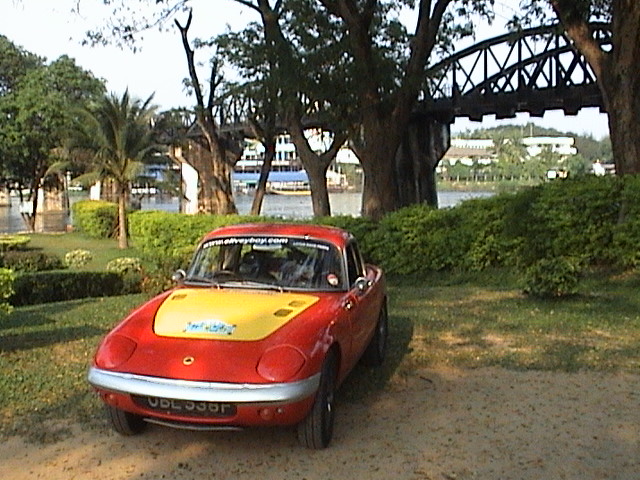 Kwai Bridge and the many who died there. On the way we stopped at the 1925 Royal Palace of Marukhathaiyawan with its traditional strict isolation of the King’s wives and concubines in the inner sanctum. Even though it hasn’t been a royal residence since 1927, out of respect for the royal family, my knees – well not just my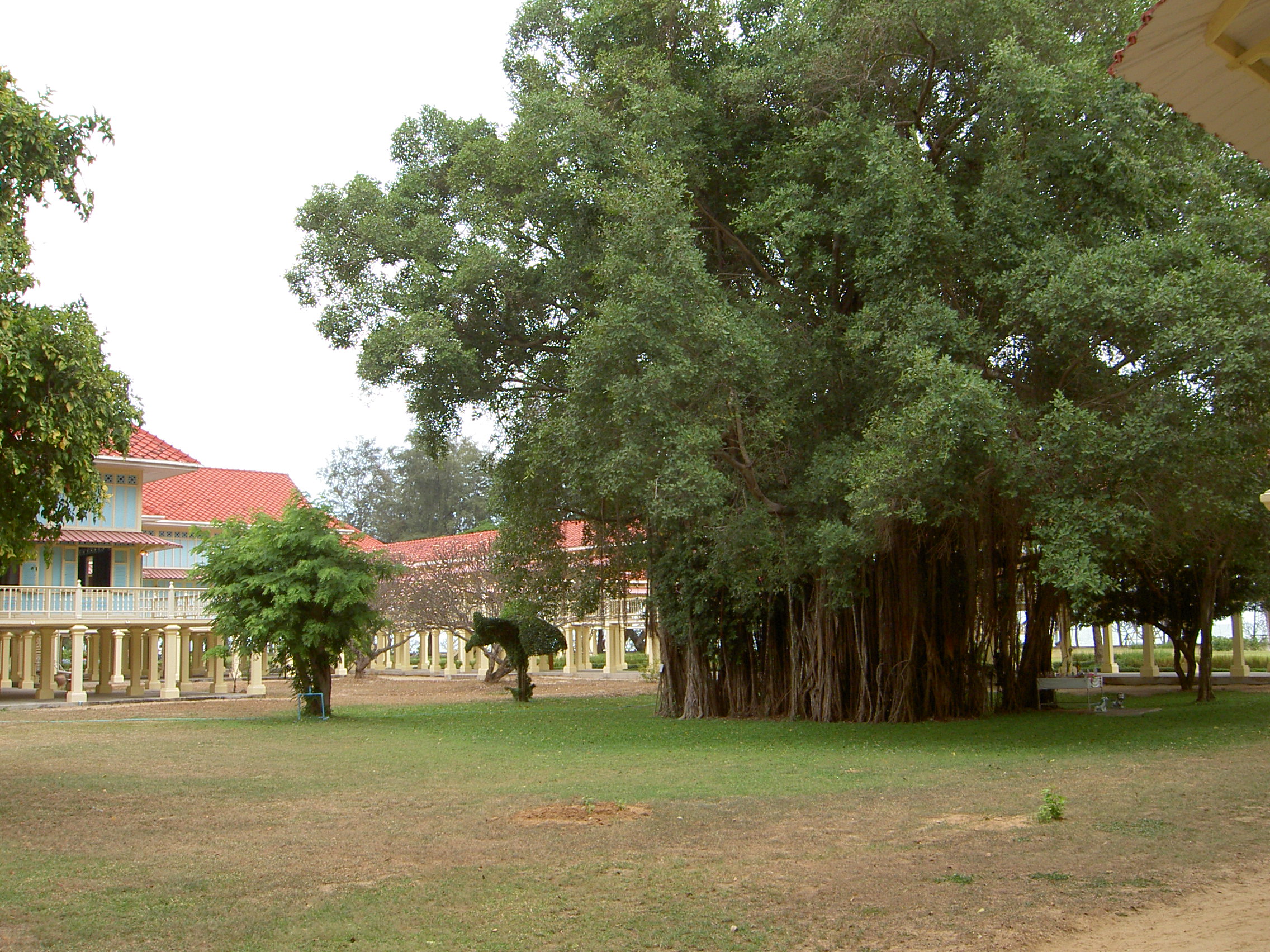
 knees but knees in general – were not to be shown; I had to wear a male sarong. Not quite a sarong but it was folded and wrapped round my waist with a “tail” pulled up between the legs and tied into the waist band; I could manage to step up 2 inches but anything else was impossible.
An early start from Kanchanburi took us the the Tiger Monastery (and the name of the rally).  The monks, helped by teams of local and overseas volunteers care for an breed tigers. The 3 month old cubs have virtually free run of the grounds whilst the adults are lead around like dogs on a lead.
 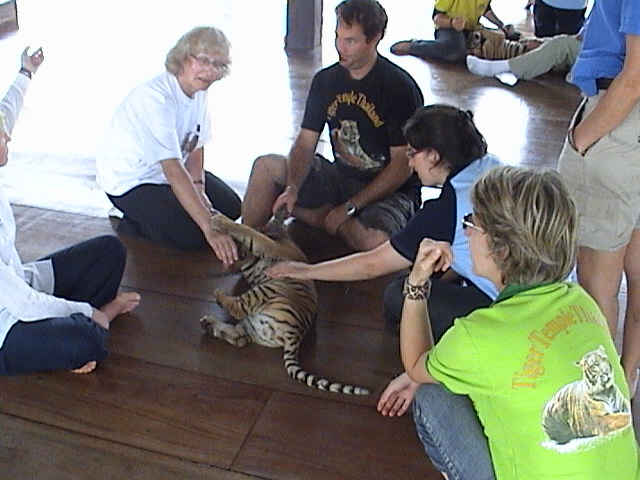 You can play with the cubs and carefully stroke the adults – I’ve never been that close to a tiger before!
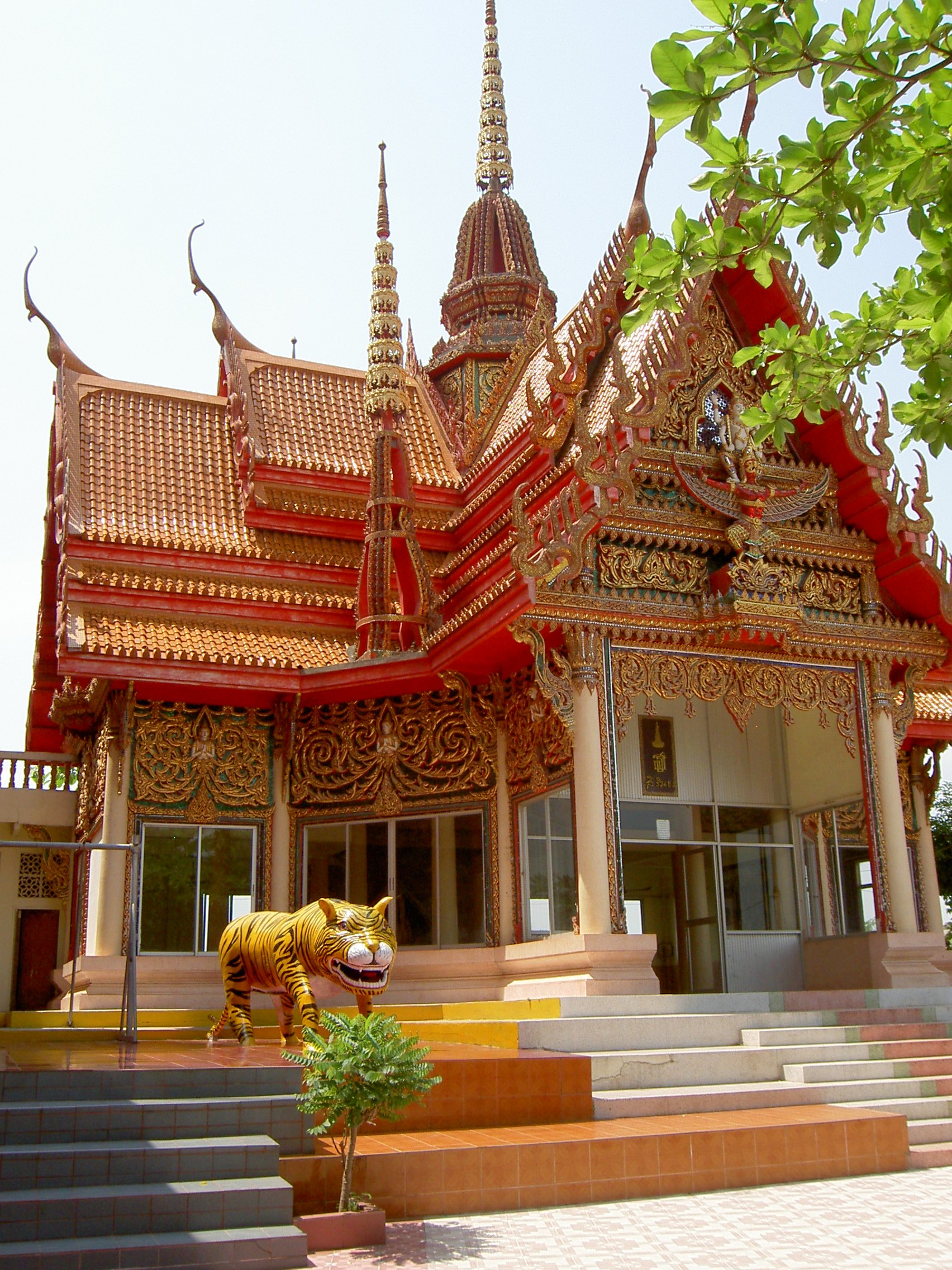 Leaving Kanchanburi for the run into Bangkok we stopped at
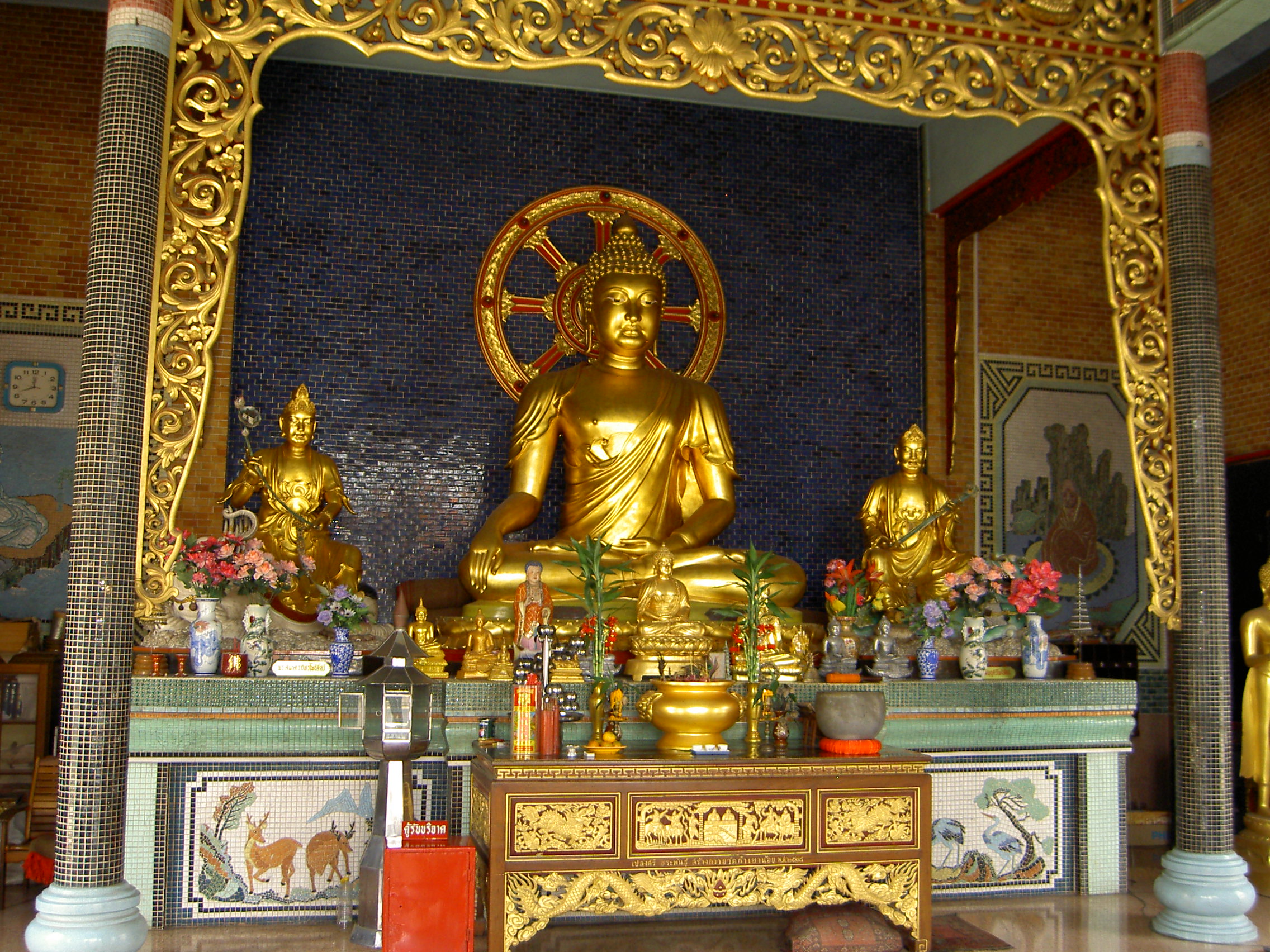 a Temple complex with Thai and Chinese temples vying for prominence – some would say the bus won the contest!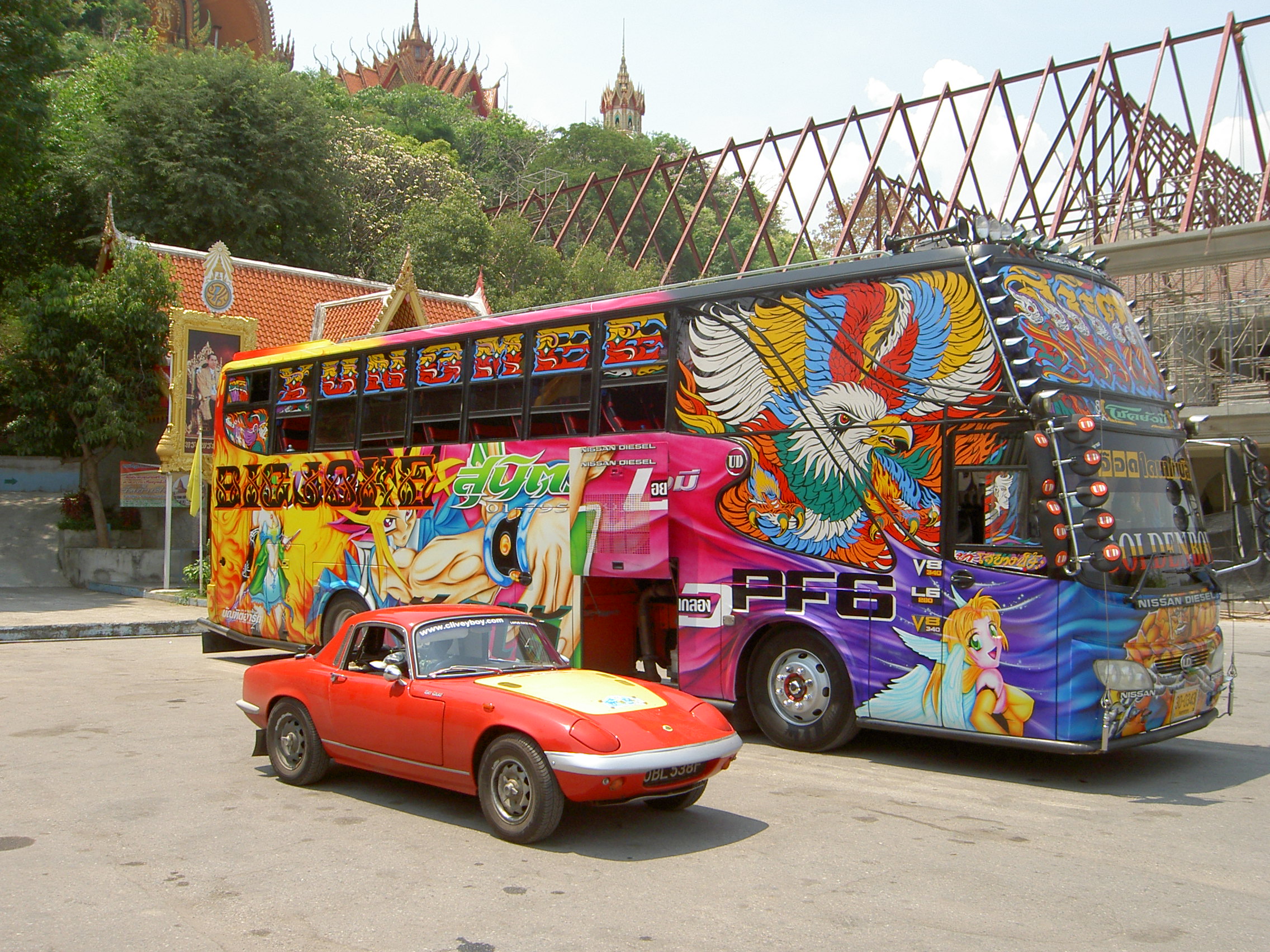
Next stop Bangkok and our secret weapon here was the electric fan we had fitted having experienced BKK streets in the past. The fan was brilliant, the temperature never rose above 80C except on hill climbs – and the traffic in BKK was so light that we didn’t need it here anyway! There was rest day in Bangkok so a chance to visit the Royal Palace complex,  the Wats and a boat trip on the canals – and collect our parcel from the hotel reception.
A fast run out of Bangkok led to the Cambodian border at Aranyaprathet. This was more like a border should be! People pushing overloaded carts which threatened to topple over or roll backwards, queues to have documents checked or stamped, apparently senseless migrations from one official to another, photocopies of anything that looked like official paperwork and then the civilised air conditioned office away from the hubbub where an under worked customs officer stamped the mighty “carnet de passage” – the document most precious of all which guarantees payment of twice the value of the car should you decide to sell it locally. (there’s a ready market for 40 year old Elans in Cambodia……isn’t there?).
The first 100 kms of Cambodian road was a real wake up after the luxury of the last ten days. This was dust and dirt, detours round bridges, broken down rally cars, baking heat and only one way to go – straight ahead! Apart from having great difficulty seeing through the dust the Elan was happy in this terrain – though inspection later revealed that one brand new shock absorber had already given up. The prize at the end of the day was Siem Reap and the Ankor Wat complex.
We had a rest day here, totally inadequate for a proper appreciation of the site – one crew had spent the week before the rally here with a dedicated guide and had still not seen it all. We did what we could, which included trying to get as many photos of the car in front of the ancient temples – an occupation which the security guards did not always appreciate! On our second night, the hotel organised our evening meal at a temple; we travelled by Tuk-tuk to find dancers silhouetted in the niches, waiters offering the full range of hotel drinks and nibbles, lights playing over the ruins and choruses of crickets. This was followed by a sumptuous meal, local music and dancing and a coach back to our hotel – the Raffles Grand Hotel d’Ankor.
From Siem Reap, better roads took us to Phnom Penh. We detoured off the new road to find the older ferry and the ancient hill capital of Odong. For the only time in the trip we found ourselves “adopted” by a group of children who gently coaxed some dollars out of us to “pay for English school”.
The road from Phnom Penh led to Saigon (Ho Chi Minh City – HCMC) where the Vietnamese authorities had plans for us – we were to travel in convoy as they were concerned over the ability of right hand drive cars to cope with driving on the right! These plans fell apart from the outset but at the time we were warned the very existence of the rally was in danger if we did not co-operate.
At the border we were given temporary Vietnamese number plates – they decided to stick ours (the size of half an A4 sheet) in what would be the middle of the passenger’s windscreen – just being right hand drive it was dead-centre of the drivers vision! They agreed that this was not ideal so moved it to the bottom of the passenger’s side. After clearing customs we were told the first convoy had just left so we should catch it up and rendezvous at the Ben Dinh tunnels for the second convoy into HCMC. We never found this first convoy but along with 30 of the 35 cars we got there and waited for the second convoy to materialise – it never did.
We had visited these tunnels in a previous trip to Vietnam, underground complexes where the Vietcong lived right under the feet of the Americans during the “American” wars. They had booby-trapped trap door entrances, multiple levels and housed families and soldiers with hospitals and kitchens and provided invisible access routes sometimes right to the heart of American camps.
Eventually news came that there was no convoy, we should make our own way to HCMC. The car park sprang to life as we set off in a convoy of our own to the centre of the city. The enforced delay had irritated the participants as it was unnecessary, they were impatient and frustrated and had powerful cars at their disposal. In any western country we would all have lost our licences – but it was great and irresponsible fun!
Relaxing over our beers in the hotel we were told we had to move the cars to a stadium on the outskirts – as there was no room in the hotel car park (where we had already parked) and to avoid the need to drive in the city traffic when leaving………..err?! Again the threat of rally cancellation was held over us and half the cars moved out. Our arrival in HCMC was not straightforward!
Leaving HCMC was no picnic. I tried to do some videoing to capture the sight and sound of the massed ranks of motorbikes which fill the streets – and forgot to navigate! Oops, round a large block and try again! We started by heading for the stadium and found that the convoy had just left and we should try to catch up. Catch up in that traffic – you’ve got to be joking. Not only had we done two sides of a triangle but there were road works, buses, lorries a few cars, bicycles and motorbikes – say thanks for that newly fitted electric fan as this is not Lotus Elan driving territory!
We headed for the hills – Dalat, as the Cameron Highlands two weeks ago, the cool hill station escape from the heat and activity of the commercial capital. Our room had no need for air conditioning and the windows opened to a view of the lake and hills beyond – all that contrast in just 300 kms and a few hours motoring!
The Elan was by far the noisiest car in the rally as the exhaust had been so squashed by the “roads” of India that the once circular silencer was more like a pancake. We were guided into our lunch stop on the way up by a competitor who heard us coming! It was also one of the most reliable and it was in Dalat we did our only piece of repair – replacing the top bush on a front shock absorber.
From Dalat we returned to the coast via some Cham temples at Phan Rang, which we visited in bright sunshine, arriving in Nha Trang in pouring rain. Our hotel was a Russian owned island complex with the choice of cable car or speedboat to get there. Fortunately the hotel supplied umbrellas and we joined the other members of the rally sheltering in the otherwise deserted poolside bar.
For the next few days we followed the coast north to Vinh, passing paddy fields, fishing boats, tombs of Vietnamese emperors, imperial palaces, more Cham temples, crops spread on the road to dry and always criss-crossing the single track railway line between Hanoi and HCMC. The evidence of the “American” or “Vietnam” war is much diminished compared to our last visit in 1995 when the craters at the side of the railway north of Hue showed the efforts that went into disrupting communications. Sadly the historical sites are not so easily repaired and the temples at My Son and the palaces of Hue are no more.
Our drive to Vinh had reminders of those wars as we diverted from the coast and followed the superb and empty Ho Chi Minh Trail inland through fantastic scenery – the land equivalent of Halong Bay which we would visit at the end of the rally. This was a most enjoyable drive, no lorries or coaches, no noisy horns and no motorbikes; the bends were made for the Elan! Surprisingly few other rally cars followed this route – maybe they wanted to avoid the cross-country section later in the day as we slowly clawed our way eastwards in a land of north-south roads.
Day 25 brought another border crossing – Laos and its one-time French capital –Vientiane. We managed a few sights before they all closed at 4pm but were then offered the luxury of an air-conditioned tour round the sights; as it was about 40 degrees in the shade, this was gratefully received.
Our next stop was Luang Prabang – a centre for trekking, canoeing and outdoor pursuits; we preferred a beer on the banks of the Mekong, watching the setting sun cast its golden-red rays over the slow moving waters. We had a rest day to enjoy the peace of the area – a boat trip to caves with 1,000 Buddha statues. Our boat driver was a fisherman, who stopped the boat mid stream to pick up a dead fish – a very pungent dead fish; whilst we were in the caves he set out his nets, carefully collecting them back up for our journey back – two fish this time!
Our next stop was the Plain of Jars. There are three main sites with collections of huge jars carved out of solid rock and averaging 1.5 metres in both diameter and height. As the roads had been too easy so far we decided to visit “site 2”, 11 kms off the main road on a deeply rutted dirt track – fortunately there was no traffic so no hard choices on who would volunteer to fall into the ruts! This hilltop site was a peaceful idyll – until you looked at the concrete markers all around showing the land which had been cleared of mines. During the American/Vietnamese wars, the Americans had dropped two million tons of bombs over Laos, one planeload every eight minutes, twenty four hours a day for nine years. Clearing that lot is unfinished business. It is strange to see ancient jars leaning over at the edge of modern-day bomb craters.
We left Laos early next morning for a scheduled 510 kms drive to the Vietnamese coast at Than Hoa although by dint of short cuts we reduced it to 460. For the first 130 kms to the border we followed the green Jaguar XK150 through the morning mist towards the red ball of sun rising ahead of us. In a village just before the border were two petrol stations. The second and more popular had ordinary electric pumps and a queue of rally cars. The first, where we stopped had “gravity” pumps. This involves hand pumping 5 litres of fuel from an upright barrel into a glass jar and releasing into the tank – and you had to pay in local currency, dollars not welcome here! I stopped after 25 litres as they did not operate in units of less than 5 litres. This operation was preceded by the ritual establishment that we really did not want diesel in our tank so we had several visits to the out of action electric pumps just to point out which one we wanted.
The Jaguar returned to our pumps after getting bored in the queues at the other pumps but, having no Lao Kip he decided to forgo the fuel and carry on – and yes a little way into Vietnam, there at the roadside was………….a Jaguar with no fuel………! We gave him our 10 litre can and he then discovered that the float chambers were overflowing as dirt was blocking the floats. Once it goes wrong, it gets worse!
The border crossing was easy and the road good apart from a couple of places where there were rockfalls. We found ourselves at the head of the convoy every time and found that where our raised suspension allowed us an easy passage, others were bottoming out.
We rejoined the Ho Chi Minh trail and enjoyed the open road heading north before reluctantly leaving to head east to the bustle of the coast and some very slow, bumpy and potholed tracks (roads would be an optimistic description). As we neared our hotel a motorbike was in close attendance with the passenger keenly photographing our every move. At the hotel we found he was the photographer for Vietnam’s largest car magazine so an interview followed and we were featured in the May edition!
Our last driving day took us through slow queues of traffic to Hanoi’s inland container depot and we parked inside a big box in front of a red XK120 for the journey back to Felixstowe.
This had been a very gentle rally, the car was excellent, nearly 5,000 miles in the heat and humidity and apart from that one bush no problems at all. Sure there were a few things to sort out back home – one rear Spax had died (Koni next time), the brakes remained awful and the clutch pressure plate and release bearing needed replacing and there’s that noisy thing called an exhaust. So where next? By way of contrast a regularity rally with HERO in Iceland in September!